Grammar
Tenses
Present

Present Simple
Present Continuous
Present Perfect
Present Perfect Continuous
Past
Past Simple
Past Continuous
Past Perfect
Past Perfect Continuous
Future
Future Simple
Future Continuous
Future Perfect
Future Perfect Continuous
Parts Of Speech
Nouns
Countable and uncountable nouns
Verbal nouns
Singular and Plural nouns
Proper nouns
Nouns gender
Nouns definition
Concrete nouns
Abstract nouns
Common nouns
Collective nouns
Definition Of Nouns
Animate and Inanimate nouns
Nouns
Verbs
Stative and dynamic verbs
Finite and nonfinite verbs
To be verbs
Transitive and intransitive verbs
Auxiliary verbs
Modal verbs
Regular and irregular verbs
Action verbs
Verbs
Adverbs
Relative adverbs
Interrogative adverbs
Adverbs of time
Adverbs of place
Adverbs of reason
Adverbs of quantity
Adverbs of manner
Adverbs of frequency
Adverbs of affirmation
Adverbs
Adjectives
Quantitative adjective
Proper adjective
Possessive adjective
Numeral adjective
Interrogative adjective
Distributive adjective
Descriptive adjective
Demonstrative adjective
Pronouns
Subject pronoun
Relative pronoun
Reflexive pronoun
Reciprocal pronoun
Possessive pronoun
Personal pronoun
Interrogative pronoun
Indefinite pronoun
Emphatic pronoun
Distributive pronoun
Demonstrative pronoun
Pronouns
Pre Position
Preposition by function
Time preposition
Reason preposition
Possession preposition
Place preposition
Phrases preposition
Origin preposition
Measure preposition
Direction preposition
Contrast preposition
Agent preposition
Preposition by construction
Simple preposition
Phrase preposition
Double preposition
Compound preposition
prepositions
Conjunctions
Subordinating conjunction
Correlative conjunction
Coordinating conjunction
Conjunctive adverbs
conjunctions
Interjections
Express calling interjection
Phrases
Sentences
Clauses
Part of Speech
Grammar Rules
Passive and Active
Preference
Requests and offers
wishes
Be used to
Some and any
Could have done
Describing people
Giving advices
Possession
Comparative and superlative
Giving Reason
Making Suggestions
Apologizing
Forming questions
Since and for
Directions
Obligation
Adverbials
invitation
Articles
Imaginary condition
Zero conditional
First conditional
Second conditional
Third conditional
Reported speech
Demonstratives
Determiners
Direct and Indirect speech
Linguistics
Phonetics
Phonology
Linguistics fields
Syntax
Morphology
Semantics
pragmatics
History
Writing
Grammar
Phonetics and Phonology
Semiotics
Reading Comprehension
Elementary
Intermediate
Advanced
Teaching Methods
Teaching Strategies
Assessment

Adapting Identification of Similarities and Differences to the Stages of Language Acquisition
 المؤلف:
Jane D. Hill Kathleen M. Flynn
المؤلف:
Jane D. Hill Kathleen M. Flynn
 المصدر:
Classroom Instruction that works with English Language Learners
المصدر:
Classroom Instruction that works with English Language Learners
 الجزء والصفحة:
P104-C11
الجزء والصفحة:
P104-C11
 2025-09-18
 556
556




+
-
20
Adapting Identification of Similarities and Differences to the Stages of Language Acquisition
Identifying similarities and differences has long been used in ESL classes to build basic vocabulary in different categories, including color words and words used to describe size (adjectives), shape words (nouns), and words for functions (verbs). This is done with an attribute chart (see Figure 1). The teacher gives a small group of students two objects, such as an apple and an orange, and then directs the students to the color box.
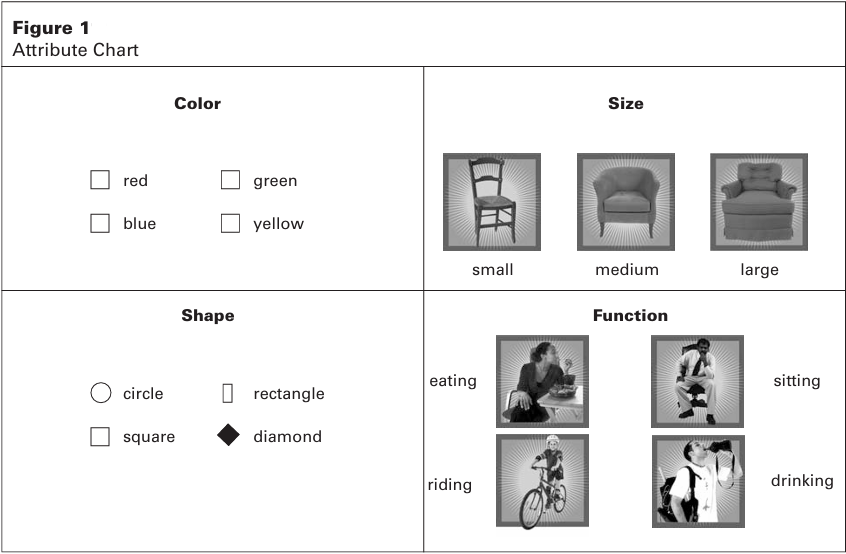
Preproduction
Students can point to the red color swatch when holding the apple and repeat the word “red.”
Early Production
Students can complete a sentence starter with a one-word response: “The apple and the orange are the same because they are both . . . .”
Speech Emergence
Students can complete a sentence starter with a phrase or short sentence: “The apple and the orange are different because . . . .”
Intermediate and Advanced Fluency
Students will not need the sentence starters, but their responses will need some shaping. You should encourage them to “sound more like a book” by using words other than “same” and “different.”
The attribute chart can be gradually increased to include more characteristics, such as the composition of items (what they are made of) and parts of the items (e.g., eraser and lead for a pencil). Plan for oral language development as students talk about what is the same and what is different. Attribute charts allow Preproduction students to build vocabulary, Early Production students to use familiar vocabulary, and Speech Emergence students to practice using sentences. Intermediate and Advanced Fluency students are able to work on improving their academic language knowledge by using words other than “same” and “different” as they compare items.
The next step is to allow students to select items to compare. This is a three-step process:
1. Select the items you want to compare.
2. Select the characteristics of the items on which you want to base your comparison.
3. Explain how the items are similar and different with respect to the characteristics you selected.
The process may be stated in simpler terms for young students:
1. What do I want to compare?
2. What is it about them that I want to compare?
3. How are they the same? How are they different?
Model the steps with a think-aloud: “First, I have to pick two things to compare. I want to compare an apple and an orange. Next, I have to pick the characteristics I’m going to compare. I want to compare color, shape, taste, and their parts. Finally, I describe how they are the same and different: The apple and the orange are the same because they are both round; the apple and the orange are different because the apple is red and the orange is orange.”
After you have modeled the steps, make them available by posting them in the classroom. Students will have fun with this activity as they compare familiar objects from nonacademic topics.
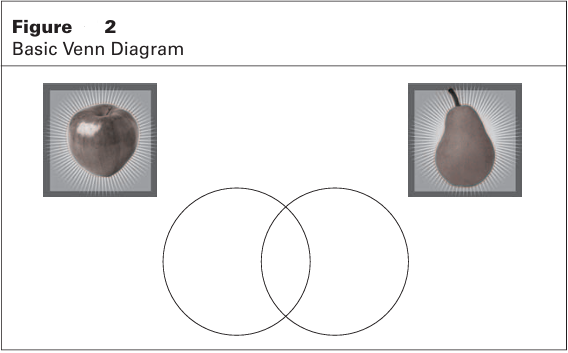
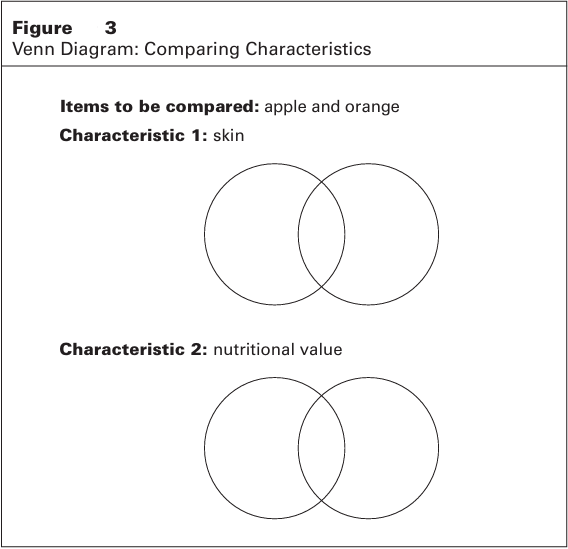
It will not take long for students to become familiar with Venn diagrams (see Figure 2). Teachers can add another layer to the Venn diagram by having students select the characteristics of the items to be compared (Figure 3). ELLs can talk about similarities and differences, while English-dominant students write about the comparisons.
An additional level of complexity can be added by using a comparison matrix (see Figure 1 in Classroom Example). Initially, provide students with familiar items and tell them which characteristics to compare. Gradually, they can add to the list of characteristics (e.g., texture, how items are eaten, nutritional value).
Preproduction
Students are working to learn vocabulary and can be drawing pictures.
Early Production
Students are also working at an oral level using vocabulary. While you are circulating, be sure to model with sentence starters: “The apple, orange, and banana are the same/different because ________________.”
Speech Emergence
Students will rely less on sentence starters as they begin to produce longer sentences. As you listen, help these students by expanding the sentences, such as by turning short, disjointed sentences into compound sentences with conjunctions such as “and” and “because.” These students can also be engaged in writing activities.
Intermediate and Advanced Fluency
Students can write about the similarities and differences they identify with the help of teacher feedback, as can English-dominant students.
 الاكثر قراءة في Teaching Strategies
 اخر الاخبار
اخبار العتبة العباسية المقدسة

الآخبار الصحية


مواضيع ذات صلة
 قسم الشؤون الفكرية يصدر كتاباً يوثق تاريخ السدانة في العتبة العباسية المقدسة
 "المهمة".. إصدار قصصي يوثّق القصص الفائزة في مسابقة فتوى الدفاع المقدسة للقصة القصيرة
 (نوافذ).. إصدار أدبي يوثق القصص الفائزة في مسابقة الإمام العسكري (عليه السلام)