Grammar
Tenses
Present

Present Simple
Present Continuous
Present Perfect
Present Perfect Continuous
Past
Past Simple
Past Continuous
Past Perfect
Past Perfect Continuous
Future
Future Simple
Future Continuous
Future Perfect
Future Perfect Continuous
Parts Of Speech
Nouns
Countable and uncountable nouns
Verbal nouns
Singular and Plural nouns
Proper nouns
Nouns gender
Nouns definition
Concrete nouns
Abstract nouns
Common nouns
Collective nouns
Definition Of Nouns
Animate and Inanimate nouns
Nouns
Verbs
Stative and dynamic verbs
Finite and nonfinite verbs
To be verbs
Transitive and intransitive verbs
Auxiliary verbs
Modal verbs
Regular and irregular verbs
Action verbs
Verbs
Adverbs
Relative adverbs
Interrogative adverbs
Adverbs of time
Adverbs of place
Adverbs of reason
Adverbs of quantity
Adverbs of manner
Adverbs of frequency
Adverbs of affirmation
Adverbs
Adjectives
Quantitative adjective
Proper adjective
Possessive adjective
Numeral adjective
Interrogative adjective
Distributive adjective
Descriptive adjective
Demonstrative adjective
Pronouns
Subject pronoun
Relative pronoun
Reflexive pronoun
Reciprocal pronoun
Possessive pronoun
Personal pronoun
Interrogative pronoun
Indefinite pronoun
Emphatic pronoun
Distributive pronoun
Demonstrative pronoun
Pronouns
Pre Position
Preposition by function
Time preposition
Reason preposition
Possession preposition
Place preposition
Phrases preposition
Origin preposition
Measure preposition
Direction preposition
Contrast preposition
Agent preposition
Preposition by construction
Simple preposition
Phrase preposition
Double preposition
Compound preposition
prepositions
Conjunctions
Subordinating conjunction
Correlative conjunction
Coordinating conjunction
Conjunctive adverbs
conjunctions
Interjections
Express calling interjection
Phrases
Sentences
Clauses
Part of Speech
Grammar Rules
Passive and Active
Preference
Requests and offers
wishes
Be used to
Some and any
Could have done
Describing people
Giving advices
Possession
Comparative and superlative
Giving Reason
Making Suggestions
Apologizing
Forming questions
Since and for
Directions
Obligation
Adverbials
invitation
Articles
Imaginary condition
Zero conditional
First conditional
Second conditional
Third conditional
Reported speech
Demonstratives
Determiners
Direct and Indirect speech
Linguistics
Phonetics
Phonology
Linguistics fields
Syntax
Morphology
Semantics
pragmatics
History
Writing
Grammar
Phonetics and Phonology
Semiotics
Reading Comprehension
Elementary
Intermediate
Advanced
Teaching Methods
Teaching Strategies
Assessment

GENERATING AND TESTING HYPOTHESES Classroom Example
 المؤلف:
Jane D. Hill Kathleen M. Flynn
المؤلف:
Jane D. Hill Kathleen M. Flynn
 المصدر:
Classroom Instruction that works with English Language Learners
المصدر:
Classroom Instruction that works with English Language Learners
 الجزء والصفحة:
P97-C10
الجزء والصفحة:
P97-C10
 2025-09-18
 361
361




+
-
20
GENERATING AND TESTING HYPOTHESES
Classroom Example
Let’s look at a mainstream lesson designed to help students understand inductive reasoning and then review how to adapt it for ELLs at various stages of language acquisition.
Subject: Social Studies
Content Objective: To learn that conclusions should be based on a number of observations.
Tell students to take 5 to 10 minutes to go on an inductive outing. This means that you want them to walk around a designated area and carefully observe everything around them. Ask students to make a list of several specific things that they observe. When they return to the room from a walk around the school grounds, ask them to write a conclusion that they can draw about the area—about the building, the grounds, or the people they have seen. Remind them to make sure their conclusions are supported by three or four observations.
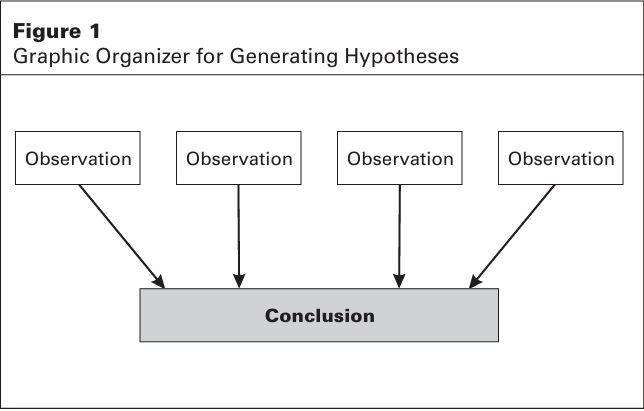
Likewise, when students return to the classroom from a walk around the neighborhood, explain that they need to be ready to share the pieces of evidence that led to their conclusions. For example, if they noticed that a particular house had skis hanging in the garage, a basketball hoop above the driveway, tennis rackets on the porch, and a volleyball net in the backyard, they could reasonably conclude that the people living there are very involved in sports. Figure 1 presents a graphic organizer that you can use to help students understand what kind of information you are looking for.
Preproduction
Students can draw what they see. Upon returning to the classroom, you can help these students with word selection by giving them vocabulary for what they have represented in their pictures.
English language learners will need multiple encounters with words they are discovering in order to learn and remember the meaning of these new words. Encourage students to continue their language learning outside the classroom by developing a fun method for them to bring in evidence of seeing, hearing, or using identified vocabulary words outside of the school environment.
Early Production
Students can also use pictorial representations for what they’ve seen. When they return to the classroom, you can work with them on getting them to name what is in their pictures. This is a good time to model English; if an ELL says, “That a mower,” the teacher correctly models, “Yes, that is a mower,” but does not blatantly call attention to the grammatical error.
Speech Emergence
Students will be able to list what they observed and draw conclusions. Their writing will likely be composed of short, simple sentences, so they will benefit from you showing them how to expand their written language with adjectives and adverbs.
Intermediate and Advanced Fluency
Students will be able to write observations and conclusions. Help them “sound like a book” by asking them (as well as the English dominant students) to write their conclusions as though they were detectives reporting on a news program.
The induction outing is a good way to introduce inductive reasoning to a class. You can use the strategies described here in any situation where students can make rich observations: on a field trip, during an assembly, when a movie is being shown, and so on. It is an experience that students enjoy, and it helps them to understand two important points about inductive reasoning: To discern patterns and connections, conclusions should be based on a number of observations; and conclusions that are based on inductive reasoning may or may not be accurate or true.
Preproduction and Early Production students should not be required to draw conclusions during the induction outing; they could work on vocabulary. Though there may be times when the language objective takes precedence over the content objective, this does not mean that ELLs are not learning or are not engaged in inductive reasoning. If you have ever been in a situation where you did not speak the language, you will know that you were constantly engaged in inductive reasoning as you were trying to figure out what was going on.
 الاكثر قراءة في Teaching Strategies
 اخر الاخبار
اخبار العتبة العباسية المقدسة

الآخبار الصحية


مواضيع ذات صلة
 قسم الشؤون الفكرية يصدر كتاباً يوثق تاريخ السدانة في العتبة العباسية المقدسة
 "المهمة".. إصدار قصصي يوثّق القصص الفائزة في مسابقة فتوى الدفاع المقدسة للقصة القصيرة
 (نوافذ).. إصدار أدبي يوثق القصص الفائزة في مسابقة الإمام العسكري (عليه السلام)