Grammar
Tenses
Present

Present Simple
Present Continuous
Present Perfect
Present Perfect Continuous
Past
Past Simple
Past Continuous
Past Perfect
Past Perfect Continuous
Future
Future Simple
Future Continuous
Future Perfect
Future Perfect Continuous
Parts Of Speech
Nouns
Countable and uncountable nouns
Verbal nouns
Singular and Plural nouns
Proper nouns
Nouns gender
Nouns definition
Concrete nouns
Abstract nouns
Common nouns
Collective nouns
Definition Of Nouns
Animate and Inanimate nouns
Nouns
Verbs
Stative and dynamic verbs
Finite and nonfinite verbs
To be verbs
Transitive and intransitive verbs
Auxiliary verbs
Modal verbs
Regular and irregular verbs
Action verbs
Verbs
Adverbs
Relative adverbs
Interrogative adverbs
Adverbs of time
Adverbs of place
Adverbs of reason
Adverbs of quantity
Adverbs of manner
Adverbs of frequency
Adverbs of affirmation
Adverbs
Adjectives
Quantitative adjective
Proper adjective
Possessive adjective
Numeral adjective
Interrogative adjective
Distributive adjective
Descriptive adjective
Demonstrative adjective
Pronouns
Subject pronoun
Relative pronoun
Reflexive pronoun
Reciprocal pronoun
Possessive pronoun
Personal pronoun
Interrogative pronoun
Indefinite pronoun
Emphatic pronoun
Distributive pronoun
Demonstrative pronoun
Pronouns
Pre Position
Preposition by function
Time preposition
Reason preposition
Possession preposition
Place preposition
Phrases preposition
Origin preposition
Measure preposition
Direction preposition
Contrast preposition
Agent preposition
Preposition by construction
Simple preposition
Phrase preposition
Double preposition
Compound preposition
prepositions
Conjunctions
Subordinating conjunction
Correlative conjunction
Coordinating conjunction
Conjunctive adverbs
conjunctions
Interjections
Express calling interjection
Phrases
Sentences
Clauses
Part of Speech
Grammar Rules
Passive and Active
Preference
Requests and offers
wishes
Be used to
Some and any
Could have done
Describing people
Giving advices
Possession
Comparative and superlative
Giving Reason
Making Suggestions
Apologizing
Forming questions
Since and for
Directions
Obligation
Adverbials
invitation
Articles
Imaginary condition
Zero conditional
First conditional
Second conditional
Third conditional
Reported speech
Demonstratives
Determiners
Direct and Indirect speech
Linguistics
Phonetics
Phonology
Linguistics fields
Syntax
Morphology
Semantics
pragmatics
History
Writing
Grammar
Phonetics and Phonology
Semiotics
Reading Comprehension
Elementary
Intermediate
Advanced
Teaching Methods
Teaching Strategies
Assessment

From quality assurance to quality enhancement
 المؤلف:
Chris Dillon & Catherine Reuben & Maggie Coats & Linda Hodgkinson
المؤلف:
Chris Dillon & Catherine Reuben & Maggie Coats & Linda Hodgkinson
 المصدر:
Enhancing Teaching and Learning through Assessment
المصدر:
Enhancing Teaching and Learning through Assessment
 الجزء والصفحة:
P283-C24
الجزء والصفحة:
P283-C24
 2025-07-22
 531
531




+
-
20
From quality assurance to quality enhancement
As Coats (2003) points out, the LOTA project evolved rapidly from quality assurance to quality enhancement: "What is the difference? Quality assurance (QA) is about checking the standard of what is done; identifying 'good practice'; awarding classifications or scores. Quality enhancement (QE) is about improving and developing; not just doing things well but doing things better."
For LOTA quality enhancement means looking closely not only at the documentation and institutional processes but also at the way learning outcomes are actually being used. Just as importantly it also raises questions about how outcomes are being understood, not just by the academics in the faculties and course teams, but by the ALs who are in the 'front line' of distance teaching, and by the students themselves.
It quickly became apparent that the shift to an outcomes-based approach involved not only identifying learning outcomes and making sure that the assessment supported them, but also in involving staff in exploring how this process could be made meaningful to students such that it added value to their learning experience. The triad in Figure 1 emphasizes that outcomes, assessment, and teaching and learning are mutually connected, and should be seen as complementary aspects of quality enhancement. Underlying this triad are three main principles: transparency, transformation and transferability.
• Clearly identifying outcomes leads to transparency: teaching and assessment intentions are made explicit, and both tutors and students work with the same set of criteria to assess progress and to focus on ways to improve.
• Integrating formative and self-assessment, as well as summative assessment, into the learning process is transformative: students are encouraged to become actively involved in understanding how they are learning and how they can adapt their learning to new situations.
• Learning in a formal HE environment is about developing as an independent learner who can transfer the ability to learn effectively from HE into other, more educationally informal, environments such as the workplace.
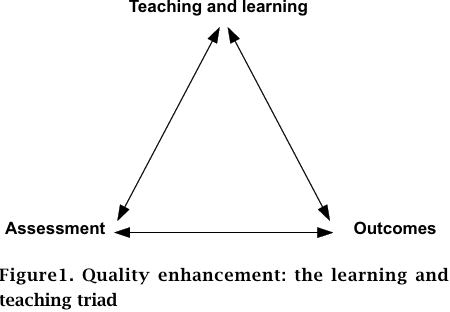
Enhancing the quality of teaching so that it leads to transparent, transformative and transferable quality learning is the key role of academic staff development. Good staff development needs to prompt new thinking about the curriculum, and how students engage with it. Academics need to start from an outcomes perspective not only by asking the question 'what do we want students to get out of this course or program - and how can the assessment help them achieve and demonstrate it?', but also by exploring how students can answer for themselves the question 'what am I getting out my studies - and how can I explain and demonstrate what that is to others'.
The heart of the LOTA approach is about making things explicit so that there is a framework and a language for asking - and answering - these questions. Enhancing learning, therefore, is not just about improving assessment practices but about understanding how the outcomes - teaching-assessment triad underpins curriculum and staff development.
 الاكثر قراءة في Teaching Strategies
 اخر الاخبار
اخبار العتبة العباسية المقدسة

الآخبار الصحية


مواضيع ذات صلة
 قسم الشؤون الفكرية يصدر كتاباً يوثق تاريخ السدانة في العتبة العباسية المقدسة
 "المهمة".. إصدار قصصي يوثّق القصص الفائزة في مسابقة فتوى الدفاع المقدسة للقصة القصيرة
 (نوافذ).. إصدار أدبي يوثق القصص الفائزة في مسابقة الإمام العسكري (عليه السلام)