









Grammar
Tenses
Present

Present Simple
Present Continuous
Present Perfect
Present Perfect Continuous
Past
Past Simple
Past Continuous
Past Perfect
Past Perfect Continuous
Future
Future Simple
Future Continuous
Future Perfect
Future Perfect Continuous
Parts Of Speech
Nouns
Countable and uncountable nouns
Verbal nouns
Singular and Plural nouns
Proper nouns
Nouns gender
Nouns definition
Concrete nouns
Abstract nouns
Common nouns
Collective nouns
Definition Of Nouns
Animate and Inanimate nouns
Nouns
Verbs
Stative and dynamic verbs
Finite and nonfinite verbs
To be verbs
Transitive and intransitive verbs
Auxiliary verbs
Modal verbs
Regular and irregular verbs
Action verbs
Verbs
Adverbs
Relative adverbs
Interrogative adverbs
Adverbs of time
Adverbs of place
Adverbs of reason
Adverbs of quantity
Adverbs of manner
Adverbs of frequency
Adverbs of affirmation
Adverbs
Adjectives
Quantitative adjective
Proper adjective
Possessive adjective
Numeral adjective
Interrogative adjective
Distributive adjective
Descriptive adjective
Demonstrative adjective
Pronouns
Subject pronoun
Relative pronoun
Reflexive pronoun
Reciprocal pronoun
Possessive pronoun
Personal pronoun
Interrogative pronoun
Indefinite pronoun
Emphatic pronoun
Distributive pronoun
Demonstrative pronoun
Pronouns
Pre Position
Preposition by function
Time preposition
Reason preposition
Possession preposition
Place preposition
Phrases preposition
Origin preposition
Measure preposition
Direction preposition
Contrast preposition
Agent preposition
Preposition by construction
Simple preposition
Phrase preposition
Double preposition
Compound preposition
prepositions
Conjunctions
Subordinating conjunction
Correlative conjunction
Coordinating conjunction
Conjunctive adverbs
conjunctions
Interjections
Express calling interjection
Phrases
Sentences
Clauses
Part of Speech
Grammar Rules
Passive and Active
Preference
Requests and offers
wishes
Be used to
Some and any
Could have done
Describing people
Giving advices
Possession
Comparative and superlative
Giving Reason
Making Suggestions
Apologizing
Forming questions
Since and for
Directions
Obligation
Adverbials
invitation
Articles
Imaginary condition
Zero conditional
First conditional
Second conditional
Third conditional
Reported speech
Demonstratives
Determiners
Direct and Indirect speech
Linguistics
Phonetics
Phonology
Linguistics fields
Syntax
Morphology
Semantics
pragmatics
History
Writing
Grammar
Phonetics and Phonology
Semiotics
Reading Comprehension
Elementary
Intermediate
Advanced
Teaching Methods
Teaching Strategies
Assessment

On the overall case-based approach
 المؤلف:
Carmel McNaught & Paul Lam & Daniel Ong & Leo Lau
المؤلف:
Carmel McNaught & Paul Lam & Daniel Ong & Leo Lau
 المصدر:
Enhancing Teaching and Learning through Assessment
المصدر:
Enhancing Teaching and Learning through Assessment
 الجزء والصفحة:
P261-C22
الجزء والصفحة:
P261-C22
 2025-07-16
 574
574




+
-
20
On the overall case-based approach
The data collected showed somewhat encouraging results concerning the overall case-based approach. It was found that many students (but no means all of them) were satisfied with the skills acquired from the activities. For example, 37% and 53% of the course-end survey respondents agreed that the activities had improved their "problem-solving skills" (mean score = 3.21) and "presentation skills" (mean score = 3.53), respectively. Also, it was stated in the focus-group meeting that this course related more to real-life situations and this was good for students. Furthermore, during the presentation sessions, several observers joined the class and found that most of the students were able to work well in groups (indicative of enhanced team-working skills) and they were able to speak in public (presentation skills).
Concerning the potential for learning brought by the new method, students were guardedly positive. Students generally agreed to the statements in the course-end survey "I learned a lot more about the theories and concepts of materials science by going through the cases" (mean score = 3.62) and "I learned much about how to apply materials science theories and concepts to solve real problems by going through the cases (mean score = 3.43). Also, more than 80% of the survey respondents claimed that they needed to have significant periods of self-studying in order to work effectively on the cases (mean = 4.00). This indicates that students were motivated enough to be willing to spend time to learn. Furthermore, more than 60% of the respondents agreed that "I learned more by going through the cases than I could have learned if the course had been conducted in a traditional format" (mean score = 3.57).
In the focus-group meeting, most of the students expressed the belief that they got a deeper understanding of their presented topic because of the required peer teaching; they needed to know more in order to present their points and teach their peers. Note that this is in contrast to their limited enthusiasm for learning from other groups. Overall, students felt they learnt from self-study, group discussion and actual presentation about their given topic or case but were less sure that they learnt from others. This does support our belief that learning requires active student engagement and 'second-hand' learning is not as effective.
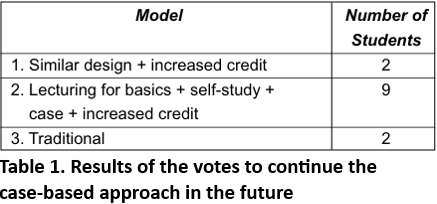
At the end of the focus-group meeting, students were given three options on improving the course and they were asked to vote. They were asked to vote concerning the types of course design they would like to see if they were to take this course again. The three options the students considered were: 1) keep the course similar, but increase the credit of the course; 2) keep the self-study and case-related parts, but include some lectures at the beginning of the course to talk about basics, and also increase course credit; and 3) revert to lecture-based and traditional design. Most students voted for the core elements of the case-based teaching to retain. Details of the vote are in Table 1:
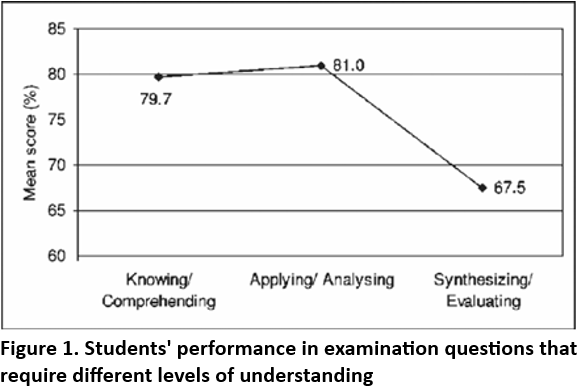
A positive effect on learning outcome was also evidenced by an analysis of students' learning outcomes on the final examination. The analysis was conducted based on Bloom's Taxonomy: the questions in the final examination were grouped into three different categories, according to their levels of cognitive reasoning required. The three categories are: 1) knowing/ comprehending, 2) applying/ analyzing, and 3) synthesizing/ evaluating. The classification of the questions was checked by fellow physicists and a science educator.
As shown in Figure 1, students performed quite well in the first and second category, with an average percentage score of 79.7 and 81.0 respectively (where 100 represents full marks for that category of question). They even achieved higher scores in the second category than in the first category questions. This fact surprised the authors and the teacher as first-year students were previously recognized as not particularly strong in tackling problems that require application of theories and analysis of situations and data. The data seems to suggest that the cases might have some positive influence on the students' ability to tackle more difficult questions. The fact that students achieved 67.5 percent of the possible marks on the very complex questions in the section is also pleasing.
Despite the promising results portrayed above, evaluation also showed areas of concerns and possibilities for improvement. On the whole, students found the workload too harsh for this one-credit course. [Students in the first year typically take around 15 credit points each semester.] Students were required to work on the task without much prior knowledge on the topic. From the mid-term evaluation survey data, more than 60% of the respondents disagreed that "the workload of the Cooperative Learning Activities is manageable" (mean score = 2.21). In the course-end survey, more than 30% of the respondents "strongly disagreed" with the statement "I found completing the cases enjoyable" (mean score = 3.29).
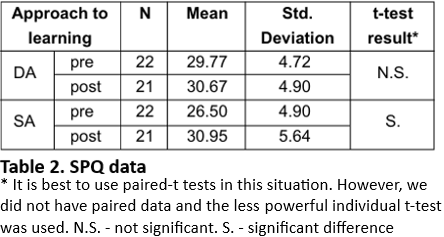
The SPQ data indicate the pressure students were under as well. The results are in Table 2. The students' deep approach scores increased, though not significantly. Their surface approach scores, however, increased more and this increase was statistically significant. Given the other data, we have about student's engagement in the course, our interpretation is that the workload pressure caused the students to feel they were attempting to 'cut corners' in the work they did.
 الاكثر قراءة في Teaching Strategies
 اخر الاخبار
اخبار العتبة العباسية المقدسة

الآخبار الصحية


مواضيع ذات صلة
 قسم الشؤون الفكرية يصدر كتاباً يوثق تاريخ السدانة في العتبة العباسية المقدسة
 "المهمة".. إصدار قصصي يوثّق القصص الفائزة في مسابقة فتوى الدفاع المقدسة للقصة القصيرة
 (نوافذ).. إصدار أدبي يوثق القصص الفائزة في مسابقة الإمام العسكري (عليه السلام)






