









Grammar
Tenses
Present

Present Simple
Present Continuous
Present Perfect
Present Perfect Continuous
Past
Past Simple
Past Continuous
Past Perfect
Past Perfect Continuous
Future
Future Simple
Future Continuous
Future Perfect
Future Perfect Continuous
Parts Of Speech
Nouns
Countable and uncountable nouns
Verbal nouns
Singular and Plural nouns
Proper nouns
Nouns gender
Nouns definition
Concrete nouns
Abstract nouns
Common nouns
Collective nouns
Definition Of Nouns
Animate and Inanimate nouns
Nouns
Verbs
Stative and dynamic verbs
Finite and nonfinite verbs
To be verbs
Transitive and intransitive verbs
Auxiliary verbs
Modal verbs
Regular and irregular verbs
Action verbs
Verbs
Adverbs
Relative adverbs
Interrogative adverbs
Adverbs of time
Adverbs of place
Adverbs of reason
Adverbs of quantity
Adverbs of manner
Adverbs of frequency
Adverbs of affirmation
Adverbs
Adjectives
Quantitative adjective
Proper adjective
Possessive adjective
Numeral adjective
Interrogative adjective
Distributive adjective
Descriptive adjective
Demonstrative adjective
Pronouns
Subject pronoun
Relative pronoun
Reflexive pronoun
Reciprocal pronoun
Possessive pronoun
Personal pronoun
Interrogative pronoun
Indefinite pronoun
Emphatic pronoun
Distributive pronoun
Demonstrative pronoun
Pronouns
Pre Position
Preposition by function
Time preposition
Reason preposition
Possession preposition
Place preposition
Phrases preposition
Origin preposition
Measure preposition
Direction preposition
Contrast preposition
Agent preposition
Preposition by construction
Simple preposition
Phrase preposition
Double preposition
Compound preposition
prepositions
Conjunctions
Subordinating conjunction
Correlative conjunction
Coordinating conjunction
Conjunctive adverbs
conjunctions
Interjections
Express calling interjection
Phrases
Sentences
Clauses
Part of Speech
Grammar Rules
Passive and Active
Preference
Requests and offers
wishes
Be used to
Some and any
Could have done
Describing people
Giving advices
Possession
Comparative and superlative
Giving Reason
Making Suggestions
Apologizing
Forming questions
Since and for
Directions
Obligation
Adverbials
invitation
Articles
Imaginary condition
Zero conditional
First conditional
Second conditional
Third conditional
Reported speech
Demonstratives
Determiners
Direct and Indirect speech
Linguistics
Phonetics
Phonology
Linguistics fields
Syntax
Morphology
Semantics
pragmatics
History
Writing
Grammar
Phonetics and Phonology
Semiotics
Reading Comprehension
Elementary
Intermediate
Advanced
Teaching Methods
Teaching Strategies
Assessment

Findings and discussion On the design of the assessment
 المؤلف:
Carmel McNaught & Paul Lam & Daniel Ong & Leo Lau
المؤلف:
Carmel McNaught & Paul Lam & Daniel Ong & Leo Lau
 المصدر:
Enhancing Teaching and Learning through Assessment
المصدر:
Enhancing Teaching and Learning through Assessment
 الجزء والصفحة:
P260-C22
الجزء والصفحة:
P260-C22
 2025-07-16
 389
389




+
-
20
Findings and discussion
On the design of the assessment
Overall, the design of the assessments seemed to have strengthened the students' motivation to learn beyond the basics of the subject area. The teacher reflected that he noticed great enthusiasm on the students' part when they did self-study and also when they prepared for the case; this was considered to be the result of the fact that the course emphasized the monitoring of the different stages of the students' learning process.
The shortcomings recorded, however, included that the teacher had a much heavier workload, and that the students were unsure about the limits of their knowledge exploration before they could claim that they had fulfilled the course's expectation.
Comments on the individual assessment strategies collected from the surveys and the focus-group interview were: concerning the early consultation sessions, the teacher thought that he was successful in recognizing the self-study, group-working and problem-solving difficulties of the students before it was too late but the practice "doubled or even tripled the workload". The students felt that they actually progressed a great deal in both knowledge and learning skills through the consultation sessions and they felt "a learning curve is drawn".
Concerning the classroom observations which were designed to rate students' abilities to participate in group discussion and give effective presentations, the strategy was considered to be of high value. The physics teachers and the educational observers could easily identify evidence of good group-working and presentation skills, and they also found they gave quite high ratings to these skills.
The presentation and reporting assessments were considered fair by the students but they were less certain about how much they actually learnt from the presentations of other groups. Students thought it fair that there were strategies to track individual performances rather than assigning the same marks to all members in the same group. Individual performances were distinguished by the teacher's paying attention to individual performances in consultation sessions and in presentations, and students giving peer comments at the end of the course to rate group members' contributions. One student remarked "I can learn from others through peer-commenting". The teacher, however, remarked that the students were still not very comfortable in criticizing each other and they "gave each other very similar marks". However, when considering how much students felt they learnt from the presentation sessions, there was only some agreement with the statement in the mid-term survey that "listening to the other groups' presentations is an effective way of learning" (students: mean score = 2.84) (5 = strongly agree, 1 = strongly disagree) on all questionnaire items).
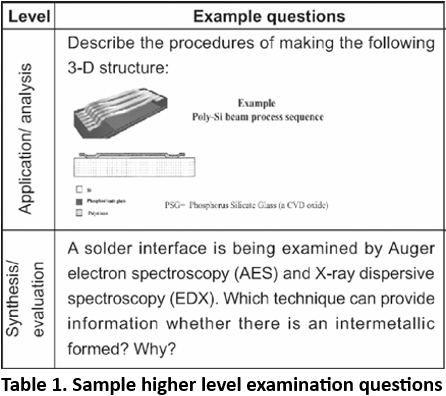
Lastly, concerning the course-end examination, the teacher was pleased that he had put effort into diversifying the nature of the questions so that many of the questions reflected the thinking skills the students had been trained in through the case-based activities in the course. As a result, questions not only required students to simply remember or understand concepts, but also to apply them, use them to analyze new situations and data, synthesize a number of ideas in order to solve problems, and evaluate strategies (Bloom's taxonomy: Bloom, 1956; revised Bloom's taxonomy: Krathwohl, 2002). Examples of the examination questions are in Table 1. Students were told that the case-based learning activities and the examination would be closely related and, naturally, this contributed to an increase in students' motivation in going through the various non-traditional case-based activities in the course.
 الاكثر قراءة في Teaching Strategies
 اخر الاخبار
اخبار العتبة العباسية المقدسة

الآخبار الصحية


مواضيع ذات صلة
 قسم الشؤون الفكرية يصدر كتاباً يوثق تاريخ السدانة في العتبة العباسية المقدسة
 "المهمة".. إصدار قصصي يوثّق القصص الفائزة في مسابقة فتوى الدفاع المقدسة للقصة القصيرة
 (نوافذ).. إصدار أدبي يوثق القصص الفائزة في مسابقة الإمام العسكري (عليه السلام)






