Grammar
Tenses
Present

Present Simple
Present Continuous
Present Perfect
Present Perfect Continuous
Past
Past Simple
Past Continuous
Past Perfect
Past Perfect Continuous
Future
Future Simple
Future Continuous
Future Perfect
Future Perfect Continuous
Parts Of Speech
Nouns
Countable and uncountable nouns
Verbal nouns
Singular and Plural nouns
Proper nouns
Nouns gender
Nouns definition
Concrete nouns
Abstract nouns
Common nouns
Collective nouns
Definition Of Nouns
Animate and Inanimate nouns
Nouns
Verbs
Stative and dynamic verbs
Finite and nonfinite verbs
To be verbs
Transitive and intransitive verbs
Auxiliary verbs
Modal verbs
Regular and irregular verbs
Action verbs
Verbs
Adverbs
Relative adverbs
Interrogative adverbs
Adverbs of time
Adverbs of place
Adverbs of reason
Adverbs of quantity
Adverbs of manner
Adverbs of frequency
Adverbs of affirmation
Adverbs
Adjectives
Quantitative adjective
Proper adjective
Possessive adjective
Numeral adjective
Interrogative adjective
Distributive adjective
Descriptive adjective
Demonstrative adjective
Pronouns
Subject pronoun
Relative pronoun
Reflexive pronoun
Reciprocal pronoun
Possessive pronoun
Personal pronoun
Interrogative pronoun
Indefinite pronoun
Emphatic pronoun
Distributive pronoun
Demonstrative pronoun
Pronouns
Pre Position
Preposition by function
Time preposition
Reason preposition
Possession preposition
Place preposition
Phrases preposition
Origin preposition
Measure preposition
Direction preposition
Contrast preposition
Agent preposition
Preposition by construction
Simple preposition
Phrase preposition
Double preposition
Compound preposition
prepositions
Conjunctions
Subordinating conjunction
Correlative conjunction
Coordinating conjunction
Conjunctive adverbs
conjunctions
Interjections
Express calling interjection
Phrases
Sentences
Clauses
Part of Speech
Grammar Rules
Passive and Active
Preference
Requests and offers
wishes
Be used to
Some and any
Could have done
Describing people
Giving advices
Possession
Comparative and superlative
Giving Reason
Making Suggestions
Apologizing
Forming questions
Since and for
Directions
Obligation
Adverbials
invitation
Articles
Imaginary condition
Zero conditional
First conditional
Second conditional
Third conditional
Reported speech
Demonstratives
Determiners
Direct and Indirect speech
Linguistics
Phonetics
Phonology
Linguistics fields
Syntax
Morphology
Semantics
pragmatics
History
Writing
Grammar
Phonetics and Phonology
Semiotics
Reading Comprehension
Elementary
Intermediate
Advanced
Teaching Methods
Teaching Strategies
Assessment

Professional Behavior
 المؤلف:
Larry W. Belbeck & Shucui Jiang & Nicoleta Nutiu
المؤلف:
Larry W. Belbeck & Shucui Jiang & Nicoleta Nutiu
 المصدر:
Enhancing Teaching and Learning through Assessment
المصدر:
Enhancing Teaching and Learning through Assessment
 الجزء والصفحة:
P234-C20
الجزء والصفحة:
P234-C20
 2025-07-12
 508
508




+
-
20
Professional Behavior
It was noted during these discussions in the first year that the course was offered, that students were very competitive, defensive of their own position and were less likely to change based on feedback from classmates.
During the second year, students were presented with "The McMaster Medical School Guide to Professional Behavior in Tutorial Meetings" (McMaster University, 2002). They were encouraged to follow these guidelines and this was part of the student self and peer assessment. Instructors encouraged positive behaviors during both classroom and electronic opportunities.
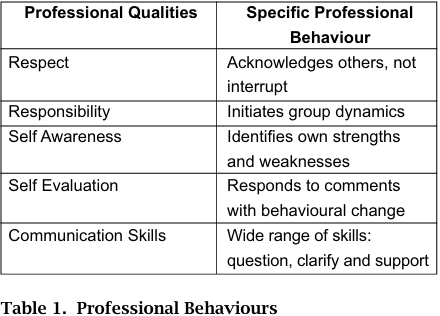
Table one is a summary of the professional qualities that we attempt to teach along with some specific examples.
When student behavior was compared with a group of practicing health care professionals, the following differences were noted at the end of the first year of the course.
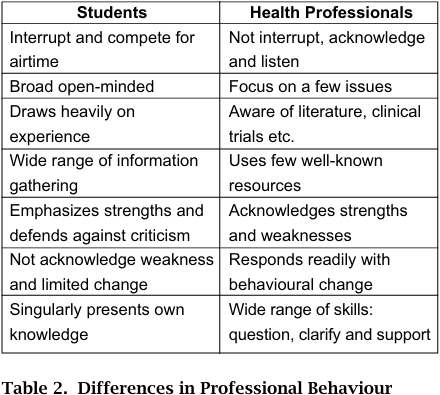
During the second year of the course, there was a much less noticeable difference in professional behavior. The question of whether this conforming to an expected standard of professional behavior interfered with reasoning or identification of issues was tested by comparing the pattern of issue generation between the two groups. Since problems varied in scope and complexity, the comparison was made between either the student or health professional and the planner who wrote the problem. The relevancy of the issues was determined by experienced tutors who ran the workshops. Similar issues were grouped so that there was no inflation of student numbers.
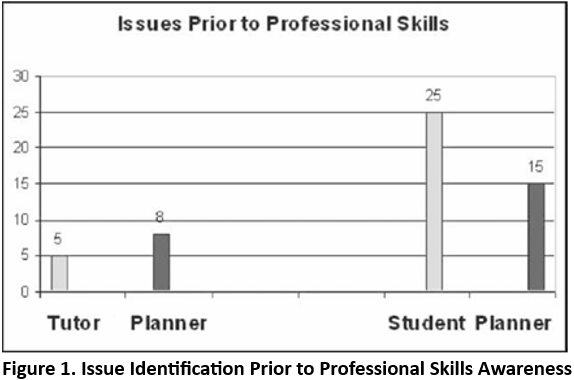
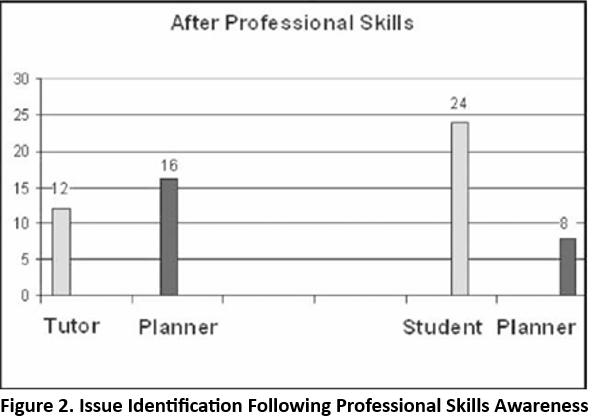
In both trials, the students generated many more issues than health professionals and pursued these issues with a wider range of information resources.
Health care professionals focus on a few issues and use a limited set of references to confirm or review the essentials to manage the case. Most do not look for further problems, probably because they are used to working under time constraints in their practice.
Thus "early closure" or being too focused is a problem to be addressed in continuing education of physicians. The evidence of this in practice are the number of patients that once labelled with a particular disease are not investigated further or treated differently in spite of unusual findings or results being detected.
Students, in the academic setting think broadly and explore problems to a greater depth. This is not surprising as these behaviors are continually assessed in the academic environment. For students, the more they portray these behaviors, the greater the reward.
For health care professionals, there is not a great reward structure, but rather change occurs because of complaints, practice standards committees or litigation. All of these are at the lower end of the scale and are likely punitive.
 الاكثر قراءة في Teaching Strategies
 اخر الاخبار
اخبار العتبة العباسية المقدسة

الآخبار الصحية


مواضيع ذات صلة
 قسم الشؤون الفكرية يصدر كتاباً يوثق تاريخ السدانة في العتبة العباسية المقدسة
 "المهمة".. إصدار قصصي يوثّق القصص الفائزة في مسابقة فتوى الدفاع المقدسة للقصة القصيرة
 (نوافذ).. إصدار أدبي يوثق القصص الفائزة في مسابقة الإمام العسكري (عليه السلام)