Grammar
Tenses
Present

Present Simple
Present Continuous
Present Perfect
Present Perfect Continuous
Past
Past Simple
Past Continuous
Past Perfect
Past Perfect Continuous
Future
Future Simple
Future Continuous
Future Perfect
Future Perfect Continuous
Parts Of Speech
Nouns
Countable and uncountable nouns
Verbal nouns
Singular and Plural nouns
Proper nouns
Nouns gender
Nouns definition
Concrete nouns
Abstract nouns
Common nouns
Collective nouns
Definition Of Nouns
Animate and Inanimate nouns
Nouns
Verbs
Stative and dynamic verbs
Finite and nonfinite verbs
To be verbs
Transitive and intransitive verbs
Auxiliary verbs
Modal verbs
Regular and irregular verbs
Action verbs
Verbs
Adverbs
Relative adverbs
Interrogative adverbs
Adverbs of time
Adverbs of place
Adverbs of reason
Adverbs of quantity
Adverbs of manner
Adverbs of frequency
Adverbs of affirmation
Adverbs
Adjectives
Quantitative adjective
Proper adjective
Possessive adjective
Numeral adjective
Interrogative adjective
Distributive adjective
Descriptive adjective
Demonstrative adjective
Pronouns
Subject pronoun
Relative pronoun
Reflexive pronoun
Reciprocal pronoun
Possessive pronoun
Personal pronoun
Interrogative pronoun
Indefinite pronoun
Emphatic pronoun
Distributive pronoun
Demonstrative pronoun
Pronouns
Pre Position
Preposition by function
Time preposition
Reason preposition
Possession preposition
Place preposition
Phrases preposition
Origin preposition
Measure preposition
Direction preposition
Contrast preposition
Agent preposition
Preposition by construction
Simple preposition
Phrase preposition
Double preposition
Compound preposition
prepositions
Conjunctions
Subordinating conjunction
Correlative conjunction
Coordinating conjunction
Conjunctive adverbs
conjunctions
Interjections
Express calling interjection
Phrases
Sentences
Clauses
Part of Speech
Grammar Rules
Passive and Active
Preference
Requests and offers
wishes
Be used to
Some and any
Could have done
Describing people
Giving advices
Possession
Comparative and superlative
Giving Reason
Making Suggestions
Apologizing
Forming questions
Since and for
Directions
Obligation
Adverbials
invitation
Articles
Imaginary condition
Zero conditional
First conditional
Second conditional
Third conditional
Reported speech
Demonstratives
Determiners
Direct and Indirect speech
Linguistics
Phonetics
Phonology
Linguistics fields
Syntax
Morphology
Semantics
pragmatics
History
Writing
Grammar
Phonetics and Phonology
Semiotics
Reading Comprehension
Elementary
Intermediate
Advanced
Teaching Methods
Teaching Strategies
Assessment

Online Pragmatics and Intercultural Communication courses
 المؤلف:
Winnie Cheng & Martin Warren
المؤلف:
Winnie Cheng & Martin Warren
 المصدر:
Enhancing Teaching and Learning through Assessment
المصدر:
Enhancing Teaching and Learning through Assessment
 الجزء والصفحة:
P201-C18
الجزء والصفحة:
P201-C18
 2025-07-05
 830
830




+
-
20
Online Pragmatics and Intercultural Communication courses
A number of concepts served as the guiding principles when OCLA was incorporated into the design of the subject syllabuses. Reading and learning from materials online and doing assessed tasks online, compared to attending lectures and interacting with the lecturer, require a much higher level of independence in learning. Online learning therefore puts a greater demand on students regarding their cognitive, motivational and interpersonal abilities for learning. Assessment procedures and methods were also re-designed to better reflect the course aims, objectives, pedagogy and learning outcomes.
In addition, the peculiarities and uniqueness of web-based learning should be maximally exploited. The increased interactivity afforded by online learning and teaching makes online collaborative assessment feasible (MacDonald et al., 2002). MacDonald et al. (2002, p.10) review a number of sub-projects which have practiced collaborative formative evaluation of learning and teaching, including peer review of students' scripts posted electronically (Davis & Berrow, 1998); model answers delivered to help students to see alternative approaches to written work (Mason, 1995); process writing of assignments or 'iterative assignment development' (McConnell, 1999); and students involved in online negotiation of assessment criteria (Kwok & Ma, 1999).
Group work and involving students in the assessment procedures are also important. The value of group work as a means to developing skills such as "communication, presentation, problem-solving, leadership, delegation and organization" (Butcher et al., 1995, p.165) is well established. The problem in an assessed course in which group work takes place is that the teacher needs to assign individual grades to the students rather than the same grade for every member of the group. In order to fairly measure individual students' performance in the group work, the contribution of the individual to the group project will be established. One possible way to deal with this potential dilemma is to introduce an element of peer assessment to determine the contribution of individuals to a group project (Conway et al., 1993; Cheng & Warren, 1999). In this study, peer assessment refers to a system of assessment whereby students, through online discussion and negotiation, assess the peers' contribution to both the conduct and the outcome of group work. In addition to peer assessment, students perform self-assessment of their own contribution to the collaborative project, and the teacher assesses student effort in group projects shown in online feedback and discussion of the feedback.
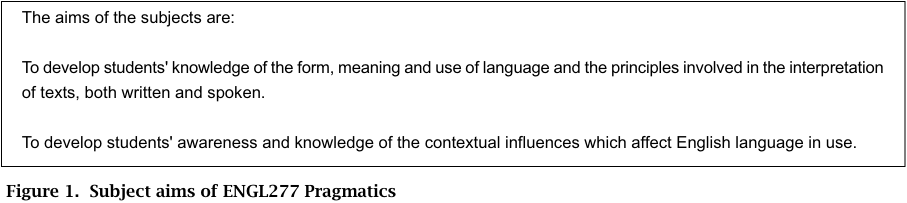
Bearing in mind the issues and guiding principles discussed above, the syllabuses of the subjects Pragmatics and Intercultural Communication were written to incorporate OCLA in their aims, learning outcomes and assessment. Figure 1 shows the subject aims of ENGL277 Pragmatics.
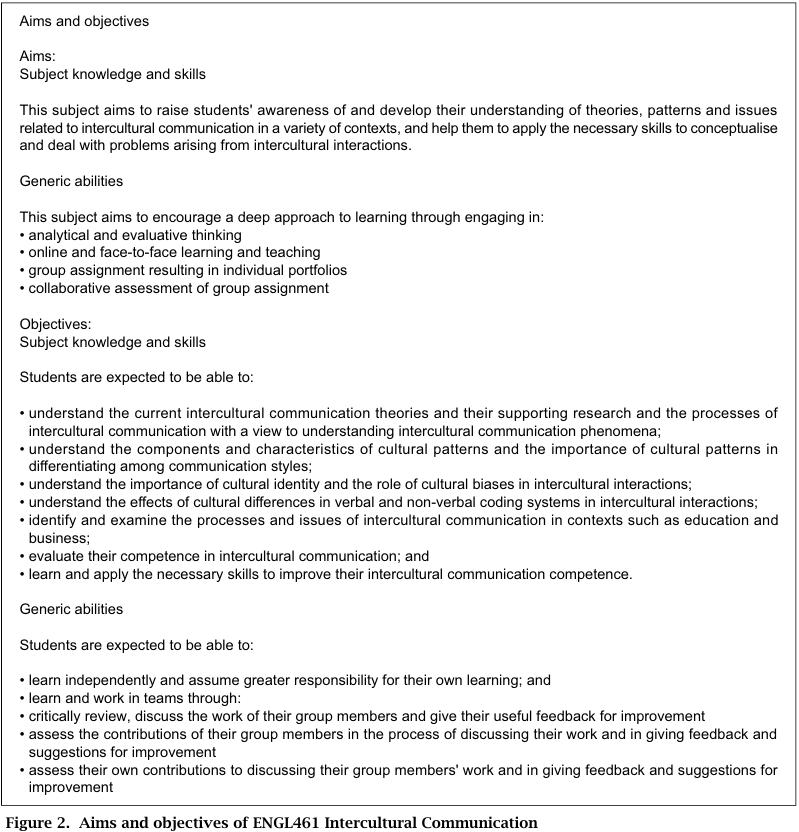
Figure 2 shows the more detailed subject aims and objectives in the syllabus of ENGL461 Intercultural Communication, which shows that both acquisition of subject knowledge and development of generic attributes are emphasized.
Online delivery of Pragmatics and Intercultural Communication made use of the combination of computers and network technology, asynchronous group and individual messaging, and the real-time interactive features of the World Wide Web. Traditional face-to-face lecturing in two-hour slots was replaced by students' online study; the lectures were presented by means of online learning materials using the WebCT platform. All teaching materials (notes, exercises, examples and audio clips) were uploaded on the subject Website. Weston and Barker (2001) summarize the major reasons for using online learning materials: the shortening of distance between student and place of learning, ease of access to resources, interactivity and multimedia, student control of learning, and distributed communication or collaboration. Compared to attending two-hour lecture sessions, when learning the subject materials online, students could do things like repeating or changing the sequence of units, and manipulating and rewinding video and audio clips that formed part of the online learning materials. Built into the learning units were discussion forums on the WebCT which allowed students to respond to each other and the teacher, giving them the opportunity to revise and reflect upon their work and to engage in reflective discussion (Bonk & King, 1998; Brown et al., 2000).
There were weekly one-hour seminars with groups of 20-25 students, whereby the concepts learnt through the online materials were consolidated through applying them to seminar activities. From the outset, it was made clear to the students that the weekly seminar must not be turned into a kind of 'WebCT user' discussion group, and that any problems or suggestions for the online learning should be discussed on the WebCT, or e-mail messages, in an office visit or by telephone.
In the first lesson, the rationale, procedure, instructional materials, teaching and learning activities, assessments and evaluation were explained to the students. The students were told that online learning means taking greater responsibility for their learning, experiencing a higher level of interactivity than attending lectures, and adjusting to greater flexibility and control in terms of when and how they learn. It was emphasized that in order to make the most of this new development, it was important that the students should approach it positively and enthusiastically, and that both their learning process and product would be closely monitored and fully evaluated.
 الاكثر قراءة في Teaching Strategies
 اخر الاخبار
اخبار العتبة العباسية المقدسة

الآخبار الصحية


مواضيع ذات صلة
 قسم الشؤون الفكرية يصدر كتاباً يوثق تاريخ السدانة في العتبة العباسية المقدسة
 "المهمة".. إصدار قصصي يوثّق القصص الفائزة في مسابقة فتوى الدفاع المقدسة للقصة القصيرة
 (نوافذ).. إصدار أدبي يوثق القصص الفائزة في مسابقة الإمام العسكري (عليه السلام)