









Grammar
Tenses
Present

Present Simple
Present Continuous
Present Perfect
Present Perfect Continuous
Past
Past Simple
Past Continuous
Past Perfect
Past Perfect Continuous
Future
Future Simple
Future Continuous
Future Perfect
Future Perfect Continuous
Parts Of Speech
Nouns
Countable and uncountable nouns
Verbal nouns
Singular and Plural nouns
Proper nouns
Nouns gender
Nouns definition
Concrete nouns
Abstract nouns
Common nouns
Collective nouns
Definition Of Nouns
Animate and Inanimate nouns
Nouns
Verbs
Stative and dynamic verbs
Finite and nonfinite verbs
To be verbs
Transitive and intransitive verbs
Auxiliary verbs
Modal verbs
Regular and irregular verbs
Action verbs
Verbs
Adverbs
Relative adverbs
Interrogative adverbs
Adverbs of time
Adverbs of place
Adverbs of reason
Adverbs of quantity
Adverbs of manner
Adverbs of frequency
Adverbs of affirmation
Adverbs
Adjectives
Quantitative adjective
Proper adjective
Possessive adjective
Numeral adjective
Interrogative adjective
Distributive adjective
Descriptive adjective
Demonstrative adjective
Pronouns
Subject pronoun
Relative pronoun
Reflexive pronoun
Reciprocal pronoun
Possessive pronoun
Personal pronoun
Interrogative pronoun
Indefinite pronoun
Emphatic pronoun
Distributive pronoun
Demonstrative pronoun
Pronouns
Pre Position
Preposition by function
Time preposition
Reason preposition
Possession preposition
Place preposition
Phrases preposition
Origin preposition
Measure preposition
Direction preposition
Contrast preposition
Agent preposition
Preposition by construction
Simple preposition
Phrase preposition
Double preposition
Compound preposition
prepositions
Conjunctions
Subordinating conjunction
Correlative conjunction
Coordinating conjunction
Conjunctive adverbs
conjunctions
Interjections
Express calling interjection
Phrases
Sentences
Clauses
Part of Speech
Grammar Rules
Passive and Active
Preference
Requests and offers
wishes
Be used to
Some and any
Could have done
Describing people
Giving advices
Possession
Comparative and superlative
Giving Reason
Making Suggestions
Apologizing
Forming questions
Since and for
Directions
Obligation
Adverbials
invitation
Articles
Imaginary condition
Zero conditional
First conditional
Second conditional
Third conditional
Reported speech
Demonstratives
Determiners
Direct and Indirect speech
Linguistics
Phonetics
Phonology
Linguistics fields
Syntax
Morphology
Semantics
pragmatics
History
Writing
Grammar
Phonetics and Phonology
Semiotics
Reading Comprehension
Elementary
Intermediate
Advanced
Teaching Methods
Teaching Strategies
Assessment

Vowels
 المؤلف:
Josef schmied
المؤلف:
Josef schmied
 المصدر:
A Handbook Of Varieties Of English Phonology
المصدر:
A Handbook Of Varieties Of English Phonology
 الجزء والصفحة:
927-52
الجزء والصفحة:
927-52
 2024-05-20
 1865
1865




+
-
20
Vowels
A comparison of the English phoneme system with that of most African languages shows that the major difference are not the consonants but the few vowel contrasts compared to the extensive English vowel system. Thus the vowel system of EAfE deviates systematically, vowels tend to merge, because the extreme range of the English vowel continuum is not covered by the underlying African systems of, for instance, the Bantu languages. On the whole three basic generalizations may be made for English vowels:
(a) Length differences in vowels are levelled and not used phonemically; thus FLEECE and KIT, GOOSE and FOOT, THOUGHT and NORTH, and BATH, STRUT and TRAP tend to merge. This is not only a quantitative, but also a qualitative shift, as usually short vowels in EAfE are longer and more peripheral than in RP, especially /ɪ/ tends towards /i'/ , /ʊ/ towards /u'/ , /ɔ/ towards /o'/ and /Λ/ and /æ/ towards /a'/.
(b) The central vowels of STRUT, NURSE and lettER, are avoided and tend towards half-open or open positions of BATH and, less often, DRESS. This conforms to the tendency towards more extreme articulatory positions of the tongue in general. It leads (together with the syllable-timing, to the phenomenon that, whereas vowels in full syllables tend to be underdifferentiated, those in unstressed ones may be overdifferentiated. Hence the difference between policeman and policemen or between the suffixes -ance and -ence may be clearer than in Standard English.
(c) Diphthongs tend to have only marginal status and to be monophthongized. In the short closing diphthongs MOUTH and particularly FACE the second element is hardly heard in many African varieties (as in Scotland; thus coinciding almost with the DRESS vowel). Diphthongs with a longer glide are preserved, but they are not really pronounced as falling diphthongs, i.e. with less emphasis on the second element than on the first, but rather as double monophthongs (e.g. [oɪ] , [aʊ]). All the centring diphthongs (NEAR, SQUARE, CURE) tend to be pronounced as opening diphthongs or double monophthongs ( [ɪa, ea, ua] ; cf. tendency (b) above).
These general observations on vowel pronunciation seem to hold for so many African varieties that this cannot be interpreted merely as a product of mother-tongue interference. In fact, some of these features of “Africanization” have already been predicted by Gimson (1980: 306) in very general terms, i.e. without any reference to Africa, because of the particularly complex structure of the English vowel system:
… the full systems [20 vowels and 24 consonants] must be regarded as complex compared with the systems of many other languages. In particular, the opposition of the close vowels /i:/-/i/, /u:/-/u/, the existence of a central long vowel /з:/ and the delicately differentiated front vowel set of /i:/-/i/-/e/-/æ/ + /Λ/ , together with the significant or conditioned variations of vowel length, will pose problems to many foreign learners.
Finally, it is worth considering the vowel system as a whole (in terms of Wells 1982). In contrast to West African varieties, which tend towards a basic seven-vowel system, East African varieties tend towards a basic five-vowel system (Table 1).
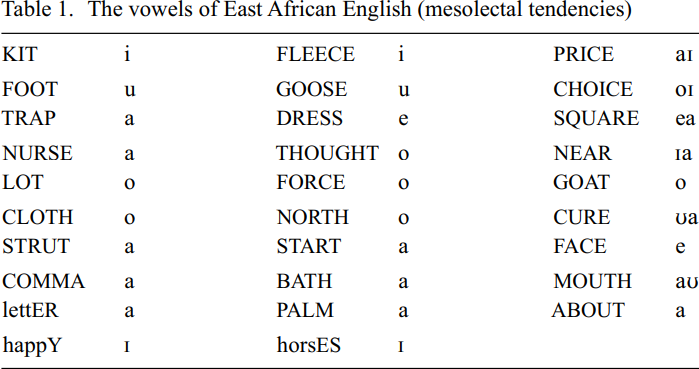
An interesting single parameter in this respect is the deviation of the RP long central NURSE vowel: it tends toward a back vowel /ɔ/ in West African varieties, towards a front vowel /a/ in Eastern and towards /e/ Southern African varieties, but these tendencies are not uniform in a region, neither across all ethnic groups, nor across the lexicon, as in Tanzania girl tends towards front (DRESS) and turn towards back pronunciation (START) because of spelling pronunciation.
 الاكثر قراءة في Phonology
 اخر الاخبار
اخبار العتبة العباسية المقدسة

الآخبار الصحية


مواضيع ذات صلة
 قسم الشؤون الفكرية يصدر كتاباً يوثق تاريخ السدانة في العتبة العباسية المقدسة
 "المهمة".. إصدار قصصي يوثّق القصص الفائزة في مسابقة فتوى الدفاع المقدسة للقصة القصيرة
 (نوافذ).. إصدار أدبي يوثق القصص الفائزة في مسابقة الإمام العسكري (عليه السلام)






