









Grammar
Tenses
Present

Present Simple
Present Continuous
Present Perfect
Present Perfect Continuous
Past
Past Simple
Past Continuous
Past Perfect
Past Perfect Continuous
Future
Future Simple
Future Continuous
Future Perfect
Future Perfect Continuous
Parts Of Speech
Nouns
Countable and uncountable nouns
Verbal nouns
Singular and Plural nouns
Proper nouns
Nouns gender
Nouns definition
Concrete nouns
Abstract nouns
Common nouns
Collective nouns
Definition Of Nouns
Animate and Inanimate nouns
Nouns
Verbs
Stative and dynamic verbs
Finite and nonfinite verbs
To be verbs
Transitive and intransitive verbs
Auxiliary verbs
Modal verbs
Regular and irregular verbs
Action verbs
Verbs
Adverbs
Relative adverbs
Interrogative adverbs
Adverbs of time
Adverbs of place
Adverbs of reason
Adverbs of quantity
Adverbs of manner
Adverbs of frequency
Adverbs of affirmation
Adverbs
Adjectives
Quantitative adjective
Proper adjective
Possessive adjective
Numeral adjective
Interrogative adjective
Distributive adjective
Descriptive adjective
Demonstrative adjective
Pronouns
Subject pronoun
Relative pronoun
Reflexive pronoun
Reciprocal pronoun
Possessive pronoun
Personal pronoun
Interrogative pronoun
Indefinite pronoun
Emphatic pronoun
Distributive pronoun
Demonstrative pronoun
Pronouns
Pre Position
Preposition by function
Time preposition
Reason preposition
Possession preposition
Place preposition
Phrases preposition
Origin preposition
Measure preposition
Direction preposition
Contrast preposition
Agent preposition
Preposition by construction
Simple preposition
Phrase preposition
Double preposition
Compound preposition
prepositions
Conjunctions
Subordinating conjunction
Correlative conjunction
Coordinating conjunction
Conjunctive adverbs
conjunctions
Interjections
Express calling interjection
Phrases
Sentences
Clauses
Part of Speech
Grammar Rules
Passive and Active
Preference
Requests and offers
wishes
Be used to
Some and any
Could have done
Describing people
Giving advices
Possession
Comparative and superlative
Giving Reason
Making Suggestions
Apologizing
Forming questions
Since and for
Directions
Obligation
Adverbials
invitation
Articles
Imaginary condition
Zero conditional
First conditional
Second conditional
Third conditional
Reported speech
Demonstratives
Determiners
Direct and Indirect speech
Linguistics
Phonetics
Phonology
Linguistics fields
Syntax
Morphology
Semantics
pragmatics
History
Writing
Grammar
Phonetics and Phonology
Semiotics
Reading Comprehension
Elementary
Intermediate
Advanced
Teaching Methods
Teaching Strategies
Assessment

Vowels CommA
 المؤلف:
Augustin Simo Bobda
المؤلف:
Augustin Simo Bobda
 المصدر:
A Handbook Of Varieties Of English Phonology
المصدر:
A Handbook Of Varieties Of English Phonology
 الجزء والصفحة:
892-50
الجزء والصفحة:
892-50
 2024-05-17
 1423
1423




+
-
20
Vowels CommA
The spelling-induced /a/ is the most common realization of the commA vowel in CamE. When the vowel is represented by o, it is realized as /ɔ/; e.g. abb [ɔ] t, big [ɔ] t, Lenn [ɔ] n. CamE has a predilection for /i/ before final /n/ irrespective of the grapheme, as in Samps[i]n, Wils[i]n. /i/ is even more systematic in words which have an /i/ in the preceding syllable, as in hidd[i]n, Hilt[i]n, kitch[i]n, pris[i]n. This can be considered as a case of vowel assimilation or harmony. This phenomenon yields other vowels in other contexts, like [ç] in Rob [ɔ] rt and Thom [ɔ] s.
Seen through Wells’ lexical sets, and accommodating both Foulkes and Docherty’s (1999) addition as well as the modifications suggested by the split observed in CamE phonology, the vowels of CamE can be summarized as in Table 1.
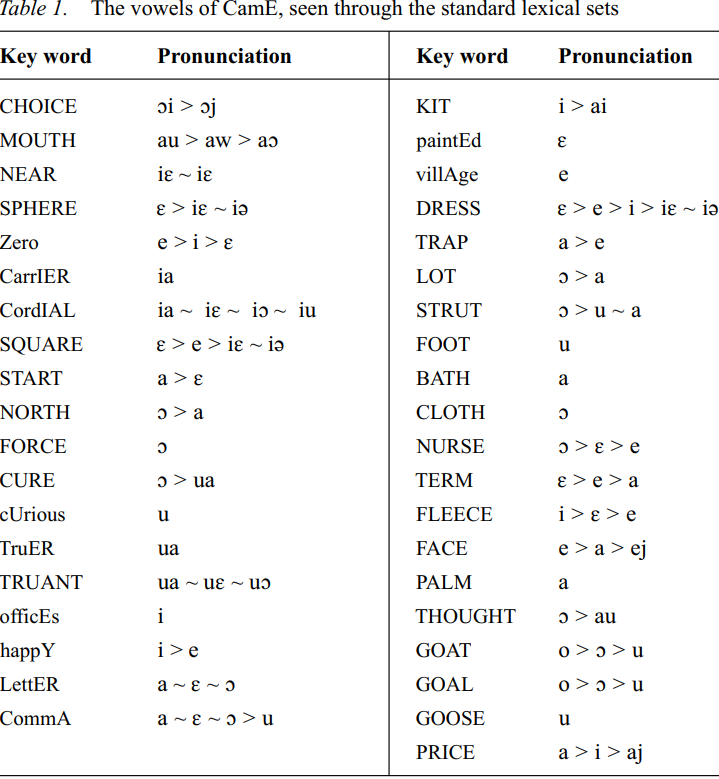
From the above picture, a seven-vowel system ([i, e, ε, a, ɔ, o, u]), plus a marginal schwa, appears. The marginal nature of the schwa is due to its extremely low frequency. It normally occurs only as the second member of the NEAR diphthong in acrolectal speech, and in epenthetic environments like [ebəl, riðəm, kapitalizəm] able, rhythm, capitalism. The low frequency of the schwa is mostly due to the fact that CamE generally does not apply the Vowel Reduction rule.
Of particular interest in the discussion of the patterns of realization of the standard lexical sets has been the phenomenon of splits (e.g. of the NURSE and CURE vowels) and mergers (e.g. of the LOT, THOUGHT, NORTH, FORCE and STRUT vowels). The splits are responsible for the splitting of some pairs which are homophonous in RP, like dollar/dolour [dɔla, dɔlɔ] , fisher/fissure [fiʃa, fiʃɔ] word/ whirred [wɔd / wɔt , wεd / wεt], swab/swob [swab/swap , swɔb,swaɔp], kernel/colonel [kεnεl , kɔlɔnεl]. The mergers create new homophones in CamE, like match, march [matʃ] , talk, thug [tɔk] , circular/secular [sekula], fodder, further [fɔda] , hod, hud, hoard [hɔd/hɔt]. A more comprehensive list of such splits and mergers can be found in Simo Bobda (1994: 157–161).
The discussion has also highlighted, beyond mere cases of segment restructuring, some vocalic processes like E-Tensing, Glide Formation, i-Assimilation, as well as the behavior of CamE with regard to some RP rules like Vowel Reduction, CiV Tensing and Trisyllabic Laxing.
 الاكثر قراءة في Phonology
 اخر الاخبار
اخبار العتبة العباسية المقدسة

الآخبار الصحية


مواضيع ذات صلة
 قسم الشؤون الفكرية يصدر كتاباً يوثق تاريخ السدانة في العتبة العباسية المقدسة
 "المهمة".. إصدار قصصي يوثّق القصص الفائزة في مسابقة فتوى الدفاع المقدسة للقصة القصيرة
 (نوافذ).. إصدار أدبي يوثق القصص الفائزة في مسابقة الإمام العسكري (عليه السلام)






