Grammar
Tenses
Present

Present Simple
Present Continuous
Present Perfect
Present Perfect Continuous
Past
Past Simple
Past Continuous
Past Perfect
Past Perfect Continuous
Future
Future Simple
Future Continuous
Future Perfect
Future Perfect Continuous
Parts Of Speech
Nouns
Countable and uncountable nouns
Verbal nouns
Singular and Plural nouns
Proper nouns
Nouns gender
Nouns definition
Concrete nouns
Abstract nouns
Common nouns
Collective nouns
Definition Of Nouns
Animate and Inanimate nouns
Nouns
Verbs
Stative and dynamic verbs
Finite and nonfinite verbs
To be verbs
Transitive and intransitive verbs
Auxiliary verbs
Modal verbs
Regular and irregular verbs
Action verbs
Verbs
Adverbs
Relative adverbs
Interrogative adverbs
Adverbs of time
Adverbs of place
Adverbs of reason
Adverbs of quantity
Adverbs of manner
Adverbs of frequency
Adverbs of affirmation
Adverbs
Adjectives
Quantitative adjective
Proper adjective
Possessive adjective
Numeral adjective
Interrogative adjective
Distributive adjective
Descriptive adjective
Demonstrative adjective
Pronouns
Subject pronoun
Relative pronoun
Reflexive pronoun
Reciprocal pronoun
Possessive pronoun
Personal pronoun
Interrogative pronoun
Indefinite pronoun
Emphatic pronoun
Distributive pronoun
Demonstrative pronoun
Pronouns
Pre Position
Preposition by function
Time preposition
Reason preposition
Possession preposition
Place preposition
Phrases preposition
Origin preposition
Measure preposition
Direction preposition
Contrast preposition
Agent preposition
Preposition by construction
Simple preposition
Phrase preposition
Double preposition
Compound preposition
prepositions
Conjunctions
Subordinating conjunction
Correlative conjunction
Coordinating conjunction
Conjunctive adverbs
conjunctions
Interjections
Express calling interjection
Phrases
Sentences
Clauses
Part of Speech
Grammar Rules
Passive and Active
Preference
Requests and offers
wishes
Be used to
Some and any
Could have done
Describing people
Giving advices
Possession
Comparative and superlative
Giving Reason
Making Suggestions
Apologizing
Forming questions
Since and for
Directions
Obligation
Adverbials
invitation
Articles
Imaginary condition
Zero conditional
First conditional
Second conditional
Third conditional
Reported speech
Demonstratives
Determiners
Direct and Indirect speech
Linguistics
Phonetics
Phonology
Linguistics fields
Syntax
Morphology
Semantics
pragmatics
History
Writing
Grammar
Phonetics and Phonology
Semiotics
Reading Comprehension
Elementary
Intermediate
Advanced
Teaching Methods
Teaching Strategies
Assessment

The vowels of RP
 المؤلف:
Clive Upton
المؤلف:
Clive Upton
 المصدر:
A Handbook Of Varieties Of English Phonology
المصدر:
A Handbook Of Varieties Of English Phonology
 الجزء والصفحة:
220-11
الجزء والصفحة:
220-11
 2024-03-11
 1800
1800




+
-
20
The vowels of RP
There is an extensive literature in which a good deal of agreement, if not absolute unanimity, can be seen in the discussion of changes in RP. There is also, however, some disagreement about precisely how the accent is to be represented, because some commentators are more inclined to hold the line on the older transcriptional and realizational forms than others. Given the fact of language change, there comes a time when certain sounds, conventionally labelled in a previous time, alter to such an extent that different symbols represent them more accurately: the phonetic symbols being absolutes, their interpretation cannot be altered to suit the new development, so that if anything is to change in the interests of accuracy and clarity it must be the label that is applied to the sound. This is especially important since transcriptions in dictionaries and English language teaching texts are invariably broadly phonemic, and if their users are to be properly served they need to be provided with transcriptions that correspond as honestly as possible to the sounds of the modern accent. The RP vowel inventory incorporates some judicious relabelling from that which is often to be seen. It contains nineteen stressed vowels,  and two unstressed vowels, /i/ and /ə/.
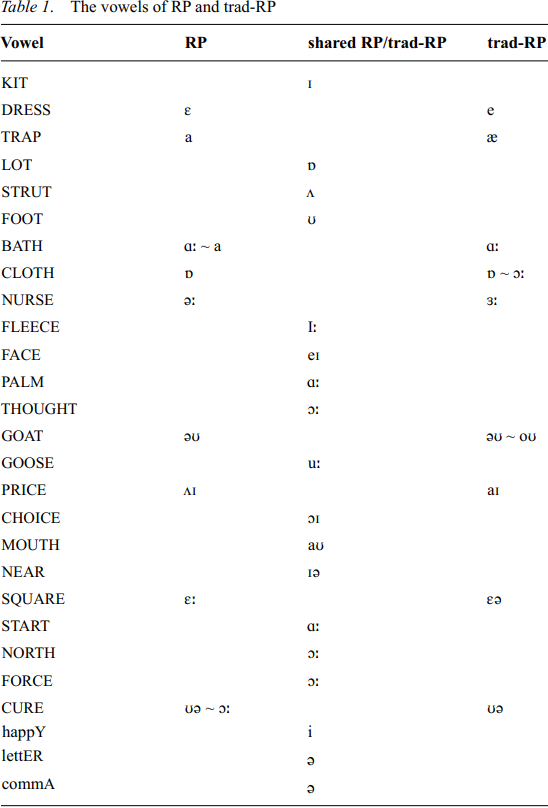
RP and trad-RP share the same phonemic structure but differ in realizational (and hence labelling) particulars, and differ also occasionally in the lexical distribution of phonemes. Table 1 combines the accents in most of the lexical sets. Where there are differences, these are shown in separate columns.
It will be evident from Table 1 that RP and trad-RP coincide on KIT, LOT, STRUT, FOOT, FLEECE, FACE, PALM, THOUGHT, GOOSE, CHOICE, MOUTH, NEAR, START, NORTH, FORCE, happY, lettER, and commA. NURSE shows only a slight difference, in which the RP transcription is indicative of a less restrictive rendering of the typical sound than is the trad-RP transcription. The BATH vowel coincides on [a:] in both varieties, with the addition of a further [a] variant in RP. CLOTH similarly coincides, though with a short vowel, in both varieties, with a long-vowel alternative in trad-RP. Both accents share  in GOAT, with trad-RP having alternative
  , and both share
  in CURE, with RP having alternative
  . Most significant developments have taken place, and so distinguish RP from trad-RP, in DRESS, TRAP, PRICE, and SQUARE.
 الاكثر قراءة في Phonology
 اخر الاخبار
اخبار العتبة العباسية المقدسة

الآخبار الصحية


مواضيع ذات صلة
 قسم الشؤون الفكرية يصدر كتاباً يوثق تاريخ السدانة في العتبة العباسية المقدسة
 "المهمة".. إصدار قصصي يوثّق القصص الفائزة في مسابقة فتوى الدفاع المقدسة للقصة القصيرة
 (نوافذ).. إصدار أدبي يوثق القصص الفائزة في مسابقة الإمام العسكري (عليه السلام)