









Grammar
Tenses
Present

Present Simple
Present Continuous
Present Perfect
Present Perfect Continuous
Past
Past Simple
Past Continuous
Past Perfect
Past Perfect Continuous
Future
Future Simple
Future Continuous
Future Perfect
Future Perfect Continuous
Parts Of Speech
Nouns
Countable and uncountable nouns
Verbal nouns
Singular and Plural nouns
Proper nouns
Nouns gender
Nouns definition
Concrete nouns
Abstract nouns
Common nouns
Collective nouns
Definition Of Nouns
Animate and Inanimate nouns
Nouns
Verbs
Stative and dynamic verbs
Finite and nonfinite verbs
To be verbs
Transitive and intransitive verbs
Auxiliary verbs
Modal verbs
Regular and irregular verbs
Action verbs
Verbs
Adverbs
Relative adverbs
Interrogative adverbs
Adverbs of time
Adverbs of place
Adverbs of reason
Adverbs of quantity
Adverbs of manner
Adverbs of frequency
Adverbs of affirmation
Adverbs
Adjectives
Quantitative adjective
Proper adjective
Possessive adjective
Numeral adjective
Interrogative adjective
Distributive adjective
Descriptive adjective
Demonstrative adjective
Pronouns
Subject pronoun
Relative pronoun
Reflexive pronoun
Reciprocal pronoun
Possessive pronoun
Personal pronoun
Interrogative pronoun
Indefinite pronoun
Emphatic pronoun
Distributive pronoun
Demonstrative pronoun
Pronouns
Pre Position
Preposition by function
Time preposition
Reason preposition
Possession preposition
Place preposition
Phrases preposition
Origin preposition
Measure preposition
Direction preposition
Contrast preposition
Agent preposition
Preposition by construction
Simple preposition
Phrase preposition
Double preposition
Compound preposition
prepositions
Conjunctions
Subordinating conjunction
Correlative conjunction
Coordinating conjunction
Conjunctive adverbs
conjunctions
Interjections
Express calling interjection
Phrases
Sentences
Clauses
Part of Speech
Grammar Rules
Passive and Active
Preference
Requests and offers
wishes
Be used to
Some and any
Could have done
Describing people
Giving advices
Possession
Comparative and superlative
Giving Reason
Making Suggestions
Apologizing
Forming questions
Since and for
Directions
Obligation
Adverbials
invitation
Articles
Imaginary condition
Zero conditional
First conditional
Second conditional
Third conditional
Reported speech
Demonstratives
Determiners
Direct and Indirect speech
Linguistics
Phonetics
Phonology
Linguistics fields
Syntax
Morphology
Semantics
pragmatics
History
Writing
Grammar
Phonetics and Phonology
Semiotics
Reading Comprehension
Elementary
Intermediate
Advanced
Teaching Methods
Teaching Strategies
Assessment

Consonants R (non-prevocalic /r/)
 المؤلف:
Heinrich Ramisch
المؤلف:
Heinrich Ramisch
 المصدر:
A Handbook Of Varieties Of English Phonology
المصدر:
A Handbook Of Varieties Of English Phonology
 الجزء والصفحة:
211-10
الجزء والصفحة:
211-10
 2024-03-09
 1995
1995




+
-
20
Consonants
R (non-prevocalic /r/)
Channel Island English is variably rhotic, but only to a lesser degree. Thus, non-prevocalic /r/ may be pronounced in preconsonantal (e.g. farm) or in absolute final positions (e.g. far). The typical local realization is a retroflex approximant, e.g.  . The pronunciation of non-prevocalic /r/ in accents of British English is of a complex nature, involving both regional and social factors. In the traditional rural accents of England, three areas can generally be described as still preserving non-prevocalic /r/: Northumberland, Lancashire and a larger area in the south-west, ranging from Kent to Cornwall in the west and to Shropshire in the West Midlands. In recent times, the rhotic areas have definitely become smaller.
The realization of non-prevocalic /r/ in the Channel Islands can certainly be attributed to an influence from other varieties of English. But on the other hand, an influence from Channel Island French seems equally possible. Speakers of the Norman French dialects are accustomed to pronouncing [r] (normally an apical type of r, pronounced with different degrees of vibration) both in preconsonantal (e.g. [vεr], Standard French parti ‘gone’) and in absolute-final position (e.g. [parti] Standard French vert ‘green’). Moreover, it is reasonable to assume that Norman French speakers of earlier periods who learnt English only at school tended to realize non-prevocalic /r/ under the influence of English orthography; in other words, their pronunciation of non-prevocalic /r/ would be based on a spelling pronunciation.
A clear indication that the realization of non-prevocalic /r/ is indeed influenced by Norman French becomes apparent in the ending -er in Guernsey English ,which can be pronounced as [œr] (recall Table 2 above). Thus, the pronunciation of words such as better or youngster is ['betœr] and ['jΛŋstœr]. There is evidently an influence from Norman French here, the same ending [œr] also being used in Guernsey French as in 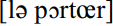 (Standard French le porteur ‘carrier’). Another argument for the English ending -er being identified with the ending [œr] of Guernsey French is the fact that the latter is also found in English loan-words used in Guernsey French. In this way, the English words shutter and mourner have become
  in Guernsey French (Tomlinson 1981: 265, 325). The realisation of non-prevocalic /r/ was not very widespread among the 40 informants in Guernsey. The feature was mostly found in group MO at a rate of 9.2%. With the younger informants, it occurred only very occasionally, and solely in group MY. One can conclude, therefore, that the pronunciation of non-prevocalic /r/ is becoming increasingly rare in the Channel Islands as well.
 الاكثر قراءة في Phonology
 اخر الاخبار
اخبار العتبة العباسية المقدسة

الآخبار الصحية


مواضيع ذات صلة
 قسم الشؤون الفكرية يصدر كتاباً يوثق تاريخ السدانة في العتبة العباسية المقدسة
 "المهمة".. إصدار قصصي يوثّق القصص الفائزة في مسابقة فتوى الدفاع المقدسة للقصة القصيرة
 (نوافذ).. إصدار أدبي يوثق القصص الفائزة في مسابقة الإمام العسكري (عليه السلام)






