0
EN
1
المرجع الالكتروني للمعلوماتية

تاريخ الرياضيات

الاعداد و نظريتها

تاريخ التحليل

تار يخ الجبر

الهندسة و التبلوجي

الرياضيات في الحضارات المختلفة

العربية

اليونانية

البابلية

الصينية

المايا

المصرية

الهندية

الرياضيات المتقطعة

المنطق

اسس الرياضيات

فلسفة الرياضيات

مواضيع عامة في المنطق

الجبر

الجبر الخطي

الجبر المجرد

الجبر البولياني

مواضيع عامة في الجبر

الضبابية

نظرية المجموعات

نظرية الزمر

نظرية الحلقات والحقول

نظرية الاعداد

نظرية الفئات

حساب المتجهات

المتتاليات-المتسلسلات

المصفوفات و نظريتها

المثلثات

الهندسة

الهندسة المستوية

الهندسة غير المستوية

مواضيع عامة في الهندسة

التفاضل و التكامل

المعادلات التفاضلية و التكاملية

معادلات تفاضلية

معادلات تكاملية

مواضيع عامة في المعادلات

التحليل

التحليل العددي

التحليل العقدي

التحليل الدالي

مواضيع عامة في التحليل

التحليل الحقيقي

التبلوجيا

نظرية الالعاب

الاحتمالات و الاحصاء

نظرية التحكم

بحوث العمليات

نظرية الكم

الشفرات

الرياضيات التطبيقية

نظريات ومبرهنات

علماء الرياضيات

500AD

500-1499

1000to1499

1500to1599

1600to1649

1650to1699

1700to1749

1750to1779

1780to1799

1800to1819

1820to1829

1830to1839

1840to1849

1850to1859

1860to1864

1865to1869

1870to1874

1875to1879

1880to1884

1885to1889

1890to1894

1895to1899

1900to1904

1905to1909

1910to1914

1915to1919

1920to1924

1925to1929

1930to1939

1940to the present

علماء الرياضيات

الرياضيات في العلوم الاخرى

بحوث و اطاريح جامعية

هل تعلم

طرائق التدريس

الرياضيات العامة

نظرية البيان

قم بتسجيل الدخول اولاً لكي يتسنى لك الاعجاب والتعليق.

Lucas Sequence

المؤلف:  Ribenboim, P.

المصدر:  The Little Book of Big Primes. New York: Springer-Verlag

الجزء والصفحة:  ...

1-11-2020

1193

+

-

20

Lucas Sequence

Let PQ be integers satisfying

 D=P^2-4Q>0.

(1)

Then roots of

 x^2-Px+Q=0

(2)

are

a = 1/2(P+sqrt(D))

(3)

b = 1/2(P-sqrt(D)),

(4)

so

a+b = P

(5)

ab = 1/4(P^2-D)

(6)

= Q

(7)

a-b = sqrt(D).

(8)

Now define

U_n(P,Q) = (a^n-b^n)/(a-b)

(9)

V_n(P,Q) = a^n+b^n

(10)

for integer n>=0, so the first few values are

U_0 = 0

(11)

U_1 = 1

(12)

U_2 = P

(13)

U_3 = P^2-Q

(14)

U_4 = P(P^2-2Q)

(15)

U_5 = P^4-3QP^2+Q^2

(16)

U_6 = P(P^2-3Q)(P^2-Q)

(17)

U_7 = P^6-5QP^4+6Q^2P^2-Q^3

(18)

U_8 = P(P^2-2Q)(P^4-4QP^2+2Q^2)

(19)

U_9 = (P^2-Q)(P^6-6QP^4+9Q^2P^2-Q^3)

(20)

U_(10) = P(P^4-3QP^2+Q^2)(P^4-5QP^2+5Q^2)

(21)

and

V_0 = 2

(22)

V_1 = P

(23)

V_2 = P^2-2Q

(24)

V_3 = P(P^2-3Q)

(25)

V_4 = P^4-4QP^2+2Q^2

(26)

V_5 = P(P^4-5QP^2+5Q^2)

(27)

V_6 = (P^2-2Q)(P^4-4QP^2+Q^2)

(28)

V_7 = P(P^6-7QP^4+14Q^2P^2-7Q^3)

(29)

V_8 = P^8-8QP^6+20Q^2P^4-16Q^3P^2+2Q^4

(30)

V_9 = P(P^2-3Q)(P^6-6QP^4+9Q^2P^2-3Q^3)

(31)

V_(10) = (P^2-2Q)(P^8-8QP^6+19Q^2P^4-12Q^3P^2+Q^4).

(32)

Closed forms for these are given by

U_n = 2^(1-n)sum_(k=0)^(|_(n-1)/2_|)(n; 2k+1)P^(n-2k-1)(P^2-4Q)^k

(33)

V_n = 2^(1-n)sum_(k=0)^(|_n/2_|)(n; 2k)P^(n-2k)(P^2-4Q)^k.

(34)

The sequences

U(P,Q) = <span style={U_n(P,Q):n>=1}" src="https://mathworld.wolfram.com/images/equations/LucasSequence/Inline102.gif" style="height:15px; width:103px" />

(35)

V(P,Q) = <span style={V_n(P,Q):n>=1}" src="https://mathworld.wolfram.com/images/equations/LucasSequence/Inline105.gif" style="height:15px; width:101px" />

(36)

are called Lucas sequences, where the definition is usually extended to include
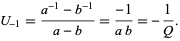
 U_(-1)=(a^(-1)-b^(-1))/(a-b)=(-1)/(ab)=-1/Q.

(37)

The following table summarizes special cases of U_n(P,Q) and V_n(P,Q).

(P,Q) U_n V_n
(1,-1) Fibonacci numbers Lucas numbers
(2,-1) Pell numbers Pell-Lucas numbers
(1,-2) Jacobsthal numbers Pell-Jacobsthal numbers

The Lucas sequences satisfy the general recurrence relations

U_(m+n) = (a^(m+n)-b^(m+n))/(a-b)

(38)

= ((a^m-b^m)(a^n+b^n))/(a-b)-(a^nb^n(a^(m-n)-b^(m-n)))/(a-b)

(39)

= U_mV_n-a^nb^nU_(m-n)

(40)

V_(m+n) = a^(m+n)+b^(m+n)

(41)

= (a^m+b^m)(a^n+b^n)-a^nb^n(a^(m-n)+b^(m-n))

(42)

= V_mV_n-a^nb^nV_(m-n).

(43)

Taking n=1 then gives

U_m(P,Q) = PU_(m-1)(P,Q)-QU_(m-2)(P,Q)

(44)

V_m(P,Q) = PV_(m-1)(P,Q)-QV_(m-2)(P,Q).

(45)

Other identities include

U_(2n) = U_nV_n

(46)

U_(2n+1) = U_(n+1)V_n-Q^n

(47)

V_(2n) = V_n^2-2(ab)^n

(48)

= V_n^2-2Q^n

(49)

V_(2n+1) = V_(n+1)V_n-PQ^n.

(50)

These formulas allow calculations for large n to be decomposed into a chain in which only four quantities must be kept track of at a time, and the number of steps needed is ∼lgn. The chain is particularly simple if n has many 2s in its factorization.


REFERENCES:

Dickson, L. E. "Recurring Series; Lucas' u_nv_n." Ch. 17 in History of the Theory of Numbers, Vol. 1: Divisibility and Primality. New York: Dover, pp. 393-411, 2005.

Ribenboim, P. The Little Book of Big Primes. New York: Springer-Verlag, pp. 35-53, 1991.

اخر الاخبار

اشترك بقناتنا على التلجرام ليصلك كل ما هو جديد



