الوضع الليلي


 11:41:31
  2025-06-09
  1851
1851
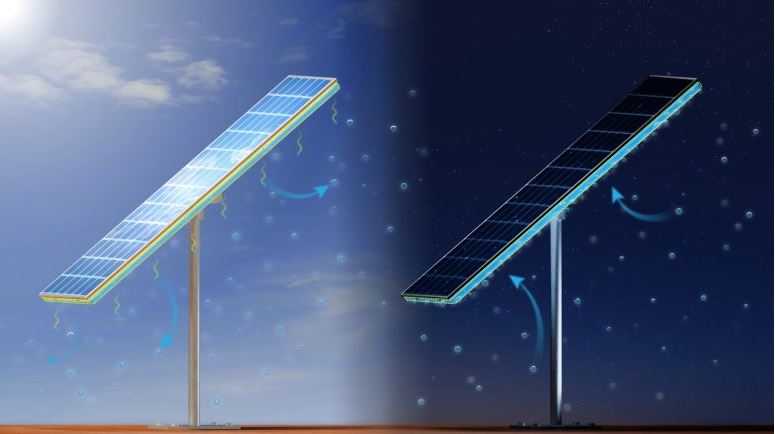
A new composite material passively keeps solar panels cool, boosting power output by 12.9% and extending their lifespan by more than 200%.
An international team of researchers led by King Abdullah University of Science and Technology (KAUST) in Saudi Arabia has developed a new acrylate-based composite material that improves the performance of solar cells.
When applied to solar cells operating in Saudi Arabia for several weeks, the material significantly increased power output and lifespan while lowering the amount of electricity the cells used. The findings were published in the journal Materials Science and Engineering: R.
The need for passive cooling
Solar energy is a key focus for green economies around the world, with solar cells making up more than three-quarters of all renewable energy installations. However, delivering reliable and long-lasting solar power presents significant challenges.
Commercial solar panels convert only about 20 percent of sunlight into electricity, while the rest is either absorbed as heat or reflected. This heat lowers the performance and shortens the lifespan of the panels, leading to earlier replacement. As a result, cooling is essential, but traditional systems like fans and pumps require electricity. Passive cooling offers an alternative that does not consume energy.
“We specialize in materials that enable passive cooling. These materials are thin and can be placed on different systems that require cooling to operate, like greenhouses and solar cells, without affecting performance,” said KAUST Professor Qiaoqiang Gan, who led the study.
In the new study, conducted through the KAUST Center of Excellence for Renewable Energy and Storage Technologies, Gan and his colleagues developed a hygroscopic composite made from lithium chloride and sodium polyacrylate. This material absorbs moisture from the air at night and releases it during the day. Polyacrylate is an inexpensive polymer, and the fabrication process does not require harmful chemicals or specialized reagents, unlike other hygroscopic materials used for cooling. This makes the composite more cost-effective.
Field testing in desert conditions
While operating for weeks in the Saudi desert, solar cells with this material adhered to them were 9.4 oC cooler than those without the new material. They also showed an increased power output of more than 12% and an increased lifespan of more than 200% while reducing their cost of generating electricity by nearly 20%.
In addition to Saudi Arabia, experiments were done in some of the coolest parts of the mainland United States under rainfall to prove that the passive cooling technology works in any environment.
Gan tested the composite material on solar cells provided by KAUST Professor Stefaan De Wolf, whose research team has regularly achieved world records in solar cell performance through their customized designs.
“This work is an excellent example of combining different expertise at KAUST. We tested the new cooling technology on top-performing solar cells in multiple environments and saw excellent results in every case,” said De Wolf.
Reality Of Islam |
|

NASA has de
MIT researc

Researchers

Researchers
 9:3:43
2018-11-05
9:3:43
2018-11-05
10 benefits of Marriage in Islam
7:5:22
2019-04-08
benefits of reciting surat yunus, hud &
9:45:7
2018-12-24
advantages & disadvantages of divorce
11:35:12
2018-06-10
6:0:51
2018-10-16
a hero waters thirsty wild animals
9:4:9
2022-01-06
allah will not answer all your prayers
6:56:28
2022-01-01
10:43:56
2022-06-22
7:45:39
2018-06-21
11:11:59
2023-02-01
11:2:27
2022-10-06
9:50:37
2023-02-28
5:41:46
2023-03-18
| LATEST |
 HOME
HOME