Smooth Number
An integer is  -smooth if it has no prime factors
  . The following table gives the first few
  -smooth numbers for small
  . Berndt (1994, p. 52) called the 7-smooth numbers "highly composite numbers."
 |
OEIS |
 -smooth numbers -smooth numbers |
| 2 |
A000079 |
1, 2, 4, 8, 16, 32, 64, 128, 256, 512, ... |
| 3 |
A003586 |
1, 2, 3, 4, 6, 8, 9, 12, 16, 18, 24, ... |
| 5 |
A051037 |
1, 2, 3, 4, 5, 6, 8, 9, 10, 12, 15, 16, ... |
| 7 |
A002473 |
1, 2, 3, 4, 5, 6, 7, 8, 9, 10, 12, 14, 15, ... |
| 11 |
A051038 |
1, 2, 3, 4, 5, 6, 7, 8, 9, 10, 11, 12, 14, ... |
The probability that a random positive integer  is
is  -smooth is
  , where
  is the number of
  -smooth numbers
  . This fact is important in application of Kraitchik's extension of Fermat's factorization method because it is related to the number of random numbers which must be examined to find a suitable subset whose product is a square.
Since about 
 -smooth numbers must be found (where
  is the prime counting function), the number of random numbers which must be examined is about
  . But because it takes about
  steps to determine if a number is
  -smooth using trial division, the expected number of steps needed to find a subset of numbers whose product is a square is
 ![∼[pi(k)]^2n/psi(n,k)](https://mathworld.wolfram.com/images/equations/SmoothNumber/Inline19.gif) (Pomerance 1996). Canfield et al. (1983) showed that this function is minimized when
(Pomerance 1996). Canfield et al. (1983) showed that this function is minimized when
 |
(1)
|
and that the minimum value is about
 |
(2)
|
In the continued fraction factorization algorithm,  can be taken as
  , but in Fermat's factorization method, it is
  .
.  is an estimate for the largest prime in the factor base (Pomerance 1996).
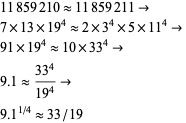
The curiosity
 |
(3)
|
involves the largest consecutive 19-smooth numbers, 11859210 and 11859211.
REFERENCES:
Berndt, B. C. Ramanujan's Notebooks, Part IV. New York: Springer-Verlag, 1994.
Blecksmith, R.; McCallum, M.; and Selfridge, J. L. "3-Smooth Representations of Integers." Amer. Math. Monthly 105, 529-543, 1998.
Canfield, E. R.; Erdős, P.; and Pomerance, C. "On a Problem of Oppenheim Concerning 'Factorisation Numerorum.' " J. Number Th. 17, 1-28, 1983.
Mintz, D. J. "2, 3 Sequence as a Binary Mixture." Fib. Quart. 19, 351-360, 1981.
Pomerance, C. "On the Role of Smooth Numbers in Number Theoretic Algorithms." In Proc. Internat. Congr. Math., Zürich, Switzerland, 1994, Vol. 1 (Ed. S. D. Chatterji). Basel: Birkhäuser, pp. 411-422, 1995.
Pomerance, C. "A Tale of Two Sieves." Not. Amer. Math. Soc. 43, 1473-1485, 1996.
Ramanujan, S. Collected Papers of Srinivasa Ramanujan (Ed. G. H. Hardy, P. V. S. Aiyar, and B. M. Wilson). Providence, RI: Amer. Math. Soc., p. xxiv, 2000.
Sloane, N. J. A. Sequences A000079/M1129, A002473/M0477, A003586, A051037, and A051038 in "The On-Line Encyclopedia of Integer Sequences."








