Storytelling into Understanding
THE STUDY
Eve’s Stories
Eve’s corpus contains 17 non-obligatory stories. The most obvious difference between her texts and Lizabeth’s is her use of modalized verbs and verbs signaling repeated events. Three of her accounts use past time, but two of these are broad-stroke descriptions of events which took place over a long stretch of time, and one is labeled by Eve herself as an “example” of what her students typically do. At no time does she tell stories floated for their entertainment value. At no time does she describe a single event. She generalizes and extrapolates and defines.
While Eve’s earliest stories in sessions one and two are what I am terming Synopses of What Usually Happens, the stories she tells somewhat later, beginning with session three, are Synopses (Plum, 1988) marked by modalized verbs. They are descriptions of projected strategies she is thinking of using with her students to train them in FMC.
They are What We Could Do stories. Both Synopsis types differ from Anecdotes because they are depictions of recurring phenomena and tend to pose and illustrate problems. Story 2—about What Usually Happens—is told very early in the first Study Group session and suggests Eve belongs to an existing Discourse on the teaching of reading that includes an understanding of the differences between exposition and narration and of the comparative difficulties for the inexperienced reader of processing these two broad text types.
Story 2
How do you get students to get involved with the reading? For social studies it’s very factual and all of that. And for literature they can kind of get into the story it’s about. And we have to read it [passages in social studies textbooks], like, four different times before it clicks for them. If I don’t give them all the vocabulary and all the questions before we even start they won’t be able to answer any of it by the time we’re done reading. And I’ll even stop and just kind of check to see if [inaudible], and they just don’t, because it’s harder for them to connect it to themselves or their experiences because it really has nothing to do with their life.
There are 15 verb phrases in this passage. All verbs are either in the present or in an informal use of the future used to describe a repeated event (e.g., “I’ll even stop”). Eve’s interest in this story is the achievement of a summary statement on middle school students’ difficulties with the kind of expository writing typical of social studies textbooks. Her students are the chief participants, but she herself has an important secondary role. She is constructed, this early, as a Principal-2, a teacher engaged in evaluating and improving her students’ academic skills. Interestingly, this Principal is also someone whose existing Discourse on TEACHING READING contains an important element of TEACHING FMC: she already practices during-reading comprehension checks with her students.
Study Group discussion of the technical distinction between Known and New information did not begin until approximately 20 minutes into session three. Before the researcher had finished presenting an illustration of the concept, Eve had already decided that the activity was something “really cool” to use with her students. Story 3 illustrates her understanding and is her first story with a significant What We Could Do element in the form of the modal verb in the first line.
Story 3
This would be really cool. Because they do have trouble with this kind of thing—like, they read a sentence, and then they read the next sentence, and they don’t really know how to connect the information from the second sentence to help them with the first.
Eve has understood not only that Known and New are linked in a system of unfolding contrasts but that the inability to identify the semantic relationships between Known and New propositions is a significant problem among her own students. She has integrated TEACHING FMC with TEACHING READING by mapping certain essentials of FMC onto her existing conception of her students’ reading difficulties. Another feature of Story 3 is Eve’s recognition of a strategy she feels could be effectively used in her classroom. She is already making plans. The description of strategies to be used in the future becomes a developing theme in her stories. Only a few minutes later, as illustrated by Story 4, she has already decided on the parameters of a specific activity.
Story 4
Yeah. That’s something they really need to work...that would help these kids so much. Just read one paragraph, and then just do that. And then once they underline each circle, they try to make a chain or a web. Not really a web, a chain.
The newer Discourse is further elaborated here through the addition of her own terminology—chain, web—to describe the patterning of a specific field model. In this story, Eve is both a Principal-2 evaluating her students and a Principal-3 who talks about possibilities and is therefore a Teacher-as-Projected-Evaluator/Guide.
Story 5 is an extended text which unfolded across multiple turns and involved an intricate interchange of ideas with the researcher during session four. Between Story 5 and this point in time, the Study Group has worked together on constructing Field Models of three paragraphs from a variety of publications, tried their hand at writing training paragraphs, and spent considerable time on understanding a schematic of FMC (Figure 1).
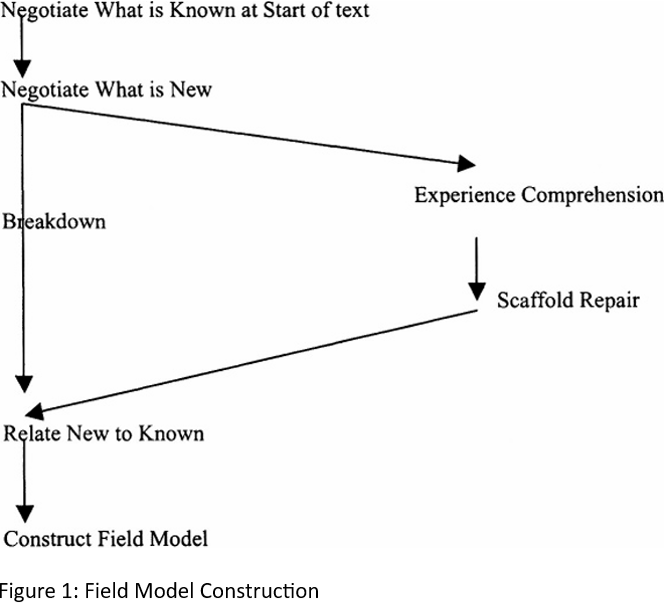
Story 5 is told by a Principal-3. It is introduced by the evaluative, speculative modals would and could as well as the if-clause of the first line, and constitutes a long examination of possible strategies and the kind of Field Model that might result from work with a the following training paragraph which Eve had adapted from a social studies textbook:
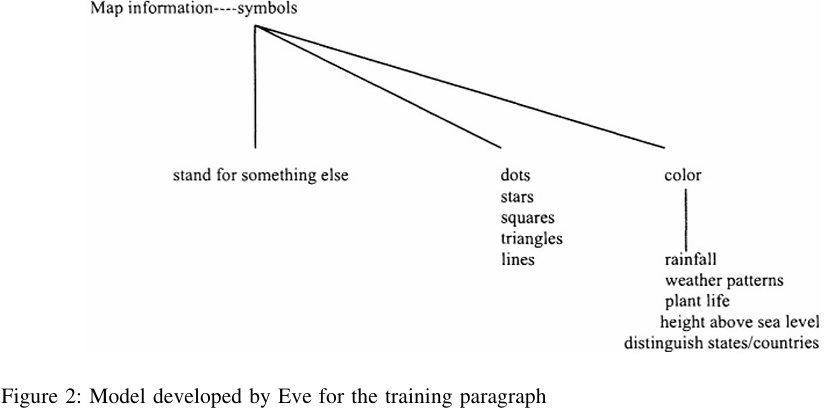
Information on maps can be shown by symbols. A symbol is anything that stands for something else. Common map symbols are dots, stars, squares, triangles, and lines. Color is a special symbol on maps. It is often used to stand for rainfall, weather patterns, plant life, and height above sea level. Colors are often used to distinguish states or countries from one another. (Adapted from Banks et al., 1998: 11.)
Eve (“E”) and the researcher (“R”) are working together to put together the Field Model of the paragraph, which the researcher is drawing on a large sheet of newsprint (Figure 2) taped to the wall. (Interrupted turns in Story 6 are indicated by the absence of punctuation at their termination.)
Story 5
E: So if [you] had the students decipher that, they would...could they do it? Because when I was writing it I was thinking more of the underlining, circling . . . underlining what’s not Known and then circling what is. . . . Oh, OK, so that would be the Known.
R: Right.
E: and then the New would be “stands for something else.”
R: That’s right. Exactly.
E: And that would go under “the symbol.” That defines it.
R: Right.
E: And then you’d go to “map symbols” ... or that’s still New?
R: That’s still
E: I mean Known.
R: That’s still Known. The idea
E: And then the dots and the stars and the types
R: Yeah.
E: of symbols would be the New information.
R: Right. Because you’ve already mentioned maps before.
E: Yeah.
R: You haven’t said “map symbols” exactly, but you said the whole thing in the first sentence.
E: So when we explain this whole format to the kids, we have to explain to them that Known means words that have already been mentioned
R: Yeah.
E: not necessarily words they know what they are [i.e., not necessarily familiar lexicon] at that point.
R: Yeah, at that point.
E: So the Known is just what’s already been stated.
R: Right.
E: New is new information.
R: Right. Now you’re also going to have to be dealing with the issue of their not knowing vocabulary.
E: Yeah.
R: And not having the background information that they need. OK?
E: But that part doesn’t really matter necessarily, when they’re sketching out their thing because
R: I think it does because that is the second aspect of this that you need to apply as they’re working on a field model, which is issues that may confront them, especially second language learners. So you may even be dealing with defining the word symbol when you talk about the first sentence.
E: Say that one more time.
R: You may even have to define words as you go that are defined later by the text of the paragraph.
E: Right. That’s what I meant by it wouldn’t necessarily matter at that particular moment, when they’re saying this is Known information, even though they still don’t necessarily know what it means. Because later they will know what it means.
R: That’s right. And if it’s something . . . I think that’s a good point because...I think that if it’s something that is not explained in the paragraph—you’re going to know whether or not it is—then you need to deal with it as a background information issue and probably as a vocabulary issue.
E: Mm-hmm.
R: That’s right.
E: OK, I think I’ll be able to do this with the kids.
Eve’s comfort with the terminology of Teaching FMC is so well developed by this point that she is able to seek refinements in her understanding and even problematizes the issue of New information versus new vocabulary. The concluding assertion that she will be able to use FMC effectively in her classroom signifies that her identification with Teaching FMC is well on its way to completion.
Story 6, told somewhat later in session four, also uses the present tense and conditional clauses to position the Principal-3 and other participants as people involved in a generalized, projected process.
Story 6
Also, when you do this type of Known...I mean, Unknown-Known, where they actually have to read the sentence prior to the next sentence, that...I think that helps them, whereas a lot of times if the teachers just say, “OK, what does blah-blah-blah mean?” they go, “I don’t know.” So [the teachers then say], “Go back into the paragraph.” That’s not enough. That’s not guiding them enough. If you say, “Well, read the sentence before this one, what in this sentence gives you a clue about this sentence,” they kind of have to . . . with this kind of model we’re doing now, they really have to use the sentence before to go with the next sentence instead of just saying, “Go back into the paragraph,” or “Go back to sentence three, it’s in the third sentence, what don’t you get?” Because that’s a tendency to just focus on the sentence that that information is in, or the whole paragraph. But what I think what really helps is that the sentence right before really does give you a lot of information to figure out the next sentence. Because I’ve never taught that way, to actually look at using the sentence before as Known or New and then go to the next sentence to find out what’s Known from before. I don’t know. I think you definitely have to do the New-Known first before doing the field model. Like, if they just read the paragraph and then just tried to do a field model, they might....I’ll try that next week just to see.
What is particularly striking about this narrative is its detailed juxtaposition of TEACHING READING and TEACHING FMC: what teachers traditionally do to assist students with reading comprehension versus what FMC requires teachers and consequently their students to do. The story also takes a distinctly theoretical perspective by labeling FMC a “model,” a term the researcher had not yet used. Eve’s Discourse on TEACHING FMC is one in which she sees that a technique is in fact a principle which carries value because of its match with the real-world needs of her students and what she knows about the structural patterning of expository text.
During the remainder of the study Eve carried this perspective forward without once looking back, reviewing basic definitions with her students each time she had them work with FMC, gradually increasing the length and difficulty level of the numerous training paragraphs she was locating and developing, and engaging her students in Socratic dialogue about language and message at every turn. In all, with a class of sixth graders from predominantly Spanish-speaking backgrounds, she taught the technique ten times and exposed her students to the new approach over a period of a month. During interviews she provided richly-detailed accounts of her students’ improved attention and engagement with reading activities, as well as her own surprise and her pride in their accomplishment. The last training paragraph she used, a passage from a personalized account of the United States’ internment of Japanese-Americans during World War II, was the centerpiece for an astonishing display of her sixth graders’ progress. The text, which uses narrative as an expository technique, contains a number of subtleties of expression. It is by no means as transparent as the brief, single-topic, tightly organized paragraphs Eve had used previously with this group of students. As she showed it to me before class started, I commented that it might well be too difficult because of possible problems with identifying pronoun antecedents. I pointed out that at three points the text uses pronouns to effect implied shifts in participants in order to achieve movement of topic as well as a sense of the intimacy of the Japanese-American population. Eve had not realized how difficult the paragraph was but decided to use it anyway. She felt that at the very least it would spark some useful debate. She gave it to her class cold, via overhead and individual photocopies for each student. To our amazement, even shock, the class jumped into the difficult portions of the analysis without hesitation and promptly identified the correct sense of every single pronoun with virtually no guidance from Eve. The students essentially led the discussion themselves.








