Knowledge about Language and Testing
THE NON-USE OF KAL
Situational Constraints
KAL, some interviewees declare, is sometimes applied to testing in the lower grades during class sessions. However for end-of-term/year testing, they say it is impossible to engage the students in activities such as process writing, as there are time constraints. The examination has to fit into a certain time slot to accommodate all the subjects to be tested. In addition, one respondent wanted to know “where she would get the time to mark the finished product plus drafts?”
The six interviewees, who blamed their situations for the non-use of KAL said that they sometimes think about the fact that grammar tests should really be given in contexts and that oral testing should be done. They said however, that there are many constraints to achieving the ideal. For 14 of the30 respondents to the questionnaire, the use of KAL means the testing of oral skills. They say they know it is important but they do not see how they can do oral tests given the large classes, time limitations, exam requirements and the lack of resources. The following table gives the reasons identified by the teachers. Each respond gave multiple reasons, as depicted in table 2 below.
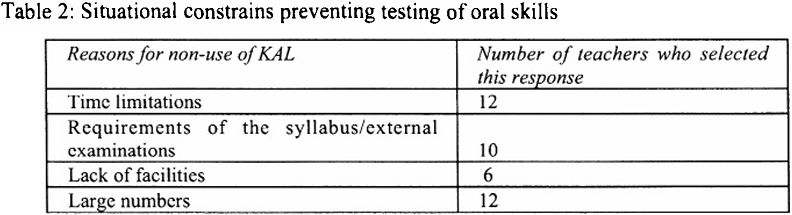
During the interviews, the teachers lamented the fact that their classes contain on average thirty- eight to forty - five students. With these numbers there is no way that they can test oral skills. Two teachers stated they do not think they could test the students’ oral skills since during classes “adequate practice could not be given”. The number of students in each class would also have an impact on the amount of time required to conduct the oral testing.
The respondents also complained that there are no facilities in place for the testing of oral skills. Some interviewees revealed the fact that the schools are not equipped with language labs in many instances. Where a room may be designated as a language lab, it is often used for foreign languages. In addition it is often reserved for the use of the upper school students who will be sitting foreign language exams. Even in this situation the equipment is limited. One teacher declared: “nobody can expect me to carry water in a basket”. Some teachers say they do not even have tape recorders.
Six of the twelve teachers interviewed said they knew that it is much better to test structural competence within contexts. However, there are difficulties that hinder this contextualization from happening. These mitigating factors range from the process of test construction to the marking exercise. The reasons teachers gave were time limitations (6 teachers), exam requirements (4 teachers), and the group construction of the test (4 teachers). The end-of -term/year tests are constructed by all the teachers of a specific grade, meaning that there are between three to five persons working on a test, limiting the influence any individual teacher can have on the test.
As suggested above, time is another important factor for the teachers. It is often much easier to use sentences as it takes less time than trying to construct relevant paragraphs. The marking exercise would also be less time consuming. The teachers say that with the large numbers in their sometimes six to seven different classes, it is much easier just to mark sentences.
Another common consideration of the teachers is the fact that the Caribbean Examinations Council English examinations use this same structure. In the grammar and vocabulary sections of this examination, the students are given sentences to fill in appropriate words or to underline particular words and phrases. Therefore, the teachers they are preparing their students to master this examination.








