THE CHALLENGE OF THE NATIONAL LITERACY STRATEGY TO APPLIED LINGUISTS IN TEACHER EDUCATION
Two-thirds of primary trainees entering the one-year PGCE program have degrees in non-language disciplines so their explicit knowledge and understanding of grammar stems from limited experiences of grammar lessons at school. For many trainees, through no fault of their own, the NLS is their first formal encounter with a description of language. Teacher educators face a significant challenge because:
- they do not have time to offer a comprehensive course in contemporary English grammar but more detailed grammatical knowledge has been mandated;
- the PGCE program involves preparation to teach ten subjects for the primary curriculum in 38 weeks.
Nevertheless, from 1998, simultaneous with the NLS, a national teacher-training curriculum (Teacher Training Agency, DfEE/TTA, 1998a) was introduced, within which the testing of subject knowledge, including grammar, had much greater prominence than before. Until then, we had trained graduates as generalists in ten subjects (maths, science, humanities, art, etc.), primary pedagogy and professional issues. There had always been an English component but now trainees who failed to show adequate grammatical understanding through a literacy skills test (DfEE/TTA, 2001) could be denied qualified teacher status.
As a result, teacher educators are required to
- find out what trainees know about grammar (through individual audits mandated by the Teacher Training Agency and inspected by OFSTED, the body responsible for inspecting teacher education),
- increase trainees’ knowledge about syntax and morphology in very quick time,
- enable them to teach grammar successfully to support children’s writing.
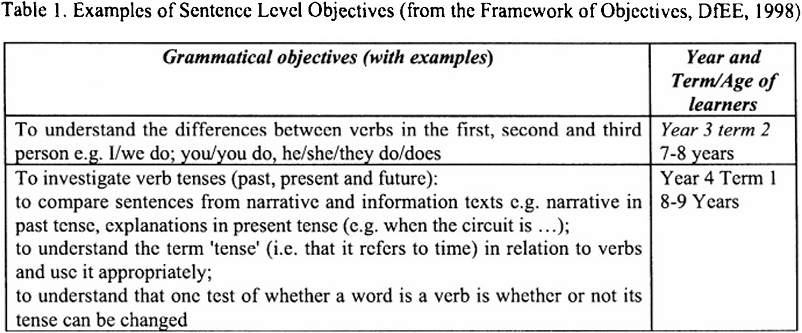
The NLS has given primary teachers a very detailed literacy program in the form of specific ‘termly’ objectives organized under three headings: text, sentence and word level. The sentence level objectives, the focus of our research, follow a traditional description, with a firm emphasis on the primacy of Standard English and are specified in linear fashion for particular age groups (table 1).
In recent decades, there has been much debate about what teachers should learn about language. Significant efforts were made to increase teachers’ knowledge about language based on the work of Halliday and others, culminating in Language in Use by Doughty et al. (1971). Later, Language in the National Curriculum, the LINC project (Carter, 1990) accompanied a major curriculum reform of 1988. The Kingman report (1988) had argued that learning about language had positive effects on children’s use of language and on their understanding of their cultural environment (Hawkins, 1994). Such arguments had contributed to the inclusion of knowledge about language in the English national curriculum that the LINC project supported with training materials and workshops for teachers. Unfortunately, the LINC project lost the support of the government because, it was claimed, it did not focus sufficiently on ‘instruction in Standard English’ (Mitchell, 1994: 101). By the mid-1990s, firm agreement on what teachers should know or teach about grammar had not been established, though it was implied (Rampton, 1995) that there was a consensus among applied linguists in favor of the LINC approach. Government did not share this view and arguments for a return to more formal grammar teaching came into fashion (Hudson, 2001).
Fears about the imposition of a back-to-basics language curriculum (Rampton, 1995) were realized with the NLS. Its description of grammar flies in the face of applied linguistics advice given since the 1970s Furthermore, the evidence in support of a detailed focus on grammar with young children is not convincing (Hudson, 2001; Wyse, 2001). While there have been attempts to introduce more teaching about language in English schools before, this has usually been argued for the middle years of education (10-14 years). Never before have such ambitious objectives been set at primary level. Teachers are expected to be able to explain sentence level grammatical terms (word classes, phrase, clause, sentence types, tenses etc) so that their pupils in turn can make active and meaningful use of them.
Now, there is ministry pressure to accept that teaching about language will lead to improvements in writing (DfEE, 2000: 7) and in children’s thinking. Beard (1999: 49) claims that there is “a growing feeling that grammar teaching has an unfulfilled potential” Although there is little to suggest that applied linguists were consulted about the grammatical content of the NLS. Wyse (2001), in a thorough review of the research associated with the NLS, concluded that the research does not show that knowledge of grammar leads to improvements in writing. While the NLS lists items of grammar for certain ages, as in Table 1, it gives no evidence that these are appropriate, useful or indeed ‘learnable’ at those ages. In addition, the linguistic specification is flawed. Sealey argued that its: “underlying conceptions of language are not consistent with an evidence-based description of the language” (1999a: 15) unlike the LINC training materials.
She also expressed similar reservations about the mandatory teacher education curriculum (Sealey, 1999b), another case of policy not drawing on evidence from applied linguistics. Cajkler (1999) observed that teachers often encounter incomprehensible advice about English in the NLS e.g. sometimes there are three tenses, sometimes two and in one place four (DfEE, 1998: 90).
Whatever the outcome of current debates about the value of grammar, trainees have a ‘grammar mountain’ to climb. Before 2001, when we began the research, we offered differentiated ‘language’ workshops followed by group and individual support sessions, focusing on subject knowledge and how to explain grammar. Subject content included a self-access language study guide, two lectures on the structure of language and two on language in social context (an overloaded curriculum permitted no more input).
This provision had undergone ongoing refinement and was informed by research conducted on 502 trainees between 1997-2001 through audits (short tests of linguistic knowledge), questionnaires and interviews (Cajkler and Hislam, 2002). This confirmed that most trainees came to the course with significant grammatical awareness but this was nevertheless the subject of uncertainty and occasional misconception. Trainees reported dependence on school experience of learning that ‘a verb is a doing word’, that ‘an adjective is a describing word’ leading to explanations of the type ‘jump is a verb because it is a doing word’. They had had little experience of explicit grammar teaching nor any significant experience of discussing language in ways described in the NLS. These findings reflected other similar studies (Myhill, 2000, Williamson and Hardman, 1995). Our provision sought to address these misconceptions and in exit audits in 2000 and 2001 there were higher scores in activities that required the naming of parts and classification of sentence types. So, we could argue that grammatical knowledge improved during the PGCE year, and indeed no one failed the mandatory literacy test introduced in 2001. This showed, at least for the assessment of subject knowledge, that we addressed trainees’ needs. But, to what extent and how were trainees actively teaching grammar in support of the NLS objectives?








