Realization(s): Systemic-Functional Linguistics and the Language Classroom
DISCUSSION
What is observable from the extracts is the highly emergent and shifting nature of the KAL that is beginning to reshape Sandra and Bobbi’s practices in grammar teaching. It is a KAL that is in flux. At the same time, the observable changes clearly interact in complex ways with other factors mediating their thinking. Gaining greater appreciation of the interactions required us to acknowledge that to develop an understanding of the teachers’ KAL, it is not enough to consider grammatical practices in isolation. Nor is it sufficient or accurate to isolate personal and contextual factors and make claims for a linear, causal relationship between such factors and teacher practice. There is a dialectic relationship between action and environment, in particular between classroom action and teachers’ KAL
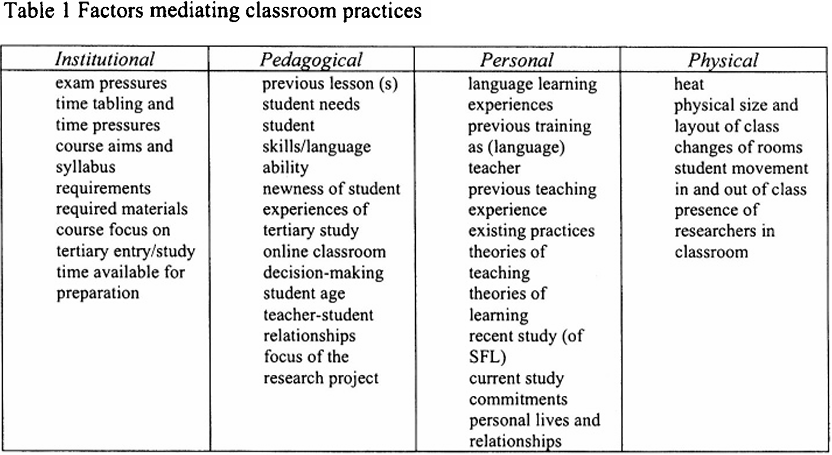
In our data no one factor (or group of factors) stood out as the most dominant or noteworthy in relation to the teachers’ approaches to teaching grammar. It was the enormous variety of factors, and in particular their complex interactions, which was striking (cf. Burns, 1996). Although not all of these factors have been identified and discussed, the items listed in Table 1 are indicative of those mediating particular instances of classroom practice.
While categorizing these factors may be a valuable heuristic for explaining the data, it should not under-represent the interrelationships. Course aims and syllabus, for example, is also clearly related to online classroom decision-making, to teachers’ language learning experience, and to aspects of the physical context (e.g. what effect does the searing heat have on students’ participation in group activities?).
KAL cannot then be seen as static or decontextualized. It is realized only in its application; the relation between knowledge and action is intrinsic. From this perspective, teachers’ classroom decision making is a perpetual and dynamic process, constantly interacting with a vast array of immediate and distant factors (spatial, temporal, and conceptual) at a level of complexity which defies neat description (see Woods, 1996). What we observed suggests that the relationship between a teacher’s KAL on one hand, and classroom action and decision-making on the other, is dialectic and dynamic, and that negotiating the ‘coral gardens of the classroom’ is one of many important factors influencing, in an ongoing fashion, teachers’ KAL and approaches to teaching it (cf. Breen, 2001).
In a context as complex as a language classroom, a significant change in one piece of the puzzle can alter the entire picture. Initially, we found that the teachers were maintaining a stable and effective classroom, in part, by continuing with grammar teaching practices familiar to them, based largely on the concepts of language with which they had experienced throughout most of their language learning and teaching (cf. Breen et al., 2001:472).
By entering their classrooms as researchers and former teachers, and by providing a clear and present - even pressing - reason for change, we were catalysts for destabilization of the teachers’ practice. The nature of the changes which took place was mediated by a wide range of factors as indicated above. In effect, Sandra and Bobbi were ‘forced’ to engage with the knowledge about language which they had learned in our course. In doing so, in articulating their understandings and exploring applications, this knowledge became active and relevant to their practice as 1anguage teachers. In turn, their teaching practice informed, developed, and added to their knowledge about language.
For the professional development of teachers, participating in such research as reported here allows and requires them to reflect critically on their own practice, revealing to them aspects of their own practice and philosophy that they may not have considered before (cf. Burns, 1996). In terms of the professional development of teacher educators, understanding that decision-making and knowledge about language is dynamic and context-dependent has important implications not only for what we teach, but for how it is taught.








