Integrating Language Teachers’ Discipline Knowledge in a Language Course
INSTRUCTOR PROFILES
Second Profile: Lisa
Cognitive and Interactional Processes Used in the Development of the Lesson
The extract below, which focuses on one of the items in the error-correction exercise, corresponds to a typical episode in the development of the class activity. This episode illustrates how the different cognitive and interactional processes are deployed and, thus, how user and analyst types of competence are interrelated through Lisa (the instructor) and her students’ discourse.
Class 3 – Lisa
T: ‘it was a such big breakfast that nobody could finish it’ |
S: ‘such a’
T: ‘such a’ | yeah? ‘it was such a big breakfast | that nobody could finish it’ | right ? ‘it was such a big breakfast that nobody could finish it’ | right? could someone rephrase this sentence | using ‘so’ instead of ‘such’? <4> say the same thing | but instead of ‘such’ || use | ‘so’ | <3> honestly | you’ll have to change several things | xxxxx | xxxxx <6> anyone got it?
S: ‘it was so big that’_
T: ‘the breakfast was so big’ | all right? ‘that nobody could finish it’ | yeah? [writing on the blackboard] so we have | ‘it was | such a good || breakfast <3> that | etcetera’ | and then we have | ‘the breakfast <5> was | so || big | that | etcetera’ | right? we have ‘such’ <4> before the noun || and we have ‘so’ || before the adjective | all right? ‘such’ plus noun | ‘so’ plus adjective | this is_ this is the general rule although there are other cases | yeah? take into consideration | the main word here is the noun | what we have in front of the noun is an a_ an adjective and a determiner which is premo_ or which are premodifying the noun | mm? what we have right after ‘so’ is the adjective | right? in this case we have ‘breakfast’ | all right? we could have other things | yeah? we could have uncountable nouns | such as | ‘it was such good weather’ | yeah? in this case | | [writing on the blackboard] you would say | ‘such | good | weather’ | yeah? xxx | so xx | right? we could have a plural noun | such as <3> I don’t know | [writing on the blackboard] ‘he was such good | people’_ | all right? ‘that_ etcetera’ | yeah? and this x the noun xx | in this case the noun is singular | and countable | right? ‘it was such a good book | that I couldn’t stop reading it’ | mm? and here we have noun | singular | countable | but in all cases || what we have ‘is | such’ plus noun | ‘such’ plus noun | ‘such’ plus noun | and we have different types of nouns | right? instead of ‘a’ | we can have ‘an’ | [writing on the blackboard] such as | ‘it was such an | interesting’ <2> right? (...)
Like Monica, Lisa follows a recurring pattern of cognitive processes for each item. This pattern involves a brief first stage at the user level and a clearly more extensive second stage at the analyst level. From the limited participation of the students, almost exclusively in the first part, we can deduce that we are again in front of a teacher-centered approach, more oriented towards declarative rather than procedural knowledge. Given the nature of the activity, an error-correction exercise, the most common process is identifying errors. The pattern of cognitive processes that characterizes Lisa’s lesson is described in table 2.
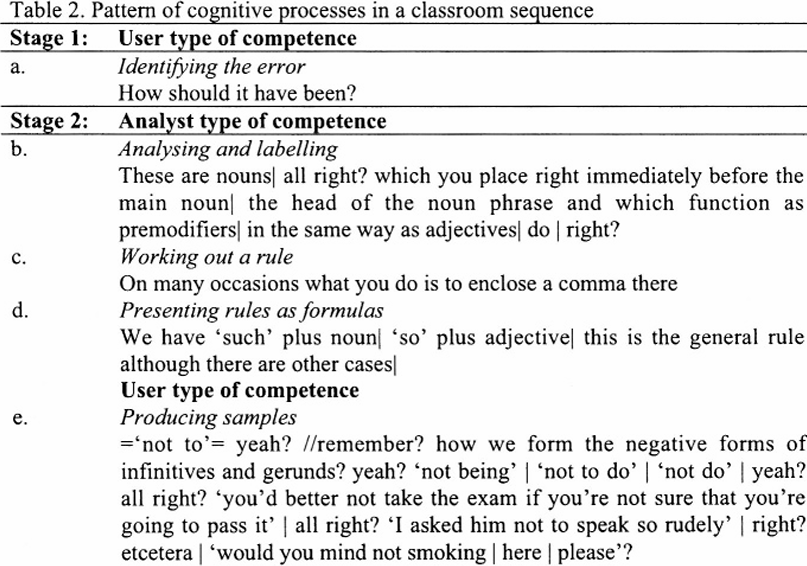
The interactional structure of the lesson is influenced by the task that is carried out, an exercise in which students have to correct a series of sentences. The instructor initiates each episode by asking students to identify and correct the error. When students provide a corrected version of the sentence, the instructor moves on to an inform move in which she analyses the language sample. Then, after a sequence of inform moves dominated by cognitive processes related to the analyst type of competence, the instructor elicits students to produce further samples of the structure described.
A distinctive feature of Lisa’s discourse is the regularity and relevance of episodes in which she introduces processes related to the analyst type of competence (b, c, d) in between processes related to the user type (a, e). Instructor and students solve the task at the user level (i.e. correcting the error) and then the instructor provides an explanation of the grammar topic illustrated by the error in question (e.g. order of adjectives, position of adverbs, etc.). This explanation is always accompanied with samples which are often directly supplied by the instructor, although sometimes she elicits them from the students. In her explanation of the grammar topic, the instructor goes beyond the particular instance and attempts to systematize the knowledge involved in each language point. The pattern seems to be based on an inductive-deductive approach starting with language use, continuing with language analysis, and followed by the application of rules to further language samples. Thus, there is a dominance of cognitive processes related to the analyst type of competence. However, these processes are always ‘anchored’ to the user type; the instructor uses each language point illustrated by the task as a springboard to analyze it systematically as a separate independent topic.
In the development of the class activity, Lisa adopts an inductive approach whereby students are first confronted with usage problems and from there she introduces the declarative knowledge she is interested in. Looking at the amount of talk-time by the instructor which is devoted to cognitive processes related to language analysis, we can say that the emphasis of the lesson is clearly in favor of declarative knowledge, appealing mainly to the analyst type of competence.
Lisa’s emphasis on the analyst type of competence is manifested not only through the number of processes related to it that she uses throughout the lesson, but also through the greater presence in range and number of specialized metalinguistic items (e.g. ‘noun’: 63, ‘verb’: 62, ‘adjective’: 53, ‘number’: 46, ‘sentence’: 43, ‘adverb’: 36, ‘object’: 30, ‘order’: 29, ‘adverbial’: 21), as compared with Monica.








