The Impact on Teachers of Language Variation as a Course Component
RESULTS
Further Views of Sociolinguistics
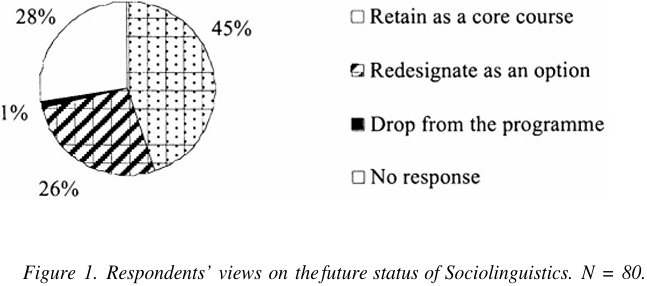
To further test opinion of Sociolinguistics, our first query in Section C of the questionnaire in “Questionnaire Design” asked whether this topic should be retained as a compulsory course, redesignated as an option or dropped from the program. Figure 1 shows the results:
A range of reasons was given to explain these positive views:
I think that I found sociolinguistics as the part of the program that gave me the clearest paradigm shift of the whole program. It let me see how it infiltrates ALL aspects of TEFL. I also feel that sticking it at the end of the course makes it like an appendix and very unlikely for people to choose as a dissertation topic. It should be placed near the beginning of the course (presumably easier said than done) to give people an insight into the social PRINCIPLES of TEFL...
I think it is compulsory that EFL teachers, being in the forefront where different cultures meet, learn the importance of interaction between society and language.
It was useful in that it made me better able to see language teaching and learning as part of a larger sociological framework and not just as an activity in a classroom.
We see here a cluster of ‘converts’ who are in no way uncertain about their commitment to the topic. There were many others who wrote along similar lines, not surprisingly the same ones who indicated that sociolinguistics should remain as a compulsory, core subject. On the other hand, a second cluster is ambivalent:
Sociolinguistics is not directly related to TEFL for all teachers in all teaching situations.
It wasn’t essential for my interests or purposes and I would have gained much more and invested greater effort in a course like ESP or Psycholinguistics because I have a much greater interest in these fields.
I find it very interesting, but it is quite theoretical, and perhaps not as necessary for improving one’s teaching per se.
These comments were all contributed by people who would redesignate sociolinguistics as an option, and are typical of the responses from this group, many of whom did seem to see TEFL ‘just as an activity in a classroom’.
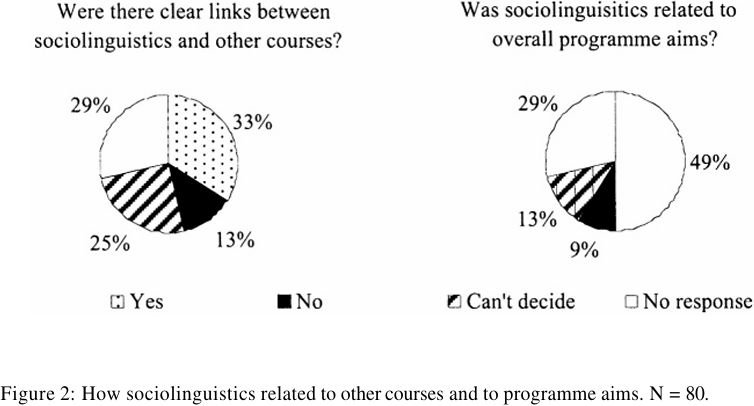
This phenomenon of a divided camp is interesting. The comments from the more strongly pro-sociolinguistics sector suggest a more subtle and sophisticated understanding of the subject and its ramifications has been gained, while the less enthusiastic group focus almost exclusively on its direct and obvious (lack of) applicability, which could be a result of poor presentation of application in our course. Alternatively, it could simply reflect different perceptions of what the purpose of an MA TEFL program should be: academic and mind-broadening, or mainly functional and of direct practical application. Responses to the next two questions throw further light on this issue.
A clear pattern emerges between those who would retain sociolinguistics as a compulsory course and those who agreed it was linked to other courses and also to the overall aims of the program.
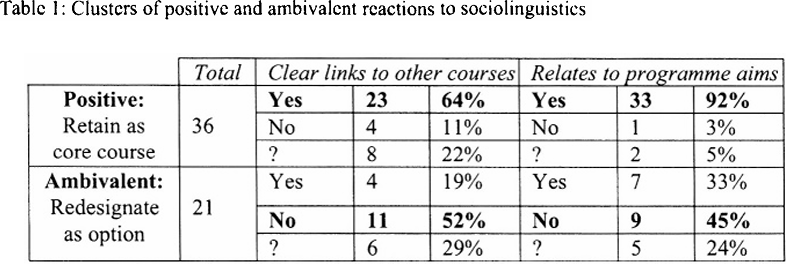
Those who were ambivalent about the status of sociolinguistics, and would redesignate it as an option, were far less likely to perceive links to other courses on the program (19% compared with 64% for strong supporters) or to see a relationship with overall program aims (33% compared with 92%). This adds weight to the earlier suggestion that those who are seeking mainly practical outcomes will not see any relationship between sociolinguistics, including language variation topics, and more obviously practical courses, such as the universally popular language teaching methodology. Nor will they perceive links with program aims that they believe to be practical in nature, regardless of the published aims, which are much wider ranging, and include:
to enable participants to make principled decisions on classroom methodology based on an understanding of research into second language acquisition, an understanding of recent approaches to language teaching, and an awareness of the dynamics of language use (italics added)
to provide an understanding of the wider context of language learning as part of an educational, social and political system (italics added)
We next asked whether respondents had written their module assignment on sociolinguistics or opted for another topic. Of the ‘ambiguous’ group, only 6 (29%) reported having chosen sociolinguistics for their assignment, compared with 25 people (69%) from the supporters’ group. Again, this reinforces the idea that there is one group who engaged fully with the course content and felt it worthy of the effort of writing a 4,000 word assignment and another smaller, but still substantial group, who were less convinced of its worth.








