Using Bulgarian Mini-Lessons in an SLA Course to Improve the KAL of American ESL Teachers
RESULTS
The questionnaires, which were answered by subjects at the beginning of the semester tried to examine the pre-existing knowledge about language and language learning. The results from the surveys revealed that trainees enter the program with certain beliefs and attitudes towards SLA, which appear to be based on their current state of knowledge about SLA and their teaching experience. Every student in the class filled out the questionnaire. Eighty percent of the students in the 2001 class answered all twenty questions. One student (pre-service teacher, non-native speaker) did not answer the question on inductive/deductive methods of teaching probably because she was not familiar with these terms. Two other pre-service teachers, monolingual, native speakers of English, did not answer questions 1, 2, 3, and 5 given in Appendix A. While one of these questions asks about a specific concept in language teaching, the other three deal with one’s experience in teaching and learning a language. It is not surprising then that the pre-service teachers were not sure how to answer the questions.
While in the class of 2002 the questions were answered in full by all participants, it must be noted that 27 percent of the answers fell under the category “never heard of this concept”, 43 percent belonged to the second column, “sounds familiar but I cannot explain it or use it in my ESL classroom”, and only 30 percent of the concepts were familiar to the students.
There is a difference in the manner in which the two questionnaires are constructed. While the first one uses a Likert scale and probes for KAL through statements that include almost no technical terms, the second one asks about particular concepts in SLA through naming the concepts themselves. It is not surprising then that while every one of the students expressed an opinion in the first survey, the students who were given the second survey did not recognize or were not able to explain 70 percent of the concepts. One should be careful when using surveys since as the results in this study show, participants’ answers depend largely on the way questions are presented to them.
In answer to the first research question we may draw the conclusion that the TESOL students in this group (mostly teachers who had no training in SLA but had experience teaching ESL students) had some preconceived notions about how languages are learned. They were not clean slates on which the instructor could start writing. This made my job as an instructor even more difficult since it was obvious that if I wanted to engage these students in active learning I could not simply lecture on SLA. I had to constantly relate the theories we talked about to my students’ experience in teaching ESL. But there was one element still missing so that the teaching process could be successful. Seventy percent of my students were monolingual and had no experience in learning a second language. To make my teaching more effective I introduced the mini-lessons in Bulgarian as a kind of mediator between my students’ experience in ESL teaching and their intuitions about learning a foreign language.
The second research question of the study tried to investigate the role of the mini-lessons in language learning. Examination of the answers in the 2001 pre/post surveys using descriptive statistics might have given us some insights in this respect. However, as Kern (1995) explains, such results are rather misleading since “many of the individual shifts cancel one another out in the averaging process” (p. 78). For example, in response to item 1 in the first questionnaire, the number of people agreeing or disagreeing with the statement in the pre/post surveys is almost the same, yet 6 students, i.e. 38 percent of all students are either more or less convinced that students’ errors should be corrected on the spot. Qualitative data from the comments in the post surveys and the discussion transcripts, give us a much better idea about the role of the Bulgarian mini-lessons in changing one’s knowledge about SLA processes. For example, one of the lessons was used to demonstrate the behavioristic and humanistic approaches to language learning with an emphasis on error correction. The students were taught how to introduce themselves in Bulgarian. During the first part of the lesson I taught them a mini dialogue in Bulgarian and then asked each student to stand up and repeat the dialogue. Every time a student mispronounced a word, I corrected him/her and asked them to repeat the word as many times as needed until they had it right. During the second part of the lesson, the same dialogue was used to practice introductions in Bulgarian, but this time the students were sitting in their places and tossing a stuffed toy to each other while practicing how to ask and answer questions about one’s name. I did not correct their mistakes during that process. At the end of the activity I practiced the dialogue with several students and emphasized the correct pronunciation of each phrase. Here are some comments from the students’ reflections on this lesson:
This activity also showed how important it is to be sensitive when correcting students. Although the first method was really intimidating, I noticed that I was not always sure about pronunciation when the teacher did not correct us during the second activity. I believe that it is important to let students speak without constantly correcting them, but I think that they need to know that what they are saying can be understood and need some correction along with positive reinforcement. At the same time, there are students who may stop talking if they are corrected; a teacher must be sensitive to the needs of the individual student and work with those needs always in mind.
One of the recurring themes in the data analysis was the role of the mini-lessons in demonstrating the effect of different language learning styles and strategies in SLA. What really came as a pleasant surprise for me while reading the reflections was the fact that students seemed to be able to analyze not only the effect of the cognitive strategies they used in doing different language exercises in Bulgarian, but also transfer what they had learned to a situation in which their own students might be involved in the process of learning English. In the dialogue below two teacher trainees discuss their experience doing an exercise on Bulgarian pronouns:
A: Well I think doing this exercise in the target language lets us empathize how our students must feel. Because if I did it in English I wouldn’t be very frustrated but doing it in a different language I was enormously frustrated. I couldn’t, I didn’t know what I was doing. And even after I had done it I couldn’t say what I had done, so it helps me realize what it’s like when you don’t understand what’s going on. And I felt that the whole lime.
Every time we did a Bulgarian lesson I wanted to just slink down in my seat.
B: And that’s when I had fun.
A: And that’s when you liked it. And so that’s a thing as a teacher, too... to realize some people really love learning a new language and other people dread it and it’s traumatizing.
B: When they don’t like speaking and they get real nervous and they’re insecure and they don’t understand anything.
A: Or if it’s the wrong learning style. If you need it visual and auditory and you’re doing something that’s tactile.
One of the mini-lessons demonstrated inductive and deductive reasoning through teaching a lesson on Comparisons of Adjectives in Bulgarian. The first part of the lesson presented the rule and examples of it on the blackboard. Students were then asked to practice the structure. Inductive reasoning was demonstrated through examples of the grammatical category using students from the class and comparing their height, age, and hair color. Students were then asked to come up with the rule on their own. In their reflections most students commented that this mini lesson helped them to conceptualize the two modes of thinking. What was more important for me though, was the fact that they were able not only to learn and retain the concept better (in later discussions any time we talked about deductive/inductive reasoning, they would mention this lesson) but that they could envision using this knowledge in their own teaching. For example:
Deductive and inductive reasoning was effectively displayed through the Bulgarian mini-lessons. Clearly, what we know about the brain implies that inductive reasoning should generally be more effective. By using examples and discussing familiar concrete issues, students are allowed to connect new information to existing schema. By constructing one’s own rules, there seems to be a greater likelihood of retention and application.
Another concept that students seemed to have learned more easily through the mini-lessons was the concept of negative and positive transfer. There were several lessons that demonstrated this concept. In one of the lessons, after students learned the Bulgarian alphabet, they were asked to read words that were grouped according to the way the letters looked – same graphemes and sounds as the English ones; same graphemes but different sounds; completely different graphemes. For example:
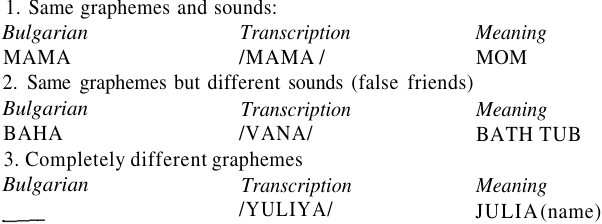
I was almost sure that, even though students were already familiar with the Bulgarian alphabet they would still experience transfer regardless of the fact that the words were grouped according to the three categories. This is exactly what happened:
Immediately, the letters that have the same shape and pronunciation as letters in English were very easy, because I could just transfer the sounds I already know. However, it was confusing to try to associate new sounds with letters that looked like English letters. I found myself using the English sound that corresponds to the shape. Learning to use these letters was even more difficult for me than using the letters that have completely unfamiliar shapes and sounds. I believe this was because I simply had to learn something new with those letters, rather than try to change a habitual concept in my mind.
One of the mini-lessons demonstrated inductive and deductive reasoning through a lesson on Comparisons of Adjectives. The first part of the lesson presented the rule and examples of it on the blackboard. Students were then asked to practice the structure. Inductive reasoning was demonstrated through examples of the grammatical category using students from the class and comparing their height, age, and hair color. Students were then asked to come up with the rule on their own. In their reflections most students commented that this mini lesson helped them to conceptualize the two modes of thinking. What was more important for me though, was the fact that they were able not only to learn and retain the concept better (in later discussions any time we talked about deductive/inductive reasoning, they would mention this lesson) but that they could envision using this knowledge in their own teaching. For example:
Deductive and inductive reasoning was effectively displayed through the Bulgarian mini-lessons. Clearly, what we know about the brain implies that inductive reasoning should generally be more effective. By using examples and discussing familiar concrete issues, students are allowed to connect new information to existing schema. By constructing one’s own rules, there seems to be a greater likelihood of retention and application.
Another concept that students seemed to have learned more easily through the mini-lessons was the concept of negative and positive transfer. There were several lessons that demonstrated this concept. In one of the lessons, after students learned the Bulgarian alphabet, they were asked to read words that were grouped according to the way the letters looked – same graphemes and sounds as the English ones; same graphemes but different sounds; completely different graphemes. For example:
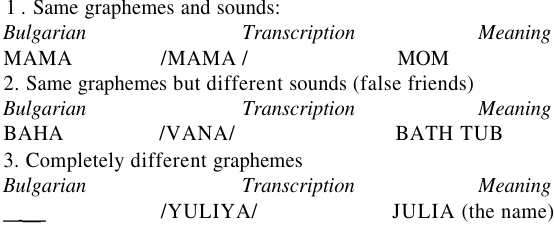
I was almost sure that, even though students were already familiar with the Bulgarian alphabet they would still experience transfer regardless of the fact that the words were grouped according to the three categories. This is exactly what happened:
Immediately, the letters that have the same shape and pronunciation as letters in English were very easy, because I could just transfer the sounds I already know. However, it was confusing to try to associate new sounds with letters that looked like English letters. I found myself using the English sound that corresponds to the shape. Learning to use these letters was even more difficult for me than using the letters that have completely unfamiliar shapes and sounds. I believe this was because I simply had to learn something new with those letters, rather than try to change a habitual concept in my mind.
Again, this lesson not only helped students in learning about transfer but also reminded them of the enormous effort ESL students have to put in learning a new alphabet and reading in English. Many students commented on the difficulty their Arabic or Chinese students might have in a similar situation since their alphabets are so different from the English alphabet. In her reflections on a similar lesson on Transfer and Controlled vs. Automatic processes, one of my students comments on the role of the lessons in elucidating metalinguistic terminology and her ability to use these terms to describe language acquisition processes:
The last Bulgarian lesson made me more aware of the systems at work when learning a new language as well as the terminology that coincides with those systems. I am now able to use my limited metalinguistic knowledge to put language acquisition into words. Initially, many in the class experienced negative transfer when they attempted to read the Bulgarian word using our knowledge of the English alphabet system. Yet, because similar symbols actually stand for different phonetic sounds, errors in pronunciation occurred. As the instructor began to use repetition as a teaching strategy, students were better able to identify new words without the interference of negative transfer. Repetition has made the sounds more automatic, somewhat moving the practice from a controlled process to an almost automatic process.
In another lesson we were discussing the different models of SLA. Students were having particular difficulty with McLaughlin’s (1983) and Bialystok’s (1978) models. Even though we had a presentation from three students on individual models, when I asked the students whether or not they could apply the models to situations related to their personal experience as either teachers or learners of language, they were not able to do so. Then I did a mini lesson in Bulgarian and tried to demonstrate how a controlled process becomes automatic through a simple exercise on pronunciation and reading using groups of words that had similar sounds. At first I asked them to read the name of my home town “____ “. Almost everyone pronounced it as /pais/ or /rais/ as a result of negative transfer. I gave them the right pronunciation / ruse/ but did not spend much time explaining or correcting them. My next step was to practice the reading of a group of words that all started with the letter “P” which in my native language represents the English sound /r/
Example: ____, ____, ____, ____, etc. These words are pronounced as /rak/, /rom/, /rod/, /rolo/.
Once the process of associating the letter P with the sound /r/ became automatic, I gave them a second group of words in which they had to learn to associate the letter Y with the /u/.
Example: ___, ___, ___, etc. These words are pronounced as /mus/, /bus/, tur/.
After this process had become automatic, I asked them to read the word P again. This time everybody pronounced it as /ruse/. This mini lesson led to an interesting discussion on controlled versus automatic processes not only in phonology but also in grammar and vocabulary learning. Students’ reflections on this lesson give us a better understanding of their experience:
In the exercise that we did in class last week when we first teamed to pronounce a set of words with the same beginning sound, PAK, POM, PACA, then another set with the same vowel, MYC, KYC, KYM, the students were learning a new skill, so the attention to the pronunciation was controlled. However, by the time we reached the end of each list of similar-sounding words, the attention of the students became more automatic. We got used to the new pronunciations and were able to transfer the pronunciations from one word to the next (provided that the words were fairly similar) with little difficulty. By the time we were asked to pronounce a word which combined elements of spelling from both lists that we had learned (PYCE), our attention was automatic and we pronounced it with no difficulty.
Another student analyzed her personal thoughts and feelings associated with learning Bulgarian up to this point with respect to the controlled and automatic processes involved. This quote seems to demonstrate the process of deconstructing one’s experience to make explicit the implicit knowledge and intuitions one has about language learning.
Our recent Bulgarian lesson illustrated the concepts of controlled and automatic processes in language learning. I realized this type of exercise was exactly what I needed to feel more comfortable reading and pronouncing some Bulgarian words! Up to this point, trying to pronounce a written Bulgarian word was completely overwhelming because of negative transfer from English pronunciation and unfamiliar letters. I now realize that this overwhelmed feeling comes from too many controlled processes required at one time. When we are unfamiliar with certain letter sounds, we have to actively think about each letter, look up the sound of the letter, and try to put the entire word together, focusing on each letter. Without any implicit knowledge of letter sounds and our limited focal capacity, there are inevitable errors and frustration in pronunciation.
After repeating several words in Bulgarian with a common letter or combination of letters, those specific pronunciations became automatic. This was an enormous help in pronouncing more complicated words using those letters. We had fewer letters to focus on, and could concentrate on the rest of the word. I am now convinced that this is a key to learning a language with a new alphabet and different letter pronunciations than that of the native language.
It must be noted that not every concept in SLA lends itself to explanation through these lessons. It is difficult to demonstrate such concepts as backsliding or the Critical Period Hypothesis through teaching a language to adults for a short period of time.
In addition to the data from the journals, analysis of the transcripts from the focus group discussion revealed two other important effects of the mini-lessons on student learning. First of all, these exercises provoked a lot of thinking and helped trainees to understand how their own ESL students felt. This is a common theme that emerged from the journal reflections as well. Almost every journal entry ended with comments on how ESL students must feel in a similar situation. The Bulgarian lessons were having an effect not only on the cognitive but also on the affective development of my students. For example:
It was confusing when the letters that looked like English had different sounds, not to mention the letters that looked totally different. It was overwhelming. I’m sure that is how my students feel. Sometimes it is just too much information and the students tend to shut down. We need to keep these factors in mind as teachers.... I wish this could be an experience for all classroom teachers so that they realize or are reminded of how difficult it can be for students!
Another recurring theme concerns the challenges of language learning that were revealed through doing exercises in Bulgarian. Trainees experienced first hand the effect of transfer, the role of translation in studying a language and often reflected on the positive and negative aspects of different formats of presenting language structures to students. For example, on one occasion students had to do an exercise on Pronouns that demonstrated the traditional method of grammar teaching and then change it using other techniques that they had already studied. The exercise required using the Nominative or Dative form of the Personal pronouns in a subject or object position in a sentence. In the discussion that followed students reflected on the experience:
I loved doing it. This is like a puzzle. This is fun. You know... I mean ...but then what you realize too, is that you really don’t need to know anything when you’re doing a foreign language. If you know the basic rules. You memorize the table. Just plug it in, you can do it. And then eventually you’ll get it. Which isn’t really good, but sometimes if you get really confused, you just go, beginning of the sentence, is subject. Don’t worry about it. And it’s not good because you don’t remember it and it really, it’s not like you know it.
Through this experience the teachers were able to see what role the knowledge of grammar rules plays in learning a language. One’s knowledge of phrase structure rules can help but also hinder one’s language learning. Students were able to do the exercise correctly without knowing the meanings of any of the words in the sentences. This often happens in a language classroom where ESL students are able to complete their worksheets or even answer questions after reading a text in which they have unknown words. This is especially true of students with extensive knowledge of grammar whose communicative competence, however, is very low. Here is how one of the trainees commented on the usefulness of this type of exercises:
Also for me... I could put the right word in the space but I still don’t know what the sentences say at all. Really… it… since they’re in Bulgarian it made me realize that this is kind of a meaningless exercise since it’s not going to help me communicate.
In order to make this activity useful for their ESL students, trainees suggested using TPR, role play, visual clues, pictures and realia, and described in details the way they will teach this grammatical structure to their students so that they can use it to communicate in different situations. The exercise also provoked a lively discussion on the role of deductive and inductive teaching in grammar presentations.
The third research question asked whether or not these lessons helped in bridging the gap between theory and practice. The data from the discussions and reflections indicate that students were able to better internalize the concepts that I illustrated through the Bulgarian lessons. In their journals trainees often wrote about their ideas for teaching ESL in light of the knowledge they had gained through a particular lesson. In the following quote a student reflects on the use of the exercise with similar sounds described above for his future work with ESL students:
This exercise illustrated the importance of automatic and controlled processes. I now believe that beginning language instruction should focus on transferring simple processes, such as letter pronunciation, from controlled to automatic. As the pronunciation of more and more sounds becomes automatic, rather than a controlled process, a language student will become more comfortable pronouncing words in their target language. This tactic can probably be used with some grammar rules, sentence structures, and simple phrases, as well. By going through this exercise ourselves in Bulgarian, the result was vivid and obvious to me.
Finally, even though most of the time students were excited to participate in these activities, in our final discussion they made several recommendations for improving them. Some students preferred to have the lessons at the beginning of the class rather than at the end, since as one of them said, “I always felt the anxiety mounting”. As with any FL classroom, there were students who feared this experience and others who had fun with it. Students also suggested that starting with the lesson would have helped them understand the concepts better as they would have been able to relate the demonstration to what they have already read. Another idea was that students should define their learning style through some instrument at the beginning of the course so that later I could accommodate the different styles through different activities in the mini-lessons. Overall even the students who initially did not like the idea of “studying” Bulgarian were happy to have participated in it in the end.
The thought of learning a new language is exciting and overwhelming. As we began the “sounds” of the Bulgarian language I became flooded with negative thoughts. Visions of high school French and Spanish classes became alive. I quickly became lost and overwhelmed, feeling I wasn’t keeping up.
I have learned, through this experience, how a foreign student may feel in an English speaking class. What an eye-opener! As I began practicum, and work with ESL students, this exercise will prepare me – get me in the mind set of the students.








