PREPOSITIONS AND THE PREPOSITIONAL PHRASE (PP)
INTERNAL STRUCTURE OF THE PREPOSITIONAL PHRASE (PP)
A notable feature of the English language is the extremely wide use it makes of prepositions; and where there is a preposition there is a PP, since prepositions cannot normally stand alone, although they can be separated from their complement by ‘stranding’.
The structure of the prepositional phrase is different from that of groups. While nouns, adjectives and adverbs each function as head of their respective group and can be used alone, a preposition cannot normally occur without a nominal unit, and a nominal unit is not part of a PP if there is no preposition. Both are equally necessary to form the phrase. For this reason we refer to such a unit as a prepositional phrase.
The internal structure of a PP consists of a preposition and its complement, both of which are obligatory, and an optional modifier. It can be represented as follows:
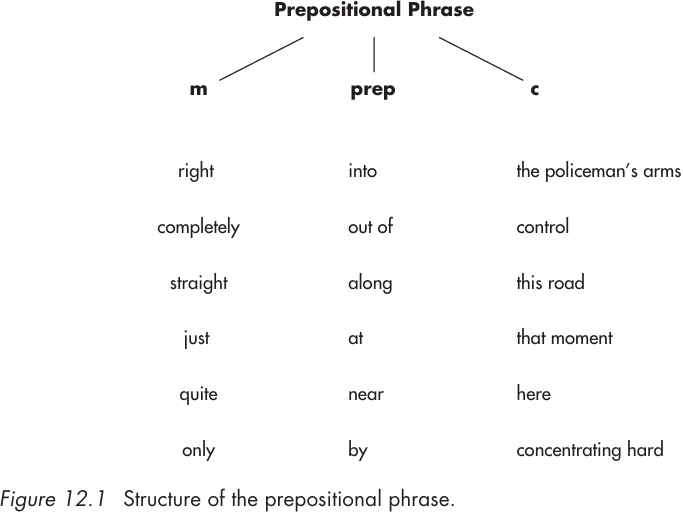
Not all PPs contain a modifier but all of them contain a preposition and a complement. The modifier typically intensifies the preposition by adding something specific to its meaning, such as exactness in the case of straight (straight along this road) or exclusiveness with only (only by concentrating hard).
Here is a recorded conversation between three students and a teacher (T), which illustrates the abundant use of prepositional phrases in English:
T: What’s this about?1
B: Oh, animals.
T: Oh, yes. People are obsessed in this country2 with being kind3 to animals,4 aren’t they?
A: Alison and her cat . . .!
B: Don’t talk to us5 about Alison’s cat!6
C: That cat is definitely not popular in our house!7
B: That cat moults constantly all over our carpet and sofa!8
T: But is it true, though? See what I mean? She hates cats! A: Just for that silly reason?9
T: No, but there seem to be more cases of animal cruelty10 going on here than anywhere else.11
A: Yeah. I get the impression from the little I know12 they’re just as crazy about dogs13 in Belgium and Holland and France and Italy14 as they are over here.15
T: Is it just one of those myths that we perpetuate regarding the British character?16 Is it true?
A: I think it probably is a myth.
(recorded conversation)








