OVERVIEW: THE STRUCTURE OF THE NOMINAL GROUP
The full nominal group structure has four primary elements: the head, which is the central element, the determiner and the pre-modifier in the pre-head position, and the post-modifier in post-head position. Of all these elements, the head together with the determiner, when present, may realize the NG itself : air, the air. Syn tactically, pre- and post-modifiers are usually not essential; for instance, one morning, the moon are both complete nominal groups.
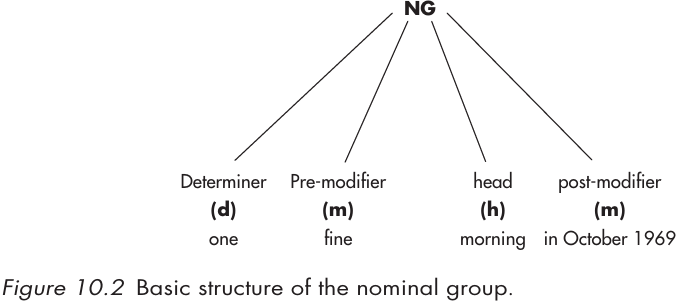
The head
The head is typically realized by a noun or pronoun (book, it). Instead of a noun we may find a substitute head, realized most commonly by one/ones (a good one/good ones).
The determiner
The determiner particularizes the noun referent in different ways:
• the articles establish its reference as definite (the man) or indefinite (a man).
• the demonstratives (this, that, these, those) signal that the referent is near the speaker (this book) or not near (that occasion) in space or time.
• the possessives (my, your, his, her, our, their, ‘s) signal to whom the referent belongs, (my room, the Minister’s reasons) and are sometimes reinforced by own (my own room).
• other words which particularize are wh-words (which book? whatever reason) and the distributives (each, every, all, either, neither). (Each child, every day, all the time, either hand, neither twin).
• quantifiers may comprise exact numerals (twelve, a hundred, first, second, etc.), or may be non-exact (many, a lot, a few, some, any).
All these classes of item that realize the determiner function are called determinatives.
The pre-head modifier, pre-modifier for short
After the determinatives, the pre-modifier describes and classifies the referent. Within this function the descriptor attributes qualities to it, realized by adjectives (smartly dressed), while the classifier restricts the referent to a sub-class (main entrance, Saturday morning), realized by nouns.
The post-head modifier, post-modifier for short
This function helps define the referent still further by means of finite and non-finite clauses. Relative clauses are either defining (the man who first set foot on the moon) or non-defining (the astronaut Neil Armstrong, who first set foot on the moon).
a street leading to the flower market in Covent Garden (non-finite –ing clause)
Different from the post-modifier is the complement. Certain abstract nouns such as fact, belief, claim, suggestion, news control a complement which is realized by a content clause:
the fact that inflation has gone down; his belief that he is always right.
Nouns which control complements are usually derived from verbs and can take a complement mediated by a preposition: a lack of knowledge; an expression of delight.








