









Grammar
Tenses
Present

Present Simple
Present Continuous
Present Perfect
Present Perfect Continuous
Past
Past Simple
Past Continuous
Past Perfect
Past Perfect Continuous
Future
Future Simple
Future Continuous
Future Perfect
Future Perfect Continuous
Parts Of Speech
Nouns
Countable and uncountable nouns
Verbal nouns
Singular and Plural nouns
Proper nouns
Nouns gender
Nouns definition
Concrete nouns
Abstract nouns
Common nouns
Collective nouns
Definition Of Nouns
Animate and Inanimate nouns
Nouns
Verbs
Stative and dynamic verbs
Finite and nonfinite verbs
To be verbs
Transitive and intransitive verbs
Auxiliary verbs
Modal verbs
Regular and irregular verbs
Action verbs
Verbs
Adverbs
Relative adverbs
Interrogative adverbs
Adverbs of time
Adverbs of place
Adverbs of reason
Adverbs of quantity
Adverbs of manner
Adverbs of frequency
Adverbs of affirmation
Adverbs
Adjectives
Quantitative adjective
Proper adjective
Possessive adjective
Numeral adjective
Interrogative adjective
Distributive adjective
Descriptive adjective
Demonstrative adjective
Pronouns
Subject pronoun
Relative pronoun
Reflexive pronoun
Reciprocal pronoun
Possessive pronoun
Personal pronoun
Interrogative pronoun
Indefinite pronoun
Emphatic pronoun
Distributive pronoun
Demonstrative pronoun
Pronouns
Pre Position
Preposition by function
Time preposition
Reason preposition
Possession preposition
Place preposition
Phrases preposition
Origin preposition
Measure preposition
Direction preposition
Contrast preposition
Agent preposition
Preposition by construction
Simple preposition
Phrase preposition
Double preposition
Compound preposition
prepositions
Conjunctions
Subordinating conjunction
Correlative conjunction
Coordinating conjunction
Conjunctive adverbs
conjunctions
Interjections
Express calling interjection
Phrases
Sentences
Clauses
Part of Speech
Grammar Rules
Passive and Active
Preference
Requests and offers
wishes
Be used to
Some and any
Could have done
Describing people
Giving advices
Possession
Comparative and superlative
Giving Reason
Making Suggestions
Apologizing
Forming questions
Since and for
Directions
Obligation
Adverbials
invitation
Articles
Imaginary condition
Zero conditional
First conditional
Second conditional
Third conditional
Reported speech
Demonstratives
Determiners
Direct and Indirect speech
Linguistics
Phonetics
Phonology
Linguistics fields
Syntax
Morphology
Semantics
pragmatics
History
Writing
Grammar
Phonetics and Phonology
Semiotics
Reading Comprehension
Elementary
Intermediate
Advanced
Teaching Methods
Teaching Strategies
Assessment

Componence, realization and function
 المؤلف:
Angela Downing
المؤلف:
Angela Downing
 المصدر:
ENGLISH GRAMMAR A UNIVERSITY COURSE
المصدر:
ENGLISH GRAMMAR A UNIVERSITY COURSE
 الجزء والصفحة:
P19-C1
الجزء والصفحة:
P19-C1
 2026-04-29
 23
23




+
-
20
Componence, realization and function
Any structure can be considered to be composed of elements which form a configuration of elements or ‘functions’, whether semantic such as Agent-Process-Affected or syntactic such as the clause configuration Subject-Predicator-Object or the modifier head-modifier structure of the nominal group.
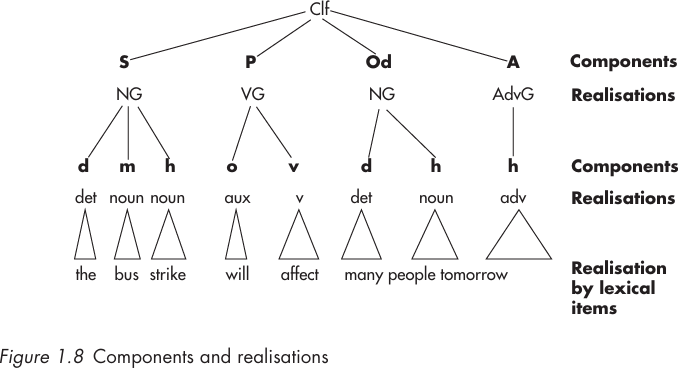
Each of these is in turn realized by a unit which is itself, at least potentially, a configuration of elements, and these in turn are realized by others until the final stage is reached and abstract categories such as subject, head, modifier, etc., are finally realized by the segments of the spoken or written language. The ‘structural tree’ on page 19 diagrams this model of analysis at the three unit ranks of clause, group and word, to illustrate the clause The bus strike will affect many people tomorrow.
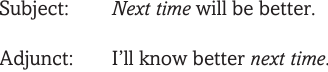
An important property of language is the fact that there is no one-to-one correspondence between the class of unit and its function. While it is true that certain classes of unit typically realize certain functions, Nominal Groups at Subject and Object functions, for instance, it is nevertheless also true that many classes of unit can fulfil many different functions, and different functions are realized by many different classes of unit. For instance, the NG next time can fulfil the following clause functions, among others:
The nearest to a one-to-one relationship in the grammar is that between the process and the verbal group that realizes it.
This many-to-many relationship is fundamental for understanding the relationship of the grammar of English to discourse. By this it is not implied that discourse (or even a text) is a kind of super-sentence, a grammatical unit that is simply ‘larger’ than a sentence and with the same kind of relationship holding between its parts as that which holds between grammatical units.
A piece of discourse is quite different in kind from a grammatical unit. Rather than grammatical, it is a pragmatic-semantic unit of whatever length, spoken or written, and which forms a unified whole, with respect both to its internal properties and to the social context in which it is produced.
To take a minimal instance, a pragmatic act such as ‘leave-taking’ may be realized by a modalized declarative clause (I’ll be seeing you) or by the formulaic expression Goodbye, among others. Typically, a discourse is made up of various types of pragmatic acts, which in turn are realized semantically and syntactically. Although we start from the grammar rather than from the text, the relationship between the two is of primary interest.
 الاكثر قراءة في Grammar
 اخر الاخبار
اخبار العتبة العباسية المقدسة

الآخبار الصحية


مواضيع ذات صلة
 قسم الشؤون الفكرية يصدر كتاباً يوثق تاريخ السدانة في العتبة العباسية المقدسة
 "المهمة".. إصدار قصصي يوثّق القصص الفائزة في مسابقة فتوى الدفاع المقدسة للقصة القصيرة
 (نوافذ).. إصدار أدبي يوثق القصص الفائزة في مسابقة الإمام العسكري (عليه السلام)






