Grammar
Tenses
Present

Present Simple
Present Continuous
Present Perfect
Present Perfect Continuous
Past
Past Simple
Past Continuous
Past Perfect
Past Perfect Continuous
Future
Future Simple
Future Continuous
Future Perfect
Future Perfect Continuous
Parts Of Speech
Nouns
Countable and uncountable nouns
Verbal nouns
Singular and Plural nouns
Proper nouns
Nouns gender
Nouns definition
Concrete nouns
Abstract nouns
Common nouns
Collective nouns
Definition Of Nouns
Animate and Inanimate nouns
Nouns
Verbs
Stative and dynamic verbs
Finite and nonfinite verbs
To be verbs
Transitive and intransitive verbs
Auxiliary verbs
Modal verbs
Regular and irregular verbs
Action verbs
Verbs
Adverbs
Relative adverbs
Interrogative adverbs
Adverbs of time
Adverbs of place
Adverbs of reason
Adverbs of quantity
Adverbs of manner
Adverbs of frequency
Adverbs of affirmation
Adverbs
Adjectives
Quantitative adjective
Proper adjective
Possessive adjective
Numeral adjective
Interrogative adjective
Distributive adjective
Descriptive adjective
Demonstrative adjective
Pronouns
Subject pronoun
Relative pronoun
Reflexive pronoun
Reciprocal pronoun
Possessive pronoun
Personal pronoun
Interrogative pronoun
Indefinite pronoun
Emphatic pronoun
Distributive pronoun
Demonstrative pronoun
Pronouns
Pre Position
Preposition by function
Time preposition
Reason preposition
Possession preposition
Place preposition
Phrases preposition
Origin preposition
Measure preposition
Direction preposition
Contrast preposition
Agent preposition
Preposition by construction
Simple preposition
Phrase preposition
Double preposition
Compound preposition
prepositions
Conjunctions
Subordinating conjunction
Correlative conjunction
Coordinating conjunction
Conjunctive adverbs
conjunctions
Interjections
Express calling interjection
Phrases
Sentences
Clauses
Part of Speech
Grammar Rules
Passive and Active
Preference
Requests and offers
wishes
Be used to
Some and any
Could have done
Describing people
Giving advices
Possession
Comparative and superlative
Giving Reason
Making Suggestions
Apologizing
Forming questions
Since and for
Directions
Obligation
Adverbials
invitation
Articles
Imaginary condition
Zero conditional
First conditional
Second conditional
Third conditional
Reported speech
Demonstratives
Determiners
Direct and Indirect speech
Linguistics
Phonetics
Phonology
Linguistics fields
Syntax
Morphology
Semantics
pragmatics
History
Writing
Grammar
Phonetics and Phonology
Semiotics
Reading Comprehension
Elementary
Intermediate
Advanced
Teaching Methods
Teaching Strategies
Assessment

Structural Constraints on Morphological Inflection
 المؤلف:
Mark Aronoff and Kirsten Fudeman
المؤلف:
Mark Aronoff and Kirsten Fudeman
 المصدر:
What is Morphology
المصدر:
What is Morphology
 الجزء والصفحة:
P198-C7
الجزء والصفحة:
P198-C7
 2026-04-17
 22
22




+
-
20
Structural Constraints on Morphological Inflection
Cross-linguistically, we often find constraints on the realization of inflectional morphology. In Russian, for example, verbs show gender agreement with their subject (feminine, masculine, or neuter) only in the past tense. This fact about Russian has a historical explanation: the past tense form was originally an adjective, and Russian adjectives agree in gender with the nouns they modify. In Modern Hebrew, verbs agree in gender with their subjects only in the present tense (and hearing a Hebrew-speaking 3-year-old girl using correct feminine forms for all her present-tense verbs is a truly breathtaking experience). Again, this fact has a historical explanation: as with Russian past tense forms, Hebrew present forms were originally participles. Gender agreement is not optional in Hebrew and Russian. Instead, its morphological realization is context-dependent.
It is surprisingly easy to find languages where verb inflection is obligatory in some contexts but impossible in others. All depend on syntactic context, rather than on tense, which is expressed as an inflectional part of the verb itself in Russian and Hebrew.
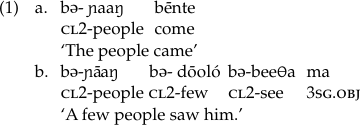
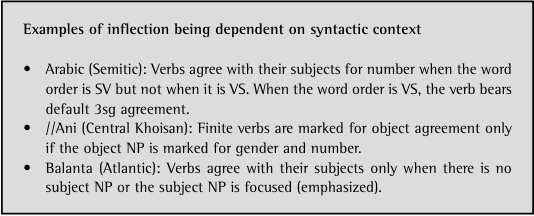
In the Kujamaat Jóola portion, we will see that subject agreement is expressed obligatorily except in the past subordinate and positive imperative forms of the verb. In some related languages, like Balanta, however, verbs agree with their subject only in certain syntactic contexts. In Balanta, verbs may be marked for subject agreement, but generally only in the absence of a subject noun phrase (1a). When a subject noun phrase is present, a subject prefix on the verb does not express agreement. Instead, it indicates that the subject is focused (1b) (data from N’Diaye-Corréard 1970: 30):
Another example of a structural constraint on morphological inflection comes from the Central Khoisan language //Ani and its system of object agreement (Vossen 1985).1 Finite verbs (except in the imperative) bear affixes that agree with a pronominal object in person, gender, and number (2a) or with a nominal object for number and gender (2b):
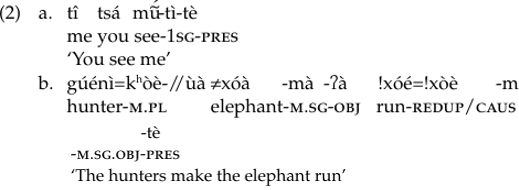
The catch is this: if a nominal object is not marked for gender and number, object agreement does not appear on the verb:

Here, in contrast to (2b), ‘elephant’ does not bear a gender–number suffix, and object agreement morphology fails to appear on the verb.
In Arabic, the basic generalization is that subject–verb number agreement appears on the verb when the word order is SV (subject–verb) (4a) but not when it is VS (4b) (data from Ouhalla 1994: 43):
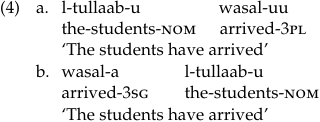
In (4b) third plural subject agreement is blocked, and instead we get default third person singular agreement.
In sum, in Balanta and Arabic subject agreement and //Ani object agreement, the realization of agreement is either obligatorily present or obligatorily absent, depending on the syntactic context. If you have had extensive experience with syntax you might want to investigate in greater detail the structural analyses behind these facts.
1 // represents a lateral click, ! a palatal retroflex click, and ʔ an alveolar click.
 الاكثر قراءة في Morphology
 اخر الاخبار
اخبار العتبة العباسية المقدسة

الآخبار الصحية


 قسم الشؤون الفكرية يصدر كتاباً يوثق تاريخ السدانة في العتبة العباسية المقدسة
 "المهمة".. إصدار قصصي يوثّق القصص الفائزة في مسابقة فتوى الدفاع المقدسة للقصة القصيرة
 (نوافذ).. إصدار أدبي يوثق القصص الفائزة في مسابقة الإمام العسكري (عليه السلام)