Grammar
Tenses
Present

Present Simple
Present Continuous
Present Perfect
Present Perfect Continuous
Past
Past Simple
Past Continuous
Past Perfect
Past Perfect Continuous
Future
Future Simple
Future Continuous
Future Perfect
Future Perfect Continuous
Parts Of Speech
Nouns
Countable and uncountable nouns
Verbal nouns
Singular and Plural nouns
Proper nouns
Nouns gender
Nouns definition
Concrete nouns
Abstract nouns
Common nouns
Collective nouns
Definition Of Nouns
Animate and Inanimate nouns
Nouns
Verbs
Stative and dynamic verbs
Finite and nonfinite verbs
To be verbs
Transitive and intransitive verbs
Auxiliary verbs
Modal verbs
Regular and irregular verbs
Action verbs
Verbs
Adverbs
Relative adverbs
Interrogative adverbs
Adverbs of time
Adverbs of place
Adverbs of reason
Adverbs of quantity
Adverbs of manner
Adverbs of frequency
Adverbs of affirmation
Adverbs
Adjectives
Quantitative adjective
Proper adjective
Possessive adjective
Numeral adjective
Interrogative adjective
Distributive adjective
Descriptive adjective
Demonstrative adjective
Pronouns
Subject pronoun
Relative pronoun
Reflexive pronoun
Reciprocal pronoun
Possessive pronoun
Personal pronoun
Interrogative pronoun
Indefinite pronoun
Emphatic pronoun
Distributive pronoun
Demonstrative pronoun
Pronouns
Pre Position
Preposition by function
Time preposition
Reason preposition
Possession preposition
Place preposition
Phrases preposition
Origin preposition
Measure preposition
Direction preposition
Contrast preposition
Agent preposition
Preposition by construction
Simple preposition
Phrase preposition
Double preposition
Compound preposition
prepositions
Conjunctions
Subordinating conjunction
Correlative conjunction
Coordinating conjunction
Conjunctive adverbs
conjunctions
Interjections
Express calling interjection
Phrases
Sentences
Clauses
Part of Speech
Grammar Rules
Passive and Active
Preference
Requests and offers
wishes
Be used to
Some and any
Could have done
Describing people
Giving advices
Possession
Comparative and superlative
Giving Reason
Making Suggestions
Apologizing
Forming questions
Since and for
Directions
Obligation
Adverbials
invitation
Articles
Imaginary condition
Zero conditional
First conditional
Second conditional
Third conditional
Reported speech
Demonstratives
Determiners
Direct and Indirect speech
Linguistics
Phonetics
Phonology
Linguistics fields
Syntax
Morphology
Semantics
pragmatics
History
Writing
Grammar
Phonetics and Phonology
Semiotics
Reading Comprehension
Elementary
Intermediate
Advanced
Teaching Methods
Teaching Strategies
Assessment

The Polysemy Problem
 المؤلف:
Mark Aronoff and Kirsten Fudeman
المؤلف:
Mark Aronoff and Kirsten Fudeman
 المصدر:
What is Morphology
المصدر:
What is Morphology
 الجزء والصفحة:
P137-C5
الجزء والصفحة:
P137-C5
 2026-04-10
 70
70




+
-
20
The Polysemy Problem
The most fundamental aspect of a word’s meaning is that it refers to some entity or relation (real or imaginary) in the world. We can refer to this entity or relation as the word’s semantic type. The word reptile refers to all individuals in the world that are reptiles. Verbs like respect or love refer to relationships between individuals. Formal approaches to grammar have provided us with terminology that allows us to make even more fine-tuned distinctions between words. We can differentiate bear from teddy bear by saying that the first is animate but the second is not, or foliage from leaf and literature from book on the basis of the mass/count distinction. Verbs are given labels such as ergative, unaccusative, transitive, or intransitive. (For a more detailed discussion, see Pustejovsky 1995: 8 ff.)
The main problem of lexical semantics is that the meanings of individual lexemes are highly diverse. We call this the problem of polysemy. As an example, take the verb lose. Lose has different meanings in the following sentences: They lost their passports; Jake lost his job; Sarah lost her husband to cancer; I lost my temper; We both lost ten pounds. But all of the meanings of lose reflected here are related – they are all instances of the same lexeme. Because lose has more than one related meaning, we say that it is polysemous.
There are many types of polysemy. In the next several examples, we present some general types of polysemy, focusing on nouns. While some nouns are inherently mass or count nouns, others can be either, as with watermelon:
(1) a. I love watermelon. (mass)
b. I sold three watermelons. (count)
Besides the mass/count alternation, there are several other well-known alternations we find in noun meaning. A few are illustrated below:
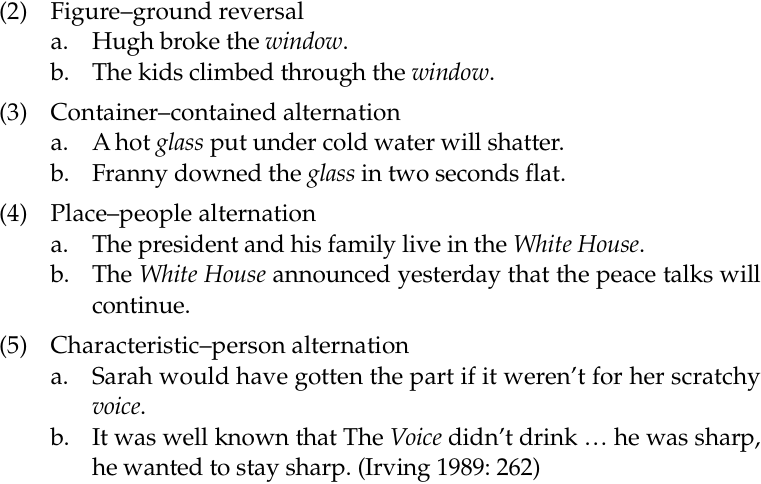
The sentences in (2–5) contain pairs of words with very different – even contradictory – interpretations. Yet they represent single lexemes. In (2a) window refers to a solid barrier, but in (2b) an aperture; glass (3a–b) can refer to the container or to the liquid inside. Examples like these show that the same phonetic string can convey different, but related meanings depending on the linguistic and pragmatic context. (As seen in Lexemes a given phonetic string may also convey unrelated meanings, in which case we are dealing with homophones.)
 الاكثر قراءة في Morphology
 اخر الاخبار
اخبار العتبة العباسية المقدسة

الآخبار الصحية


مواضيع ذات صلة
 قسم الشؤون الفكرية يصدر كتاباً يوثق تاريخ السدانة في العتبة العباسية المقدسة
 "المهمة".. إصدار قصصي يوثّق القصص الفائزة في مسابقة فتوى الدفاع المقدسة للقصة القصيرة
 (نوافذ).. إصدار أدبي يوثق القصص الفائزة في مسابقة الإمام العسكري (عليه السلام)