Non-linear morphology
Up to this point we have discussed only two kinds of morphological markers: prefixes and suffixes. For that reason, most of the word structures we have examined thus far have been quite “linear”: a simple sequence of morphemes (root plus affixes) strung together one after another, like beads on a string. However, we have already seen a few examples of more complex word structure.
We discussed the Tagalog aspect markers. We saw that realis non-active verbs are marked by an affix-in- that occurs, not before or after the root, but inside it, as illustrated in the “past” forms in (1). This marker is neither a prefix nor a suffix; we referred to it as an INFIX. We also saw that non-completive aspect is marked by copying the first consonant and vowel of the root, as seen in the “future” forms in (1). We referred to this process as REDUPLICATION.

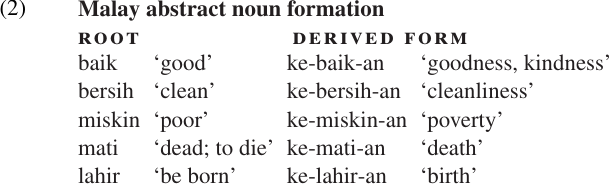
We referred to the Malay nominalizer ke- ...-an, illustrated in (2), as a CIRCUMFIX. Again, this affix is neither a prefix nor a suffix; it seems to be both at once, or rather a combination of the two.
Hockett (1954) discussed two different approaches that linguists have taken to the analysis of word structure. One of these, which he called the item and ARRANGEMENT (IA) model, assumes that all morphology is affixation. The rules of grammar must arrange the morphemes in the correct linear order, after which the rules of phonology will apply to produce the form that is actually pronounced.
The second approach, which Hockett called the ITEM AND PROCESS (IP) model, treats affixation as just one among many ways in which morphological rules may modify the form of the base. The IP model does not treat a morpheme as a string of phonemes which gets attached to the base, but rather as a pattern of phonological change which is associated with some consistent semantic or grammatical effect. Of course, one way in which the base form can be modified is simply to add a specific string of phonemes to it, resulting in affixation of the familiar sort. But many other kinds of modification are attested in human languages as well.
Circumfixes, in fixes, and reduplication are examples of morphological marking which is not simple, linear, affixation. These patterns, and others to be discussed below, are difficult to represent in a position class chart, and (at least at first glance) seem to cause serious problems for the IA model. However, recent developments in phonological theory have made it possible to describe many of these processes as special types of affixation. So, the debate between the IA and IP viewpoints continues to be a major topic of discussion in morphological theory.
The theoretical issues involved are far beyond our scope. Our primary goal will be to introduce the standard terminology used for various types of non-linear morphology, and to help you recognize these patterns when you encounter them.








