Word structure revisited
Limitations of the position class chart
We introduced the position class chart as a way of representing the morphological structure of a word. These charts are especially well suited to inflectional affixation where the affixes are arranged in paradigm sets occurring in a fixed order. Position class charts are often less successful as a way of displaying derivational morphology, for a variety of reasons.
First, we have noted that derivational morphology does not typically form paradigm sets such that only one affix in each set may occur in any given word. This means that each derivational affix in the language could potentially occupy its own position in the chart, which would require a large number of positions in many languages. Of course, there are often semantic reasons why two derivational affixes cannot occur together. For example, Manipuri (a Tibeto-Burman language spoken in north east India) has a pair of derivational modality markers which indicate the appropriateness of the time at which an action was performed: -həw ‘just in time ’and–khi‘ still (not done).’15 Since these two concepts are mutually contradictory, they cannot occur in the same verb form.
There are also categorial requirements which limit the co-occurrence of derivational affixes. For example, English has a number of nominalizing suffixes: -ment, -tion, -ity, etc. No two of these can occur next to each other, since they each attach to a base form which is not a noun and produce a stem which is a noun: e.g. creation, containment, but*creationment,*creationity. However, these affixes can co-occur if they are separated by some other affix which derives a stem of a different category: compart-ment al-iz-ation; constitu(te)-tion-al-ity; argu-ment-ativ-ity, etc. The possibility of co-occurrence shows that these nominalizing suffixes do not form a paradigm set.
Second, derivational affixes can sometimes occur more than once within the same word. This is at least marginally possible in English, as in re-reinstate, re-reinvent, etc. (School principal to teacher: If you expel my nephew again, I will simply re-reinstate him.) Clearer examples are found in other languages. Manipuri has another modality marker, -lə ∼-rə, which indicates likelihood or probability. This suffix can be doubled or even tripled to indicate certainty: saw-rə-ni ‘is probably going to be angry’; saw-rə-rə-rə-ni ‘is definitely going to be angry.’ Double causatives are reported in a number of languages, including Turkish (24c) and Quechua (25c).
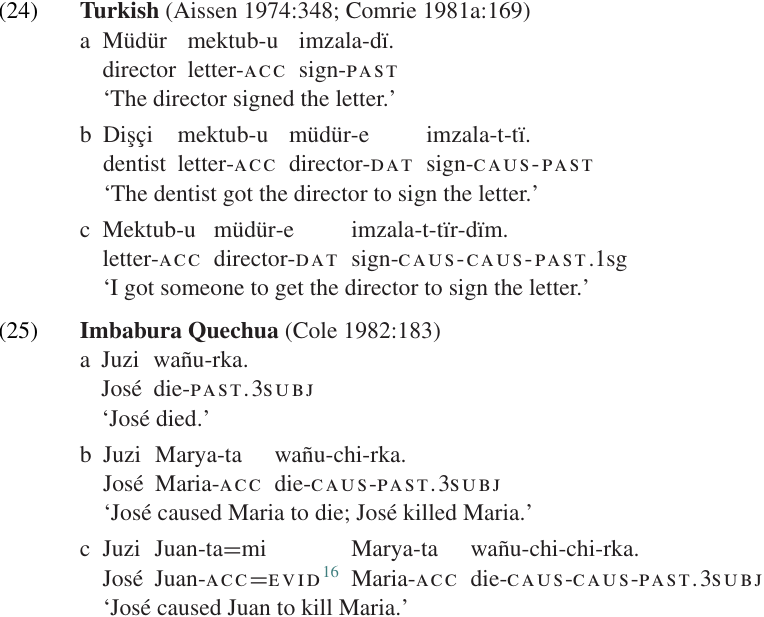
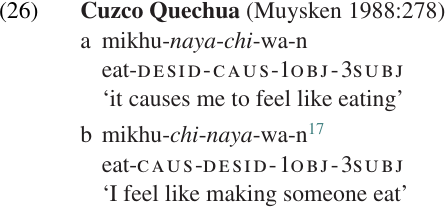
Third, the ordering of derivational affixes may be variable, with different semantic interpretations indicated by the differences in affix order. The causative and desiderative suffixes in Cuzco Quechua can appear in either order, as illustrated in (26).
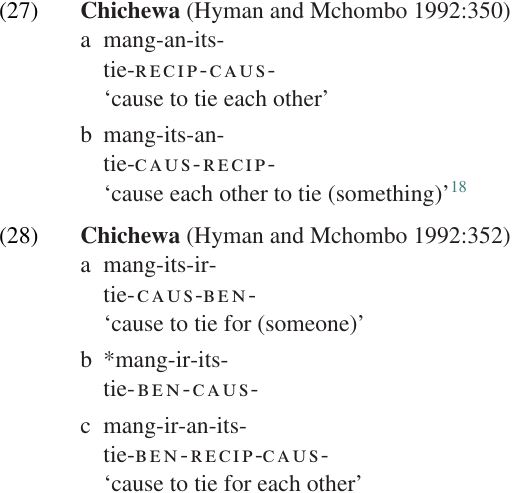
In Chichewa (Bantu, East Africa), the causative and reciprocal suffixes may appear in either order, as in (27). If the causative suffix appears next to the benefactive suffix, the causative must come first as in(28a). However, the benefactive suffix may precede the causative provided that some other affix intervenes, as in (28c). (Note that these examples involve only stems; all inflectional affixation, including subject agreement and tense, are omitted.)
Examples like these are not uncommon, but they are difficult to deal with in any satisfying way in a position class chart. Multiple occurrences of the same affix, or variable ordering with respect to other affixes, would force us to assign a single affix to more than one position class. For these reasons, it is often more helpful to show only the inflectional categories in our position class chart. A possible chart for Chichewa verbs is presented in (29), without listing the inflectional affixes in each position.19 Note that the stem of the verb may consist of a single root, or of a root with one or more derivational affixes. The internal structure of the stem is, in general, “invisible” to the rest of the grammatical system.

15. All Manipuri examples are taken from Chelliah (1992).
16. =mi is an evidential clitic indicating first-hand information.
17. The experiencer triggers object agreement, rather than subject agreement, on stems formed with the desiderative suffix like (26b). Cole (1982:182) refers to such verbs as “impersonal verbs.”
18. Hyman and Mchombo (1992:360) point out that (27b) is actually ambiguous; it can also have the interpretation given for (27a). Example (27a), however, allows only one interpretation.
19. The chart in (29) does not include the “object agreement” position. Bresnan and Mchombo (1987) present evidence that the object marker in Chichewa is actually an incorporated pronoun. See Clitics for a discussion of a similar pattern in Muna.








