









Grammar
Tenses
Present

Present Simple
Present Continuous
Present Perfect
Present Perfect Continuous
Past
Past Simple
Past Continuous
Past Perfect
Past Perfect Continuous
Future
Future Simple
Future Continuous
Future Perfect
Future Perfect Continuous
Parts Of Speech
Nouns
Countable and uncountable nouns
Verbal nouns
Singular and Plural nouns
Proper nouns
Nouns gender
Nouns definition
Concrete nouns
Abstract nouns
Common nouns
Collective nouns
Definition Of Nouns
Animate and Inanimate nouns
Nouns
Verbs
Stative and dynamic verbs
Finite and nonfinite verbs
To be verbs
Transitive and intransitive verbs
Auxiliary verbs
Modal verbs
Regular and irregular verbs
Action verbs
Verbs
Adverbs
Relative adverbs
Interrogative adverbs
Adverbs of time
Adverbs of place
Adverbs of reason
Adverbs of quantity
Adverbs of manner
Adverbs of frequency
Adverbs of affirmation
Adverbs
Adjectives
Quantitative adjective
Proper adjective
Possessive adjective
Numeral adjective
Interrogative adjective
Distributive adjective
Descriptive adjective
Demonstrative adjective
Pronouns
Subject pronoun
Relative pronoun
Reflexive pronoun
Reciprocal pronoun
Possessive pronoun
Personal pronoun
Interrogative pronoun
Indefinite pronoun
Emphatic pronoun
Distributive pronoun
Demonstrative pronoun
Pronouns
Pre Position
Preposition by function
Time preposition
Reason preposition
Possession preposition
Place preposition
Phrases preposition
Origin preposition
Measure preposition
Direction preposition
Contrast preposition
Agent preposition
Preposition by construction
Simple preposition
Phrase preposition
Double preposition
Compound preposition
prepositions
Conjunctions
Subordinating conjunction
Correlative conjunction
Coordinating conjunction
Conjunctive adverbs
conjunctions
Interjections
Express calling interjection
Phrases
Sentences
Clauses
Part of Speech
Grammar Rules
Passive and Active
Preference
Requests and offers
wishes
Be used to
Some and any
Could have done
Describing people
Giving advices
Possession
Comparative and superlative
Giving Reason
Making Suggestions
Apologizing
Forming questions
Since and for
Directions
Obligation
Adverbials
invitation
Articles
Imaginary condition
Zero conditional
First conditional
Second conditional
Third conditional
Reported speech
Demonstratives
Determiners
Direct and Indirect speech
Linguistics
Phonetics
Phonology
Linguistics fields
Syntax
Morphology
Semantics
pragmatics
History
Writing
Grammar
Phonetics and Phonology
Semiotics
Reading Comprehension
Elementary
Intermediate
Advanced
Teaching Methods
Teaching Strategies
Assessment

Canonical narrative schema
 المؤلف:
Bronwen Martin and Felizitas Ringham
المؤلف:
Bronwen Martin and Felizitas Ringham
 المصدر:
Dictionary of Semiotics
المصدر:
Dictionary of Semiotics
 الجزء والصفحة:
P32
الجزء والصفحة:
P32
 2025-05-14
 763
763




+
-
20
Canonical narrative schema
This schema presents a universal prototype for the structure of narrative. It is composed of three tests: the qualifying test, the decisive test and the glorifying test, which unfold in a logical succession. These tests are preceded by the stage of manipulation or contract.
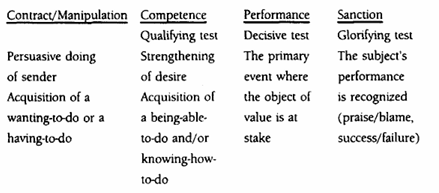
This narrative macro-structure can be exploited by individual texts in a variety of different ways. Certain stages or tests may be foregrounded, others remain implicit: in adventure stories, for example, the emphasis is on the decisive test, whereas legal discourse is centred more on the stage of sanction.
Contract/manipulation: The sender transmits to the receiver the desire or obligation to act. What is known as a contract is established between the two and the subject embarks on a quest. The contract is followed by three tests. These tests mirror the fundamental logic of human action:
The qualifying test (or stage of competence): Here the subject acquires the necessary competence needed to carry out the planned action or mission. The desire or obligation to act is not in itself sufficient: the subject must also possess the ability to act (pouvoir faire) and/or the knowledge/skills to do so (savoir/aire). For example, if your intention is to shoot someone, you first of all need to acquire a gun; the gun functions as your helper, providing you with the necessary ability to act.
The decisive test (or stage of performance): This represents the principal event or action for which the subject has been preparing, where the object of the quest is at stake. In adventure stories or newspaper articles, the decisive test frequently takes the form of a confrontation or conflict between a subject and an anti-subject.
The glorifying test (or sanction): The outcome of the event is now revealed, the decisive test has either succeeded or failed, the subject is acclaimed or punished. In other words, it is the point at which the performance of the subject is interpreted and evaluated by what is known as the sender-adjudicator.
For more details see under individual headings
 الاكثر قراءة في Semiotics
 اخر الاخبار
اخبار العتبة العباسية المقدسة

الآخبار الصحية


 قسم الشؤون الفكرية يصدر كتاباً يوثق تاريخ السدانة في العتبة العباسية المقدسة
 "المهمة".. إصدار قصصي يوثّق القصص الفائزة في مسابقة فتوى الدفاع المقدسة للقصة القصيرة
 (نوافذ).. إصدار أدبي يوثق القصص الفائزة في مسابقة الإمام العسكري (عليه السلام)






