









Grammar
Tenses
Present

Present Simple
Present Continuous
Present Perfect
Present Perfect Continuous
Past
Past Simple
Past Continuous
Past Perfect
Past Perfect Continuous
Future
Future Simple
Future Continuous
Future Perfect
Future Perfect Continuous
Parts Of Speech
Nouns
Countable and uncountable nouns
Verbal nouns
Singular and Plural nouns
Proper nouns
Nouns gender
Nouns definition
Concrete nouns
Abstract nouns
Common nouns
Collective nouns
Definition Of Nouns
Animate and Inanimate nouns
Nouns
Verbs
Stative and dynamic verbs
Finite and nonfinite verbs
To be verbs
Transitive and intransitive verbs
Auxiliary verbs
Modal verbs
Regular and irregular verbs
Action verbs
Verbs
Adverbs
Relative adverbs
Interrogative adverbs
Adverbs of time
Adverbs of place
Adverbs of reason
Adverbs of quantity
Adverbs of manner
Adverbs of frequency
Adverbs of affirmation
Adverbs
Adjectives
Quantitative adjective
Proper adjective
Possessive adjective
Numeral adjective
Interrogative adjective
Distributive adjective
Descriptive adjective
Demonstrative adjective
Pronouns
Subject pronoun
Relative pronoun
Reflexive pronoun
Reciprocal pronoun
Possessive pronoun
Personal pronoun
Interrogative pronoun
Indefinite pronoun
Emphatic pronoun
Distributive pronoun
Demonstrative pronoun
Pronouns
Pre Position
Preposition by function
Time preposition
Reason preposition
Possession preposition
Place preposition
Phrases preposition
Origin preposition
Measure preposition
Direction preposition
Contrast preposition
Agent preposition
Preposition by construction
Simple preposition
Phrase preposition
Double preposition
Compound preposition
prepositions
Conjunctions
Subordinating conjunction
Correlative conjunction
Coordinating conjunction
Conjunctive adverbs
conjunctions
Interjections
Express calling interjection
Phrases
Sentences
Clauses
Part of Speech
Grammar Rules
Passive and Active
Preference
Requests and offers
wishes
Be used to
Some and any
Could have done
Describing people
Giving advices
Possession
Comparative and superlative
Giving Reason
Making Suggestions
Apologizing
Forming questions
Since and for
Directions
Obligation
Adverbials
invitation
Articles
Imaginary condition
Zero conditional
First conditional
Second conditional
Third conditional
Reported speech
Demonstratives
Determiners
Direct and Indirect speech
Linguistics
Phonetics
Phonology
Linguistics fields
Syntax
Morphology
Semantics
pragmatics
History
Writing
Grammar
Phonetics and Phonology
Semiotics
Reading Comprehension
Elementary
Intermediate
Advanced
Teaching Methods
Teaching Strategies
Assessment

Haplology effects
 المؤلف:
Ingo Plag
المؤلف:
Ingo Plag
 المصدر:
Morphological Productivity
المصدر:
Morphological Productivity
 الجزء والصفحة:
P185-C6
الجزء والصفحة:
P185-C6
 2025-02-06
 1159
1159




+
-
20
Haplology effects
Plag (1998) proposes a theory of morphological haplology according to which morphological haplology results from a family of constraints named OCP, which prohibit adjacent identical elements in the output.1 The Obligatory Contour Principle (OCP) was originally suggested to ban adjacent identical tones from the lexical representation of a morpheme in tone languages (e.g. Leben 1973), but it seems that the concept can be fruitfully extended to non-tonal phenomena. In the case of -ize derivatives at least one OCP constraint plays a significant role, the one against identical onsets in adjacent syllables (OCP-ONSET):
(1) 
Note that OCP-ONSET is only terminologically different from Raffelsiefen's *O¡RO¡. The reason for renaming this constraint is that my terminology expresses the fact that seemingly different phenomena can be subsumed under one family of related constraints on the repetition of identical phonological structures (see Plag 1998 for elaboration and discussion).
As already mentioned above, disyllabic base words are never affected by haplological truncation, whereas dactylic bases always are. This patterning can be explained if we introduce OCP-ONSET into the hierarchy we have established so far. The data show that OCP-ONSET must be ranked between •CLASH-HEAD and R-ALIGN-HEAD. AS we will shortly see, OCP-ONSET must be crucially non-ranked with respect to MAX-C. Crucial non-ranking is expressed by a dotted line in the tableaux below and by '=' in the constraint hierarchies. Pertinent derivatives are evaluated in the tableaus in (2) and (3):
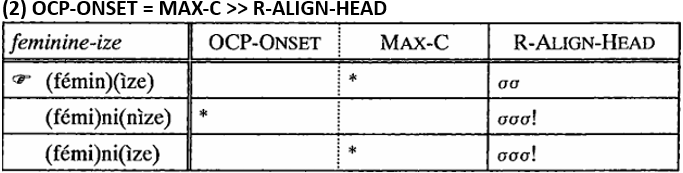
Although it may seem at first sight that MAX-C is violated in order to satisfy OCP-ONSET, we see that it is really the alignment constraint which triggers deletion with féminìze. Recall that C-final dactylic bases not leading to identical onsets (hóspitalìze) cannot be truncated due to MAX-C. If either MAX-C or OCP-ONSET must be violated, the candidate with the least violations of R-ALIGN-HEAD is optimal.
* CLASH-HEAD becomes operative only with trochaic bases, as we can see in (3):
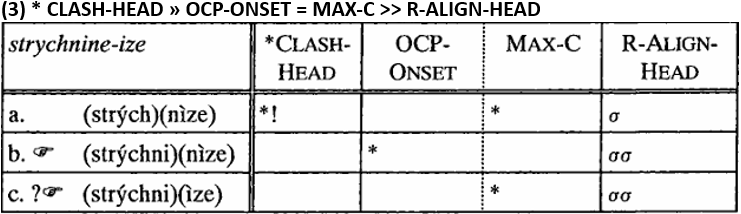
The minimally truncated form (3c), *strýchniìze, emerges falsely as optimal in this tableau, but this is only because the effects of DEP and ONSET are not presented. Thus candidate (3c) either violates DEP (if a glide is inserted in onset position) or ONSET (if no glide is inserted). The attested candidate (3b) violates neither of these constraints and is therefore selected as optimal.
1 See also Yip (1996:7) who assumes the following OCP constraints: OCP (feature), OCP (segment), OCP (affix), OCP (stem). The latter two, however, are not phonological in nature. In Plag (1998) the extension of OCP constraints to morphological elements is rejected. See that paper for a more detailed discussion.
 الاكثر قراءة في Morphology
 اخر الاخبار
اخبار العتبة العباسية المقدسة

الآخبار الصحية


مواضيع ذات صلة
 قسم الشؤون الفكرية يصدر كتاباً يوثق تاريخ السدانة في العتبة العباسية المقدسة
 "المهمة".. إصدار قصصي يوثّق القصص الفائزة في مسابقة فتوى الدفاع المقدسة للقصة القصيرة
 (نوافذ).. إصدار أدبي يوثق القصص الفائزة في مسابقة الإمام العسكري (عليه السلام)






