









Grammar
Tenses
Present

Present Simple
Present Continuous
Present Perfect
Present Perfect Continuous
Past
Past Simple
Past Continuous
Past Perfect
Past Perfect Continuous
Future
Future Simple
Future Continuous
Future Perfect
Future Perfect Continuous
Parts Of Speech
Nouns
Countable and uncountable nouns
Verbal nouns
Singular and Plural nouns
Proper nouns
Nouns gender
Nouns definition
Concrete nouns
Abstract nouns
Common nouns
Collective nouns
Definition Of Nouns
Animate and Inanimate nouns
Nouns
Verbs
Stative and dynamic verbs
Finite and nonfinite verbs
To be verbs
Transitive and intransitive verbs
Auxiliary verbs
Modal verbs
Regular and irregular verbs
Action verbs
Verbs
Adverbs
Relative adverbs
Interrogative adverbs
Adverbs of time
Adverbs of place
Adverbs of reason
Adverbs of quantity
Adverbs of manner
Adverbs of frequency
Adverbs of affirmation
Adverbs
Adjectives
Quantitative adjective
Proper adjective
Possessive adjective
Numeral adjective
Interrogative adjective
Distributive adjective
Descriptive adjective
Demonstrative adjective
Pronouns
Subject pronoun
Relative pronoun
Reflexive pronoun
Reciprocal pronoun
Possessive pronoun
Personal pronoun
Interrogative pronoun
Indefinite pronoun
Emphatic pronoun
Distributive pronoun
Demonstrative pronoun
Pronouns
Pre Position
Preposition by function
Time preposition
Reason preposition
Possession preposition
Place preposition
Phrases preposition
Origin preposition
Measure preposition
Direction preposition
Contrast preposition
Agent preposition
Preposition by construction
Simple preposition
Phrase preposition
Double preposition
Compound preposition
prepositions
Conjunctions
Subordinating conjunction
Correlative conjunction
Coordinating conjunction
Conjunctive adverbs
conjunctions
Interjections
Express calling interjection
Phrases
Sentences
Clauses
Part of Speech
Grammar Rules
Passive and Active
Preference
Requests and offers
wishes
Be used to
Some and any
Could have done
Describing people
Giving advices
Possession
Comparative and superlative
Giving Reason
Making Suggestions
Apologizing
Forming questions
Since and for
Directions
Obligation
Adverbials
invitation
Articles
Imaginary condition
Zero conditional
First conditional
Second conditional
Third conditional
Reported speech
Demonstratives
Determiners
Direct and Indirect speech
Linguistics
Phonetics
Phonology
Linguistics fields
Syntax
Morphology
Semantics
pragmatics
History
Writing
Grammar
Phonetics and Phonology
Semiotics
Reading Comprehension
Elementary
Intermediate
Advanced
Teaching Methods
Teaching Strategies
Assessment

MalE – global change
 المؤلف:
Loga Baskaran
المؤلف:
Loga Baskaran
 المصدر:
A Handbook Of Varieties Of English Phonology
المصدر:
A Handbook Of Varieties Of English Phonology
 الجزء والصفحة:
1037-61
الجزء والصفحة:
1037-61
 2024-06-14
 1239
1239




+
-
20
MalE – global change
Although previous studies of MalE closely linked it to Singapore English (SgE), it is now appropriate to divorce them from each other at least on two historical considerations. Firstly, since 1965 Singapore is no longer in any way politically connected to Malaya or Malaysia; the case for sociolinguistic differentiation over 40 years is therefore reasonably strong. Secondly, the language policies in both nations have been different for the past 40 years. This will have varied implications on the role and long-term effects of English on the local populace of each nation. Tongue (1974), who describes the English of Singapore and Malaysia (ESM), predicted that within a hundred years the idea of one ‘ESM’ would become inapplicable. In linguistic terms, there are significant differences in substrate too. Chinese varieties predominate in Singapore, but are a minority in Malaysia. The implications of this difference have yet to be researched.
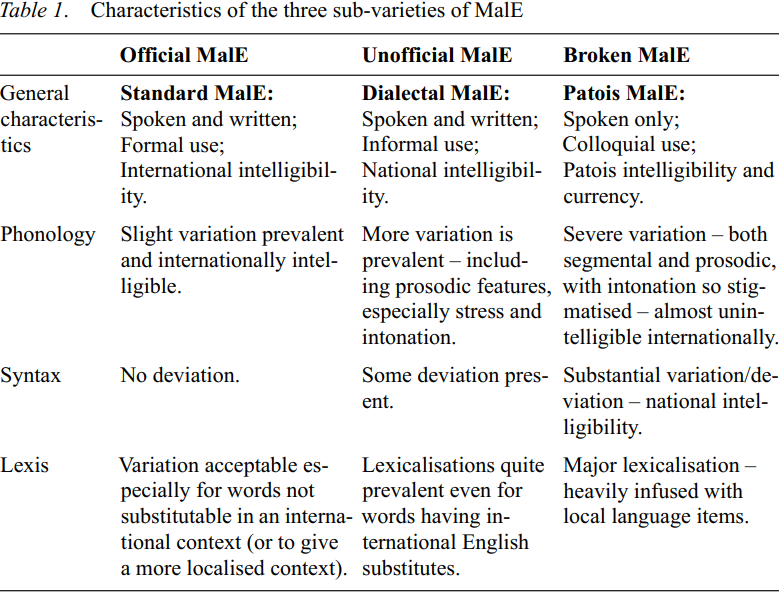
Many researchers have described ‘ESM’ in terms of a standard and colloquial form with various terms like ‘standard’, ‘informal’, ‘uneducated’, ‘low’ and ‘communicative forms’. Platt and Weber (1980), along with Mary Tay (1993). I, too, prefer to take a three-tiered approach to describing MalE although I prefer to use the terms official MalE (standard MalE), Unofficial MalE (dialectal MalE) and Broken MalE (patois MalE). Thus the basic subdivision in my description of MalE would be as tabulated below:
 الاكثر قراءة في Phonology
 اخر الاخبار
اخبار العتبة العباسية المقدسة

الآخبار الصحية


مواضيع ذات صلة
 قسم الشؤون الفكرية يصدر كتاباً يوثق تاريخ السدانة في العتبة العباسية المقدسة
 "المهمة".. إصدار قصصي يوثّق القصص الفائزة في مسابقة فتوى الدفاع المقدسة للقصة القصيرة
 (نوافذ).. إصدار أدبي يوثق القصص الفائزة في مسابقة الإمام العسكري (عليه السلام)






