









Grammar
Tenses
Present

Present Simple
Present Continuous
Present Perfect
Present Perfect Continuous
Past
Past Simple
Past Continuous
Past Perfect
Past Perfect Continuous
Future
Future Simple
Future Continuous
Future Perfect
Future Perfect Continuous
Parts Of Speech
Nouns
Countable and uncountable nouns
Verbal nouns
Singular and Plural nouns
Proper nouns
Nouns gender
Nouns definition
Concrete nouns
Abstract nouns
Common nouns
Collective nouns
Definition Of Nouns
Animate and Inanimate nouns
Nouns
Verbs
Stative and dynamic verbs
Finite and nonfinite verbs
To be verbs
Transitive and intransitive verbs
Auxiliary verbs
Modal verbs
Regular and irregular verbs
Action verbs
Verbs
Adverbs
Relative adverbs
Interrogative adverbs
Adverbs of time
Adverbs of place
Adverbs of reason
Adverbs of quantity
Adverbs of manner
Adverbs of frequency
Adverbs of affirmation
Adverbs
Adjectives
Quantitative adjective
Proper adjective
Possessive adjective
Numeral adjective
Interrogative adjective
Distributive adjective
Descriptive adjective
Demonstrative adjective
Pronouns
Subject pronoun
Relative pronoun
Reflexive pronoun
Reciprocal pronoun
Possessive pronoun
Personal pronoun
Interrogative pronoun
Indefinite pronoun
Emphatic pronoun
Distributive pronoun
Demonstrative pronoun
Pronouns
Pre Position
Preposition by function
Time preposition
Reason preposition
Possession preposition
Place preposition
Phrases preposition
Origin preposition
Measure preposition
Direction preposition
Contrast preposition
Agent preposition
Preposition by construction
Simple preposition
Phrase preposition
Double preposition
Compound preposition
prepositions
Conjunctions
Subordinating conjunction
Correlative conjunction
Coordinating conjunction
Conjunctive adverbs
conjunctions
Interjections
Express calling interjection
Phrases
Sentences
Clauses
Part of Speech
Grammar Rules
Passive and Active
Preference
Requests and offers
wishes
Be used to
Some and any
Could have done
Describing people
Giving advices
Possession
Comparative and superlative
Giving Reason
Making Suggestions
Apologizing
Forming questions
Since and for
Directions
Obligation
Adverbials
invitation
Articles
Imaginary condition
Zero conditional
First conditional
Second conditional
Third conditional
Reported speech
Demonstratives
Determiners
Direct and Indirect speech
Linguistics
Phonetics
Phonology
Linguistics fields
Syntax
Morphology
Semantics
pragmatics
History
Writing
Grammar
Phonetics and Phonology
Semiotics
Reading Comprehension
Elementary
Intermediate
Advanced
Teaching Methods
Teaching Strategies
Assessment

Stress patterns
 المؤلف:
Lionel Wee
المؤلف:
Lionel Wee
 المصدر:
A Handbook Of Varieties Of English Phonology
المصدر:
A Handbook Of Varieties Of English Phonology
 الجزء والصفحة:
1030-60
الجزء والصفحة:
1030-60
 2024-06-14
 1645
1645




+
-
20
Stress patterns
Patterns of stress assignment are difficult to detect in CollSgE because of its syllable-timed rhythm. Since all syllables are given equal time, it is not always easy to detect relative differences in prominence among the syllables. This is unlike a stress-timed variety, where stressed syllables are typically realized with higher pitch, loudness and length.
Tay (1993: 27-28) suggests a number of ways in which CollSgE stress patterns are distinctive. One is the use of equal stress in words which otherwise receive primary and secondary stress. Thus, in RP, a word like celebration receives primary stress on the syllable bra. In CollSgE, however, all four syllables receive equal stress.

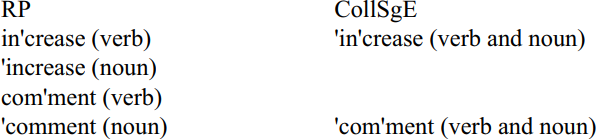
Another source of distinctiveness arises from the absence of differential stress patterns to mark changes in parts of speech. Thus, whether as a verb or a noun, the word increase is stressed in the same way; there is no difference in stress pattern corresponding to the change in grammatical category. This contrasts with RP, where in the case of increase, for example, stress is mainly on the second syllable (if meant as a verb) and on the first syllable (if meant as a noun).
Similarly, in RP, stress placement systematically distinguishes compounds from phrases. Thus if white house is a phrase, stress falls on house, while if it is a compound, stress falls on white. In CollSgE, however, regardless of whether it is a phrase or a compound, stress is consistently placed on the second word house. Thus stress in CollSgE does not distinguish nouns from verbs, nor compounds from phrases.
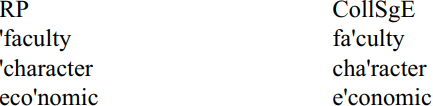
And finally, there is also the fact that in a number of words, the placement of stress simply occurs on a different syllable.
Trying to formulate a set of general rules that would predict how stress assignment works in CollSgE is not easy. However, there is a general opinion that stress in CollSgE tends to be oriented towards the end of a word. More specific attempts to describe the rules of CollSgE stress assignment run into difficulties. For example, Bao (1998: 169) suggests three possible rules: heavy syllables are stressed, stress occurs on alternative syllables, and if a word has more than one stressed syllable, the last stressed syllable carries the main stress. The distinction between heavy and non-heavy (light) syllables is based on the length of the vowel, which is assumed to be phonemically distinctive even though there is no phonetic evidence for this assumption. Bao thus acknowledges that for the rules to work, he has to assume that vowel length is phonemic in CollSgE. But this is a highly controversial assumption since there is no real evidence internal to CollSgE for treating vowel length as phonemic; the only justification is to argue, as Bao himself does, that RP (where vowel length is indeed phonemic) acts as the input to CollSgE. This is a position that other researchers may find untenable since it undermines claims that CollSgE can or should be analyzed as an autonomous variety without reference to more established varieties (e.g. Hung, 1995: 30).
 الاكثر قراءة في Phonology
 اخر الاخبار
اخبار العتبة العباسية المقدسة

الآخبار الصحية


مواضيع ذات صلة
 قسم الشؤون الفكرية يصدر كتاباً يوثق تاريخ السدانة في العتبة العباسية المقدسة
 "المهمة".. إصدار قصصي يوثّق القصص الفائزة في مسابقة فتوى الدفاع المقدسة للقصة القصيرة
 (نوافذ).. إصدار أدبي يوثق القصص الفائزة في مسابقة الإمام العسكري (عليه السلام)






