









Grammar
Tenses
Present

Present Simple
Present Continuous
Present Perfect
Present Perfect Continuous
Past
Past Simple
Past Continuous
Past Perfect
Past Perfect Continuous
Future
Future Simple
Future Continuous
Future Perfect
Future Perfect Continuous
Parts Of Speech
Nouns
Countable and uncountable nouns
Verbal nouns
Singular and Plural nouns
Proper nouns
Nouns gender
Nouns definition
Concrete nouns
Abstract nouns
Common nouns
Collective nouns
Definition Of Nouns
Animate and Inanimate nouns
Nouns
Verbs
Stative and dynamic verbs
Finite and nonfinite verbs
To be verbs
Transitive and intransitive verbs
Auxiliary verbs
Modal verbs
Regular and irregular verbs
Action verbs
Verbs
Adverbs
Relative adverbs
Interrogative adverbs
Adverbs of time
Adverbs of place
Adverbs of reason
Adverbs of quantity
Adverbs of manner
Adverbs of frequency
Adverbs of affirmation
Adverbs
Adjectives
Quantitative adjective
Proper adjective
Possessive adjective
Numeral adjective
Interrogative adjective
Distributive adjective
Descriptive adjective
Demonstrative adjective
Pronouns
Subject pronoun
Relative pronoun
Reflexive pronoun
Reciprocal pronoun
Possessive pronoun
Personal pronoun
Interrogative pronoun
Indefinite pronoun
Emphatic pronoun
Distributive pronoun
Demonstrative pronoun
Pronouns
Pre Position
Preposition by function
Time preposition
Reason preposition
Possession preposition
Place preposition
Phrases preposition
Origin preposition
Measure preposition
Direction preposition
Contrast preposition
Agent preposition
Preposition by construction
Simple preposition
Phrase preposition
Double preposition
Compound preposition
prepositions
Conjunctions
Subordinating conjunction
Correlative conjunction
Coordinating conjunction
Conjunctive adverbs
conjunctions
Interjections
Express calling interjection
Phrases
Sentences
Clauses
Part of Speech
Grammar Rules
Passive and Active
Preference
Requests and offers
wishes
Be used to
Some and any
Could have done
Describing people
Giving advices
Possession
Comparative and superlative
Giving Reason
Making Suggestions
Apologizing
Forming questions
Since and for
Directions
Obligation
Adverbials
invitation
Articles
Imaginary condition
Zero conditional
First conditional
Second conditional
Third conditional
Reported speech
Demonstratives
Determiners
Direct and Indirect speech
Linguistics
Phonetics
Phonology
Linguistics fields
Syntax
Morphology
Semantics
pragmatics
History
Writing
Grammar
Phonetics and Phonology
Semiotics
Reading Comprehension
Elementary
Intermediate
Advanced
Teaching Methods
Teaching Strategies
Assessment

Phonemic inventory
 المؤلف:
Lionel Wee
المؤلف:
Lionel Wee
 المصدر:
A Handbook Of Varieties Of English Phonology
المصدر:
A Handbook Of Varieties Of English Phonology
 الجزء والصفحة:
1024-60
الجزء والصفحة:
1024-60
 2024-06-13
 1842
1842




+
-
20
Phonemic inventory
The following set of keywords illustrates the lexical incidence of the vowels.
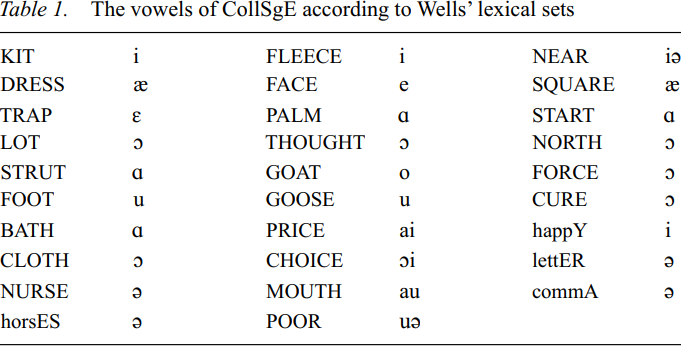
(POOR is not part of the standard lexical set, but has been included here because the CollSgE diphthong /uə/ appears in words such as poor, sure and tour.)
The following table provides a summary of the consonant inventory of CollSgE. It has been noted that accents of English do not differ very much in their consonant inventories, and in this respect, the consonant inventory of CollSgE is similar to that of a variety such as RP.
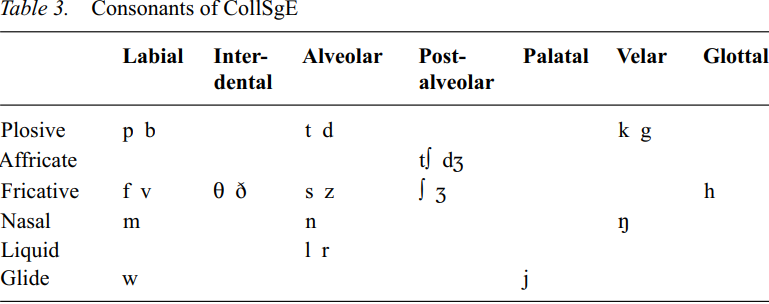
Two points are particularly worth noting. One, there is no aspiration of voiceless plosives or affricates in CollSgE. This means that /p/, for example, is realized the same way in words like pin and spin. Two, the interdental fricatives tend to be realized as [t, d] when pre-vocalic and [f] when at the end of a word. For example, thin is realized as [tin] and then as [den], but in word-final position, we get [brεf] and [brif] for breath and breathe respectively. This gives an alternation between [f] and [t] in filth [filf] and filthy [filti] since in the second word, the consonant is in pre-vocalic position. Words ending in /t/ do not display this alternation, as seen with a pair such as guilt [gilt] and guilty [gilti]. It is this alternation which leads Hung (1995: 32) to tentatively posit the interdental fricatives as CollSgE phonemes even though they are, in fact, never phonetically realized as such:
It is therefore quite possible that there is a separate phoneme in SE (represented in other accents as /θ/) which is distinct from /t/ and /f/, and which is phonetically realized as [t] in the onset and [f] in the coda of a syllable. Obviously, further data and analysis are required before any such conclusion can be drawn.
Hung’s caution is understandable since this, of course, bears on the theoretical question of just how abstract phonological representations ought to be. This is a controversial issue, and perhaps particularly so in the study of new varieties of English since there are often ideological as well as more ‘purely’ linguistic ones for wanting to treat each variety as a self-contained system. Whether this is in fact possible is a matter of some contention.
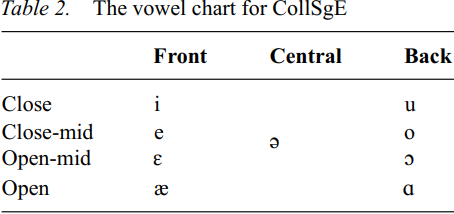
Where the vowels are concerned, CollSgE contains nine monophthongs and five diphthongs. Table 2 provides a list of the monophthongs. The five CollSgE diphthongs are /ai, ɔi, au, iə, uə/.
Two features of the CollSgE vowels bear mentioning, both relating to the neutralization of vowel distinctions. The first is that there is no length contrast so that any length difference tends to be sporadic. Hung (1995: 29) points out that while Singaporean speakers may be able to detect and even mimic vowel length differences in other varieties of English, "in their own spontaneous, natural speech, no distinction is normally made…". Thus, the distinction found in RP, for example, in pairs like pool/pull or beat/bit is absent in CollSgE; the pairs are essentially homophonous instead. The other is that there is also no contrast between tense and lax vowels so that all vowels tend to be ‘equally tense’. However, given that the tense-lax distinction has been criticized for being too vague, and that tense vowels are more likely to be longer, it might be possible to reduce the two features to one, and simply note the absence of contrastive vowel length in CollSgE.
 الاكثر قراءة في Phonology
 اخر الاخبار
اخبار العتبة العباسية المقدسة

الآخبار الصحية


مواضيع ذات صلة
 قسم الشؤون الفكرية يصدر كتاباً يوثق تاريخ السدانة في العتبة العباسية المقدسة
 "المهمة".. إصدار قصصي يوثّق القصص الفائزة في مسابقة فتوى الدفاع المقدسة للقصة القصيرة
 (نوافذ).. إصدار أدبي يوثق القصص الفائزة في مسابقة الإمام العسكري (عليه السلام)






