









Grammar
Tenses
Present

Present Simple
Present Continuous
Present Perfect
Present Perfect Continuous
Past
Past Simple
Past Continuous
Past Perfect
Past Perfect Continuous
Future
Future Simple
Future Continuous
Future Perfect
Future Perfect Continuous
Parts Of Speech
Nouns
Countable and uncountable nouns
Verbal nouns
Singular and Plural nouns
Proper nouns
Nouns gender
Nouns definition
Concrete nouns
Abstract nouns
Common nouns
Collective nouns
Definition Of Nouns
Animate and Inanimate nouns
Nouns
Verbs
Stative and dynamic verbs
Finite and nonfinite verbs
To be verbs
Transitive and intransitive verbs
Auxiliary verbs
Modal verbs
Regular and irregular verbs
Action verbs
Verbs
Adverbs
Relative adverbs
Interrogative adverbs
Adverbs of time
Adverbs of place
Adverbs of reason
Adverbs of quantity
Adverbs of manner
Adverbs of frequency
Adverbs of affirmation
Adverbs
Adjectives
Quantitative adjective
Proper adjective
Possessive adjective
Numeral adjective
Interrogative adjective
Distributive adjective
Descriptive adjective
Demonstrative adjective
Pronouns
Subject pronoun
Relative pronoun
Reflexive pronoun
Reciprocal pronoun
Possessive pronoun
Personal pronoun
Interrogative pronoun
Indefinite pronoun
Emphatic pronoun
Distributive pronoun
Demonstrative pronoun
Pronouns
Pre Position
Preposition by function
Time preposition
Reason preposition
Possession preposition
Place preposition
Phrases preposition
Origin preposition
Measure preposition
Direction preposition
Contrast preposition
Agent preposition
Preposition by construction
Simple preposition
Phrase preposition
Double preposition
Compound preposition
prepositions
Conjunctions
Subordinating conjunction
Correlative conjunction
Coordinating conjunction
Conjunctive adverbs
conjunctions
Interjections
Express calling interjection
Phrases
Sentences
Clauses
Part of Speech
Grammar Rules
Passive and Active
Preference
Requests and offers
wishes
Be used to
Some and any
Could have done
Describing people
Giving advices
Possession
Comparative and superlative
Giving Reason
Making Suggestions
Apologizing
Forming questions
Since and for
Directions
Obligation
Adverbials
invitation
Articles
Imaginary condition
Zero conditional
First conditional
Second conditional
Third conditional
Reported speech
Demonstratives
Determiners
Direct and Indirect speech
Linguistics
Phonetics
Phonology
Linguistics fields
Syntax
Morphology
Semantics
pragmatics
History
Writing
Grammar
Phonetics and Phonology
Semiotics
Reading Comprehension
Elementary
Intermediate
Advanced
Teaching Methods
Teaching Strategies
Assessment

Southeastern phonology: consonants P, T, K
 المؤلف:
Ulrike Altendorf and Dominic Watt
المؤلف:
Ulrike Altendorf and Dominic Watt
 المصدر:
A Handbook Of Varieties Of English Phonology
المصدر:
A Handbook Of Varieties Of English Phonology
 الجزء والصفحة:
192-9
الجزء والصفحة:
192-9
 2024-03-07
 1486
1486




+
-
20
Southeastern phonology: consonants
P, T, K
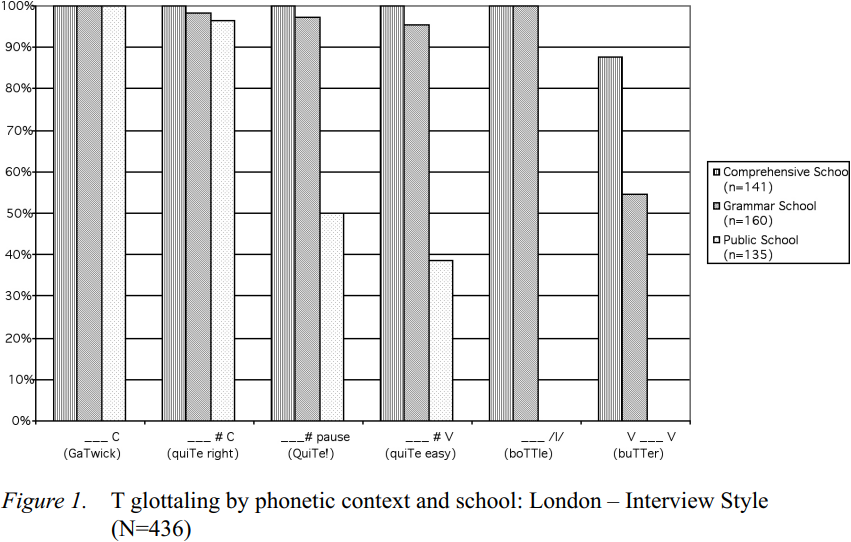
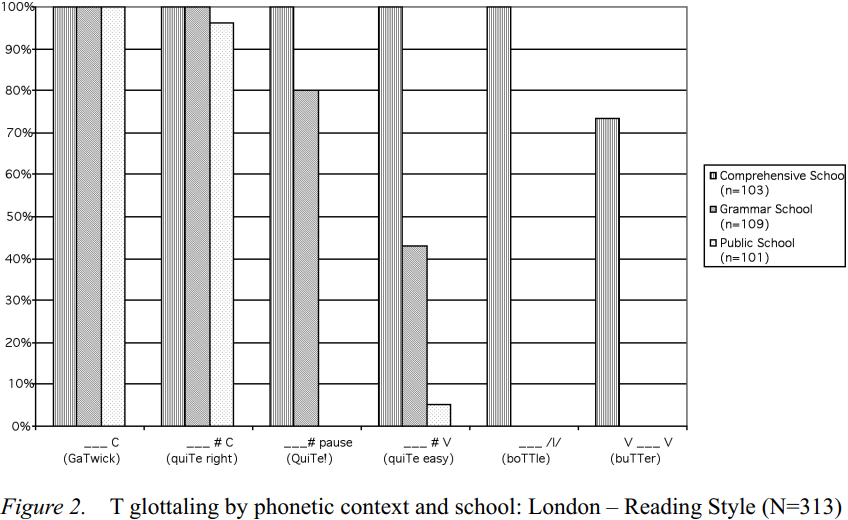
Pre-glottalization and glottal replacement of syllable-final /t/ and (to a lesser extent) /p/ and /k/ are very common in London and the Southeast. Despite its wide geographical dissemination, T glottalling has a tradition of being regarded as a stereotype of London English. Its current spread (at least in the Southeast) is equally ascribed to the “influence of London English, where it is indeed very common” (Wells 1982: 323). In recent years, glottalling – and in particular T glottalling – has increased dramatically in all social classes, styles and phonetic contexts. Social differentiation is, however, retained by differences in frequency and distribution of the glottal variant in different phonetic contexts. The result of this interplay can be seen in Figures 1 and 2, taken from Altendorf (2003). These data show the frequency of T glottaling in two styles of speech produced by schoolchildren drawn from three school types (comprehensive, grammar, and public) and demonstrate marked contextual effects for some speaker groups.
Phonetic constraints affect the occurrence and frequency of the glottal variant in the following order: pre-consonantal position (Scotland, quite nice) > pre-vocalic across word boundaries (quite easy) and pre-pausal position (Quite!) > word-internal pre-lateral position (bottle) > word-internal intervocalic position (butter). Their effect is further enhanced by social and stylistic factors:
(1) Middle-class speakers differ from working-class speakers by avoiding the glottal variant in socially sensitive positions when speaking in more formal styles. They reduce the frequency of the glottal variant in pre-pausal and prevocalic positions (as in Quite! and quite easy), and avoid it completely in the most stigmatized word-internal intervocalic position (as in butter).
(2) Upper-middle-class speakers differ from all other social classes in that they avoid the glottal variant in these socially sensitive positions in both styles. They have a markedly lower frequency of pre-pausal and pre-vocalic T glottaling in the most informal style and avoid it almost completely in the more formal reading style. T glottaling in the most stigmatized positions, in pre-lateral and intervocalic position (as in bottle and butter), does not occur at all for these speakers.
The results for the London upper middle class reported by Altendorf (2003) confirm those of Fabricius (2000). In the results for her young RP speakers, there is no intervocalic T glottaling in any style, and no pre-pausal or pre-vocalic T glottaling in the more formal style. Fabricius also shows that the effect of phonetic context and style is highly significant.
Examination of the result for environment using the Newman Keuls test for pairwise comparison showed that the consonantal environment was significantly different from the pre-vocalic and the pre-pausal environments (p<0.02). The prevocalic and prepausal results were not significantly different from each other. (Fabricius 2000: 140)
It is also interesting to note that T glottaling displays regional variation within Fabricius’ group of RP speakers.
Pre-consonantal glottalling can reasonably be regarded as the ‘first wave’ of glottalling. The ‘second wave’ seems to be the prepausal category, which shows a significant difference between the Southeastern category and the ‘rest of England’ category. As we have seen, London and the Home Counties pattern together on this feature, while the rest of England lags behind. The ‘newest’ wave of glottalling is evident in the pre-vocalic category, where the London-raised public school speakers use pre-vocalic t-glottalling at a significantly higher rate than speakers from other parts of England in less formal styles of speech. (Fabricius 2000: 134)
 الاكثر قراءة في Phonology
 اخر الاخبار
اخبار العتبة العباسية المقدسة

الآخبار الصحية


مواضيع ذات صلة
 قسم الشؤون الفكرية يصدر كتاباً يوثق تاريخ السدانة في العتبة العباسية المقدسة
 "المهمة".. إصدار قصصي يوثّق القصص الفائزة في مسابقة فتوى الدفاع المقدسة للقصة القصيرة
 (نوافذ).. إصدار أدبي يوثق القصص الفائزة في مسابقة الإمام العسكري (عليه السلام)






