Grammar
Tenses
Present

Present Simple
Present Continuous
Present Perfect
Present Perfect Continuous
Past
Past Simple
Past Continuous
Past Perfect
Past Perfect Continuous
Future
Future Simple
Future Continuous
Future Perfect
Future Perfect Continuous
Parts Of Speech
Nouns
Countable and uncountable nouns
Verbal nouns
Singular and Plural nouns
Proper nouns
Nouns gender
Nouns definition
Concrete nouns
Abstract nouns
Common nouns
Collective nouns
Definition Of Nouns
Animate and Inanimate nouns
Nouns
Verbs
Stative and dynamic verbs
Finite and nonfinite verbs
To be verbs
Transitive and intransitive verbs
Auxiliary verbs
Modal verbs
Regular and irregular verbs
Action verbs
Verbs
Adverbs
Relative adverbs
Interrogative adverbs
Adverbs of time
Adverbs of place
Adverbs of reason
Adverbs of quantity
Adverbs of manner
Adverbs of frequency
Adverbs of affirmation
Adverbs
Adjectives
Quantitative adjective
Proper adjective
Possessive adjective
Numeral adjective
Interrogative adjective
Distributive adjective
Descriptive adjective
Demonstrative adjective
Pronouns
Subject pronoun
Relative pronoun
Reflexive pronoun
Reciprocal pronoun
Possessive pronoun
Personal pronoun
Interrogative pronoun
Indefinite pronoun
Emphatic pronoun
Distributive pronoun
Demonstrative pronoun
Pronouns
Pre Position
Preposition by function
Time preposition
Reason preposition
Possession preposition
Place preposition
Phrases preposition
Origin preposition
Measure preposition
Direction preposition
Contrast preposition
Agent preposition
Preposition by construction
Simple preposition
Phrase preposition
Double preposition
Compound preposition
prepositions
Conjunctions
Subordinating conjunction
Correlative conjunction
Coordinating conjunction
Conjunctive adverbs
conjunctions
Interjections
Express calling interjection
Phrases
Sentences
Clauses
Part of Speech
Grammar Rules
Passive and Active
Preference
Requests and offers
wishes
Be used to
Some and any
Could have done
Describing people
Giving advices
Possession
Comparative and superlative
Giving Reason
Making Suggestions
Apologizing
Forming questions
Since and for
Directions
Obligation
Adverbials
invitation
Articles
Imaginary condition
Zero conditional
First conditional
Second conditional
Third conditional
Reported speech
Demonstratives
Determiners
Direct and Indirect speech
Linguistics
Phonetics
Phonology
Linguistics fields
Syntax
Morphology
Semantics
pragmatics
History
Writing
Grammar
Phonetics and Phonology
Semiotics
Reading Comprehension
Elementary
Intermediate
Advanced
Teaching Methods
Teaching Strategies
Assessment

Dialect levelling in the Southeast
 المؤلف:
Ulrike Altendorf and Dominic Watt
المؤلف:
Ulrike Altendorf and Dominic Watt
 المصدر:
A Handbook Of Varieties Of English Phonology
المصدر:
A Handbook Of Varieties Of English Phonology
 الجزء والصفحة:
182-9
الجزء والصفحة:
182-9
 2024-03-06
 1859
1859




+
-
20
Dialect levelling in the Southeast
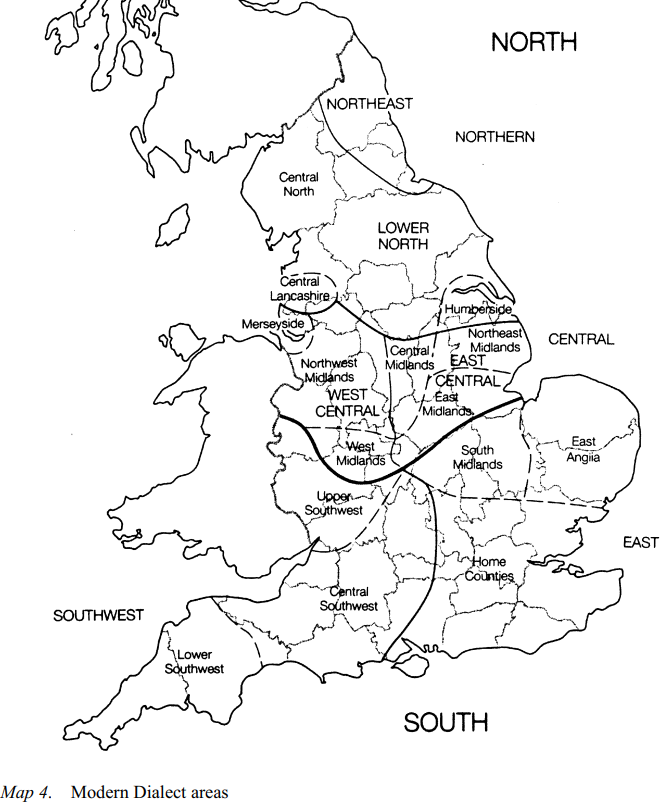
The restructuring of the Southeastern dialect area is in large part due to processes of linguistic convergence (e.g. Williams and Kerswill 1999; Kerswill 2002). These processes have, it is argued, been promoted by an increase in geographical mobility in the second half of the 20th century. Mobility and migration have taken place in three different directions:
Trend I: Centrifugal migration:
Londoners have been moving out of the capital since the Second World War, during which time London was the most heavily bombed city in Britain. The Blitz forced millions of families out of their London homes into the country. After the war, and for less dramatic reasons, around one million overspill Londoners were re-housed in municipal re-housing schemes designed to decentralize the metropolitan population. For this purpose, a number of new towns, among them Milton Keynes, Stevenage, Hemel Hempstead, Bracknell and Basildon, were founded within an eighty-kilometre radius of London. In more recent years, young families and old-age pensioners have also often moved out of the city. Young families have been moving into the London suburbs or the neighboring Home Counties to bring up their children in a safer and more pleasant environment. Old-age pensioners have been moving away to realize, where feasible, the English dream of buying a house by the seaside or a cottage in the country, or for less idealistic motives such as unaffordable London rents and living costs, spiralling crime and alienation. Lately, the increased necessity and willingness to commute has further enhanced the interchange between London and elsewhere.
(2) Trend II: Centripetal migration (Moving to the Southeast and the “NorthSouth divide”):
Since the economic revival of the Thatcher era, employment growth in Southeastern England has outstripped that in the rest of the United Kingdom. The media regularly report on the “North-South divide”, a term used to imply stronger economic growth and higher living standards in the South of England than in the North. This economic prosperity has attracted many (work) migrants, mostly to Southeastern areas outside London. The population in these areas has therefore grown at a faster rate than in the rest of the country. Today, about one third of the population of the United Kingdom lives in Southeast England.
(3) Trend III: Internal migration within the Southeast:
As people resident in the Southeast now tend to change their place of work more often than they used to, there has been a resultant increase in the levels of admixture of the population within the region. These processes of mobility have increased face-to-face interaction among speakers of different accents. This kind of communicative situation tends to bring about short-term accommodation among the interlocutors, which in turn can then lead to long-term accommodation, accent convergence and change, providing that attitudinal factors are favorable. In addition, mobility has been shown to weaken network ties and to promote the diffusion of “new” variants. In the Southeast, these processes have been dominated by the “London element”. Faced with a choice between a London variant and one associated with a rural or provincial accent, most young speakers have tended to opt for the former. This is likely to be particularly true for those young professionals who have been moving to the Southeast from other parts of Britain. To employ a term coined in the 1980s, a metropolitan accent is higher on “street cred” than a provincial one. This does not mean, however, that local accent features have been completely lost. The dialect survey by Williams and Kerswill (1999), for instance, has shown that there are still qualitative and quantitative differences between the accents of adolescents in the two Southeastern towns of Milton Keynes and Reading.
 الاكثر قراءة في Phonology
 اخر الاخبار
اخبار العتبة العباسية المقدسة

الآخبار الصحية


مواضيع ذات صلة
 قسم الشؤون الفكرية يصدر كتاباً يوثق تاريخ السدانة في العتبة العباسية المقدسة
 "المهمة".. إصدار قصصي يوثّق القصص الفائزة في مسابقة فتوى الدفاع المقدسة للقصة القصيرة
 (نوافذ).. إصدار أدبي يوثق القصص الفائزة في مسابقة الإمام العسكري (عليه السلام)