









Grammar
Tenses
Present

Present Simple
Present Continuous
Present Perfect
Present Perfect Continuous
Past
Past Simple
Past Continuous
Past Perfect
Past Perfect Continuous
Future
Future Simple
Future Continuous
Future Perfect
Future Perfect Continuous
Parts Of Speech
Nouns
Countable and uncountable nouns
Verbal nouns
Singular and Plural nouns
Proper nouns
Nouns gender
Nouns definition
Concrete nouns
Abstract nouns
Common nouns
Collective nouns
Definition Of Nouns
Animate and Inanimate nouns
Nouns
Verbs
Stative and dynamic verbs
Finite and nonfinite verbs
To be verbs
Transitive and intransitive verbs
Auxiliary verbs
Modal verbs
Regular and irregular verbs
Action verbs
Verbs
Adverbs
Relative adverbs
Interrogative adverbs
Adverbs of time
Adverbs of place
Adverbs of reason
Adverbs of quantity
Adverbs of manner
Adverbs of frequency
Adverbs of affirmation
Adverbs
Adjectives
Quantitative adjective
Proper adjective
Possessive adjective
Numeral adjective
Interrogative adjective
Distributive adjective
Descriptive adjective
Demonstrative adjective
Pronouns
Subject pronoun
Relative pronoun
Reflexive pronoun
Reciprocal pronoun
Possessive pronoun
Personal pronoun
Interrogative pronoun
Indefinite pronoun
Emphatic pronoun
Distributive pronoun
Demonstrative pronoun
Pronouns
Pre Position
Preposition by function
Time preposition
Reason preposition
Possession preposition
Place preposition
Phrases preposition
Origin preposition
Measure preposition
Direction preposition
Contrast preposition
Agent preposition
Preposition by construction
Simple preposition
Phrase preposition
Double preposition
Compound preposition
prepositions
Conjunctions
Subordinating conjunction
Correlative conjunction
Coordinating conjunction
Conjunctive adverbs
conjunctions
Interjections
Express calling interjection
Phrases
Sentences
Clauses
Part of Speech
Grammar Rules
Passive and Active
Preference
Requests and offers
wishes
Be used to
Some and any
Could have done
Describing people
Giving advices
Possession
Comparative and superlative
Giving Reason
Making Suggestions
Apologizing
Forming questions
Since and for
Directions
Obligation
Adverbials
invitation
Articles
Imaginary condition
Zero conditional
First conditional
Second conditional
Third conditional
Reported speech
Demonstratives
Determiners
Direct and Indirect speech
Linguistics
Phonetics
Phonology
Linguistics fields
Syntax
Morphology
Semantics
pragmatics
History
Writing
Grammar
Phonetics and Phonology
Semiotics
Reading Comprehension
Elementary
Intermediate
Advanced
Teaching Methods
Teaching Strategies
Assessment

Prosodic and intonational features
 المؤلف:
Joan Beal
المؤلف:
Joan Beal
 المصدر:
A Handbook Of Varieties Of English Phonology
المصدر:
A Handbook Of Varieties Of English Phonology
 الجزء والصفحة:
130-6
الجزء والصفحة:
130-6
 2024-02-26
 1605
1605




+
-
20
Prosodic and intonational features
Although popular discussions of dialect often refer to the speech of a certain area as sing-song, lilting or monotonous, until very recently there has been relatively little research on the prosodic and intonational features of northern English dialects, except for the discussion of the sociolinguistic patterning of intonational variation in Tyneside English in Pellowe and Jones (1978). However, preliminary results from the Intonational Variation in English (IviE) project indicate that “dialect variation is a significant variable in prosodic typology” (Grabe and Post 2002: 346). An intonational pattern known as the Urban Northern British Rise occurs in Newcastle (as well as in Belfast and Dublin). In this pattern, there is a rise-plateau intonation in declarative sentences, distinct from the high rising tone heard in Australian and New Zealand English. This intonation is highly salient for Tyneside English, but can also be found in other northern British varieties. Grabe and Post (2002) also found differences between dialects of English with regard to the truncation or compression of falling accents on “very short IP-final words” (Grabe and Post 2002: 345). Whereas speakers in Leeds and Liverpool tended to truncate these patterns, those in Newcastle compressed them. Clearly, there is much work to be done on the study of intonational variation in English dialects, but these findings support the division of northern dialects into middle North and far North.
Even less research has been carried out on prosodic variation in English dialects. Here, again, the North-East is distinct from the rest of the North, with a tendency for level stress, or with the main stress on the second element, in compounds. The place name Stakeford (in Northumberland) is pronounced with equal stress on each element, whereas a speaker from outside the region would pronounce it 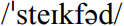 . Likewise, pitheap, the Northumbrian word for a colliery spoil heap, is pronounced
 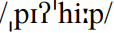 .
.
 الاكثر قراءة في Phonology
 اخر الاخبار
اخبار العتبة العباسية المقدسة

الآخبار الصحية


مواضيع ذات صلة
 قسم الشؤون الفكرية يصدر كتاباً يوثق تاريخ السدانة في العتبة العباسية المقدسة
 "المهمة".. إصدار قصصي يوثّق القصص الفائزة في مسابقة فتوى الدفاع المقدسة للقصة القصيرة
 (نوافذ).. إصدار أدبي يوثق القصص الفائزة في مسابقة الإمام العسكري (عليه السلام)






