Grammar
Tenses
Present

Present Simple
Present Continuous
Present Perfect
Present Perfect Continuous
Past
Past Simple
Past Continuous
Past Perfect
Past Perfect Continuous
Future
Future Simple
Future Continuous
Future Perfect
Future Perfect Continuous
Parts Of Speech
Nouns
Countable and uncountable nouns
Verbal nouns
Singular and Plural nouns
Proper nouns
Nouns gender
Nouns definition
Concrete nouns
Abstract nouns
Common nouns
Collective nouns
Definition Of Nouns
Animate and Inanimate nouns
Nouns
Verbs
Stative and dynamic verbs
Finite and nonfinite verbs
To be verbs
Transitive and intransitive verbs
Auxiliary verbs
Modal verbs
Regular and irregular verbs
Action verbs
Verbs
Adverbs
Relative adverbs
Interrogative adverbs
Adverbs of time
Adverbs of place
Adverbs of reason
Adverbs of quantity
Adverbs of manner
Adverbs of frequency
Adverbs of affirmation
Adverbs
Adjectives
Quantitative adjective
Proper adjective
Possessive adjective
Numeral adjective
Interrogative adjective
Distributive adjective
Descriptive adjective
Demonstrative adjective
Pronouns
Subject pronoun
Relative pronoun
Reflexive pronoun
Reciprocal pronoun
Possessive pronoun
Personal pronoun
Interrogative pronoun
Indefinite pronoun
Emphatic pronoun
Distributive pronoun
Demonstrative pronoun
Pronouns
Pre Position
Preposition by function
Time preposition
Reason preposition
Possession preposition
Place preposition
Phrases preposition
Origin preposition
Measure preposition
Direction preposition
Contrast preposition
Agent preposition
Preposition by construction
Simple preposition
Phrase preposition
Double preposition
Compound preposition
prepositions
Conjunctions
Subordinating conjunction
Correlative conjunction
Coordinating conjunction
Conjunctive adverbs
conjunctions
Interjections
Express calling interjection
Phrases
Sentences
Clauses
Part of Speech
Grammar Rules
Passive and Active
Preference
Requests and offers
wishes
Be used to
Some and any
Could have done
Describing people
Giving advices
Possession
Comparative and superlative
Giving Reason
Making Suggestions
Apologizing
Forming questions
Since and for
Directions
Obligation
Adverbials
invitation
Articles
Imaginary condition
Zero conditional
First conditional
Second conditional
Third conditional
Reported speech
Demonstratives
Determiners
Direct and Indirect speech
Linguistics
Phonetics
Phonology
Linguistics fields
Syntax
Morphology
Semantics
pragmatics
History
Writing
Grammar
Phonetics and Phonology
Semiotics
Reading Comprehension
Elementary
Intermediate
Advanced
Teaching Methods
Teaching Strategies
Assessment

Language shift in early modern Ireland
 المؤلف:
Raymond Hickey
المؤلف:
Raymond Hickey
 المصدر:
A Handbook Of Varieties Of English Phonology
المصدر:
A Handbook Of Varieties Of English Phonology
 الجزء والصفحة:
70-4
الجزء والصفحة:
70-4
 2024-02-16
 1658
1658




+
-
20
Language shift in early modern Ireland
Literary parodies do not reveal anything about the then relationship of Irish to English, the spread of English and the regional input from England. There were no censuses before 1851 which gave data on speakers of Irish and English. Adams (1965) is a useful attempt to nonetheless produce a linguistic cartography of Ireland at the beginning of the early modern period. The upshot of this situation is that there is no reliable data on the language shift which began in earnest in the early 17th century and which had been all but completed by the late 19th century.
It is clear that the Irish learned English from other Irish who already knew some, perhaps through contact with those urban Irish who were English speakers, especially on the east coast and through contact with the English planters and their employees. This fact had consequences for the nature of Irish English. Bliss (1977) pointed out that this fact is responsible for both the common malapropisms and the unconventional word stress found in Irish English. However, the stress pattern in verbs with final long vowels, e.g. distribute 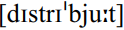 , educate [edjuIke:t] , can also be due to English input, particularly as late stress is a feature of southern Irish, not of the west and north, and so influence due to contact with Irish could only be posited for the south of Ireland.
Another point concerning the language shift in Ireland is that it was relatively long, spanning at least three centuries from 1600 to 1900 for most of the country. The scenario for language shift is one where lexical transfer into English is unlikely, or at least unlikely to become established in any nascent supraregional variety of English in Ireland. Such dictionaries as Ó Muirithe (1996) and to a lesser extent Dolan (1998) seem to reveal a large number of Irish loans in present-day Irish English. But the question of currency is the key issue here: there is a great difference between the vocabulary of an older agricultural generation (which is frequently reflected in the entries in these dictionaries) and a younger urban one.
In phonology and syntax the matter is quite different. Speakers who learn a language as adults retain the pronunciation of their native language and have difficulty with segments which are unknown to them. A simple case of this would be the substitution of English dental fricatives by stops (dental or sometimes alveolar, depending on region) in Irish English. A more subtle case would be the lenition of stops in Irish English, e.g. cat [kæt], which, while systemically completely different from lenition in Irish, could be the result of a phonological directive applied by the Irish learning English to lenite elements in positions of maximal sonority.
 الاكثر قراءة في Phonology
 اخر الاخبار
اخبار العتبة العباسية المقدسة

الآخبار الصحية


مواضيع ذات صلة
 قسم الشؤون الفكرية يصدر كتاباً يوثق تاريخ السدانة في العتبة العباسية المقدسة
 "المهمة".. إصدار قصصي يوثّق القصص الفائزة في مسابقة فتوى الدفاع المقدسة للقصة القصيرة
 (نوافذ).. إصدار أدبي يوثق القصص الفائزة في مسابقة الإمام العسكري (عليه السلام)