
Occurrence of Nikel
 المؤلف:
........
المؤلف:
........
 المصدر:
LibreTexts Project
المصدر:
LibreTexts Project
 الجزء والصفحة:
............
الجزء والصفحة:
............
 5-12-2018
 1445
1445
Occurrence of Nikel
Nickel is the earth's 22nd most abundant element and the 7th most abundant transition metal. It is a silver white crystalline metal that occurs in meteors or combined with other elements in ores. Two important groups of ores are:
- Laterites: oxide or silicate ores such as garnierite, (Ni, Mg)6 Si4O10OH)8 which are predominantly found in tropical areas such as New Caledonia, Cuba and Queensland.
- Sulfides: these are ores such as pentlandite, which contain about 1.5%, nickel associated with copper, cobalt and other metals. They are predominant in more temperate regions such as Canada, Russia and South Africa.
Canada is the world's leading nickel producer and the Sudbury Basin of Ontario contains one of the largest nickel deposits in the world.
In 1899 Ludwig Mond developed a process for extracting and purifying nickel. The so-called "Mond Process" involves the conversion of nickel oxides to pure nickel metal. The oxide is obtained from nickel ores by a series of treatments including concentration, roasting and smelting of the minerals.
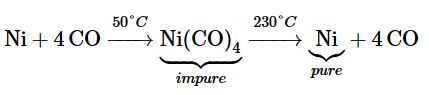
In the first step of the process, nickel oxide is reacted with water gas, a mixture of H2 and CO, at atmospheric pressure and a temperature of 50 °C. The oxide is thus reduced to impure nickel. Reaction of this impure material with residual carbon monoxide gives the toxic and volatile compound, nickel tetracarbonyl, Ni(CO)4. This compound decomposes on heating to about 230 °C to give pure nickel metal and CO, which can then be recycled. The actual temperatures and pressures used in this process may very slightly from one processing plant to the next. However the basic process as outlined is common to all.
The process can be summarized as follows:
 الاكثر قراءة في الجدول الدوري وخواص العناصر
 اخر الاخبار
اخبار العتبة العباسية المقدسة









