الوضع الليلي


 11:57:14
  2026-07-21
  508
508
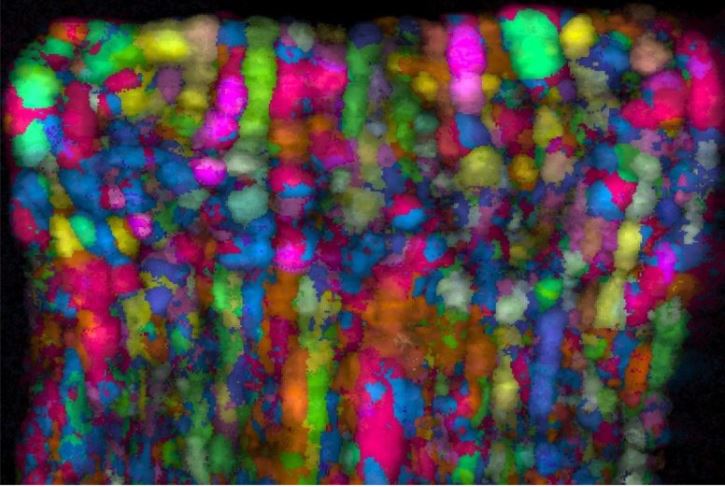
A cobalt aluminum nanolaminate has shattered the usual tradeoff between strength and flexibility, emerging up to 10 times stronger than structural steel without becoming dangerously brittle.
Jet engines demand materials that can survive tremendous heat and force without bending, cracking, or slowly losing their shape. The strongest candidates, however, often come with a major weakness: they are too brittle to deform safely.
Purdue University engineers have now found a way to overcome that tradeoff in cobalt aluminum (CoAl), an intermetallic compound with potential uses in high-performance turbines. By redesigning the material at the nanoscale, the researchers created a form of CoAl that is exceptionally strong but can still undergo substantial deformation at room temperature.
The advance, reported in Science Advances, could point toward a broader strategy for making notoriously brittle intermetallic compounds more practical for aerospace, energy, and defense technologies.
Why Intermetallics Fracture
Intermetallics contain two or more metallic elements arranged in a highly ordered crystal structure. That atomic order can give them remarkable strength, high melting temperatures, and resistance to creep, the slow deformation that occurs when a material remains under stress for long periods.
These qualities are valuable in jet engines, gas turbines, energy storage systems, and automotive components. Yet the same ordered structures that make intermetallics strong can also prevent them from deforming easily. Instead of bending under force, many fracture, particularly at room temperature.
CoAl illustrates this problem. The compound is strong enough to be considered for demanding turbine components, but its brittleness makes it difficult to manufacture into complex shapes and limits its ability to withstand sudden mechanical stress.
“Bulk CoAl intermetallics are a high-strength compound,” said corresponding author Xinghang Zhang, a professor in Purdue’s School of Materials Engineering. “Among other applications, they can potentially be used in the next-generation materials of turbine blades for aeroengines, which are gas turbine engines that generate thrust for aircraft propulsion. High-strength, plastically deformable CoAl alloys could allow an engine or turbo to spin faster while sustaining higher centrifugal force, improving their performance.”
Engineering Helpful Crystal Defects
The researchers approached the problem by deliberately introducing imperfections into the material.
In a crystal, atoms normally follow a repeating geometric pattern. A dislocation is a microscopic disruption in that pattern. Although defects are often associated with weakness, dislocations can give metals a way to change shape by allowing layers of atoms to move rather than break apart.
CoAl typically lacks enough mobile dislocations to deform substantially at room temperature. Previous efforts to improve its plasticity by changing its composition or combining it with other materials had only limited success.
Flexible Interfaces Unlock Plasticity
The Purdue team instead built dislocations directly into CoAl as it formed. They also created a network of amorphous interfaces, thin boundaries where atoms lack the ordered arrangement found in a crystal.
“In this study, we show that CoAl can exhibit significant plasticity at room temperature, offering a new, alternative approach to improve the plastic deformation capability in CoAl,” said Ke Xu, a Purdue postdoctoral researcher and the study’s first author.
These flexible internal boundaries act as more than passive separators. During deformation, parts of the interfaces crystallize and help generate additional dislocations, giving the surrounding CoAl layers more ways to absorb force.
“We directly introduced dislocations in CoAl during sputtering deposition,” Zhang said. “More importantly, we designed the framework of amorphous interfaces (FAIs)—flexible boundaries in the materials for structural flexibility, which partially crystallize during deformation and promote the nucleation of the dislocations in CoAl intermetallics.”
Stronger Than Structural Steel
The resulting nanolaminate reached a yield strength of 6 GPa (gigapascal, a stress measurement), roughly six to 10 times that of high-strength structural steel. Yield strength measures the amount of stress a material can endure before it begins to deform permanently.
Despite that extreme strength, the material sustained 15% plastic strain under compression at room temperature. In other words, it could undergo significant permanent deformation without immediately fracturing.
“This combination of ultrahigh mechanical strength and outstanding plasticity makes the current CoAl nanolaminate system one of the best intermetallic systems reported to date,” Xu said.
Building the Alloy From Vapor
The team produced the material using magnetron sputtering deposition. During this process, atoms are released from a source material and deposited as a thin film on another surface. Unlike conventional casting, which solidifies molten metal, sputtering allows a material to form directly from alloy vapor.
That unconventional route helped trap large numbers of dislocations inside the CoAl while creating the amorphous aluminum-cobalt interfaces.
“This nonequilibrium fabrication approach enables us to fabricate materials from alloy vapor to a solid, introducing a significant number of dislocations in CoAl,” Zhang said. “We were able to achieve significant strength and plasticity in CoAl, which can’t be realized via traditional casting.”
Watching Deformation at the Atomic Scale
The researchers compressed the material while observing it inside a scanning electron microscope. This in situ testing allowed them to track how the microscopic structure changed as the CoAl deformed.
University of Houston professor Yashashree Kulkarni and PhD student Anand Mathew also performed molecular dynamics simulations to examine the process at the atomic level. Their models showed parts of the amorphous interfaces crystallizing under pressure and releasing dislocations into neighboring CoAl layers.
Together, the experiments and simulations suggest that the interfaces function as active sources of plastic deformation. Rather than weakening the material, they help it respond to stress without sacrificing its exceptional strength.
From Nanolayers to Turbine Components
The current material is a nanoscale layered system produced through thin-film deposition, not yet a bulk turbine component. The researchers’ next challenge is to transfer the same structural concept into larger CoAl nanocomposites that could be manufactured at an industrial scale.
“We will also be testing the concept using other intermetallics, with the goal of establishing the general applicability of FAIs for improving plasticity in this metal class,” Xu said.
If the approach works across other compounds, it could provide engineers with a new way to design materials for environments where conventional metals struggle. Instead of choosing between strength and deformability, researchers may be able to engineer both by controlling where defects form and how internal boundaries respond to force.
“Ductile intermetallics will significantly boost our capabilities for designing advanced materials for aerospace and outer space, energy, and defense applications,” Zhang said.
Reality Of Islam |
|

NASA has de
MIT researc
Researchers

Researchers
 9:3:43
2018-11-05
9:3:43
2018-11-05
10 benefits of Marriage in Islam
7:5:22
2019-04-08
benefits of reciting surat yunus, hud &
9:45:7
2018-12-24
advantages & disadvantages of divorce
11:35:12
2018-06-10
6:0:51
2018-10-16
4:25:57
2023-02-11
11:34:48
2022-06-29
9:30:2
2021-11-12
2:42:26
2023-02-02
8:4:21
2022-01-08
6:14:17
2018-06-21
9:39:36
2022-12-28
5:41:46
2023-03-18
| LATEST |
 HOME
HOME