الوضع الليلي


 12:17:1
  2025-08-30
  2189
2189
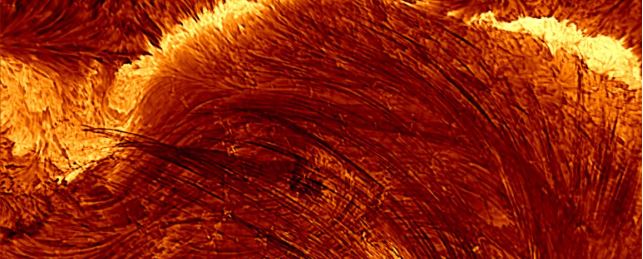
The powerful NSF Inouye Solar Telescope has just delivered absolutely mind-blowing observations of its first X-class solar flare.
On 8 August 2024, the telescope managed to capture one of the most powerful flares our sun is capable of producing – at a remarkable resolution of just four Earths across. This level of detail reveals some of the finest structures we've ever seen associated with a solar flare, opening a new window into the Sun’s most extreme eruptions.
"This is the first time the Inouye Solar Telescope has ever observed an X-class flare," says astronomer Cole Tamburri of the University of California Boulder. "These flares are among the most energetic events our star produces, and we were fortunate to catch this one under perfect observing conditions."
Weather from our Sun can have some profound effects on our planet, with solar flares capable of knocking out radio communication for ours. We're unlikely to be able to change what the Sun does, but if scientists understand how solar flares occur, they can develop better prediction tools that may allow us to prepare ourselves.
Inouye is one of the most powerful solar observatories ever built, and it's revealing structures on the sun at scales finer than any we've seen.
In its observations of the X1.3-class flare that took place in August 2024, Inouye captured the smallest coronal loops we've ever seen. On average, these loops were 48.2 kilometers (30 miles) wide, maybe as small as 21 kilometers, right at the telescope's resolution limit of 24 kilometers.
These loops are thin filaments of plasma that arc over the solar surface, following the magnetic field lines. They sometimes appear just before solar flares, which are powered by the energy released as magnetic field lines twist, snap, and reconnect.
Coronal loops are deeply relevant to models of solar flare generation, but our telescopes have only been powerful enough to resolve loop bundles. Inouye has more than twice the resolving power of the next most powerful solar telescope, and its captures of the flare represent the first time scientists have been able to see individual loops.
"We're finally peering into the spatial scales we've been speculating about for years. This opens the door to studying not just their size, but their shapes, their evolution, and even the scales where magnetic reconnection – the engine behind flares – occurs," Tamburri says.
Reality Of Islam |
|
NASA has de

MIT researc

Researchers

Researchers
 9:3:43
2018-11-05
9:3:43
2018-11-05
10 benefits of Marriage in Islam
7:5:22
2019-04-08
benefits of reciting surat yunus, hud &
9:45:7
2018-12-24
advantages & disadvantages of divorce
11:35:12
2018-06-10
6:0:51
2018-10-16
6:14:3
2023-01-18
9:30:2
2021-11-12
1:16:44
2018-05-14
10:43:56
2022-06-22
2:5:14
2023-01-28
al-hussain (peace be upon him)
10:18:1
2022-09-21
7:34:7
2023-02-28
5:41:46
2023-03-18
| LATEST |
 HOME
HOME