الوضع الليلي


 11:7:27
  2026-08-20
  1122
1122
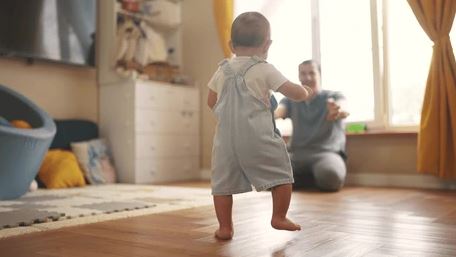
Walking, in the world of childhood, is considered the first step toward independence. One child may be late in taking that step, while another may hurry to embrace the open spaces with his little feet. Faced with the many surprises and complications, parents are left wondering about the reason. The reason is that it is a decision the child must make for himself.
Nader finally decided to free himself from us. We were watching television when he decided to cross the distance between the cabinet and the window, taking twenty steps all at once. As he passed before our eyes, my husband and I exchanged astonished looks without saying a word. We held our breath for fear of disturbing him, until the moment he let himself fall to the floor near the window. Then he approached us as if he were asking us for something. It was a deeply moving moment for us, followed by our congratulations to him. We were even prouder than he was.
The time had come for him to decide whether our holding on to him had become an obstacle, at a time when we knew perfectly well that he had been capable of moving around and getting away from us for more than a month. Everything had been prepared for this step. We had arranged the room to receive his crawling and walking movements; every source of danger had been removed, and anything that could hurt him had been taken out of reach of his hands and height.
Nader's mother continues explaining her concern about her son's ability to walk. She says:
“The younger children in the family began walking at around one year of age, while my son reached fifteen months without taking this step. This caused anxiety to grow in our hearts until he finally did what we had been hoping for.”
Another mother explains how her daughter began walking:
“Of course, it was a very important moment. With Nahida, the matter was simple. She actually began walking fifteen days before her first birthday. She had already been moving around for about a month while holding onto furniture, leaning against walls, or holding an outstretched hand. From time to time, she would agree to take two or three steps to move from one person's arms to another's.
Then, one day, we found her in the middle of the entrance hall, far from all the walls. She calmly crossed the passage between the rooms. With my mouth open in astonishment, I could not stop myself from shouting, ‘Well done! Well done! You're walking! How happy I am!’ But her reaction was immediate. Nahida stopped walking at once and let herself fall to the floor.
Perhaps my happiness had gone beyond the limit. It is very tiring to have a child who is on the verge of walking but never leaves us, hesitating to make the firm decision to do so—and then to have her suddenly encounter the happiness I had openly expressed.
For ten days, Nahida turned a deaf ear to everything we said to her, to our encouragement, and to our insistence. She continued to extend her hand toward us, clearly refusing to walk on her own, as though she had lost everything.
I thought that perhaps, because of falling again and again while trying to walk, she had been hurt and no longer dared to try. Then, after some time, I realized that if she began walking, it would be for her own benefit and comfort, not as a favor to us or to make us happy. It was a decision she had to make herself.”
The moment when a child makes the decision to walk represents a revolution in his existence, as well as in the existence of his parents.
Nader's parents summarize the situation with a specific phrase: “Nader has finally decided to set off.” Every word in this sentence carries significance. The word “finally” points to the parents' desire and eagerness for their child to walk, as well as their impatience with his delayed ability to do so. This may be because he prefers to take his time and remain attached to his parents.
The word “decided” emphasizes that walking is not merely the ability to move one's feet; rather, it is the result of a will aimed at independence.
The word “set off” points to the complexity of the step he has taken. Nader's mother does not say, for example, “He finally decided to let go of our hand.” Instead, she uses an expression that unconsciously carries a deeper meaning: by setting off, Nader is leaving her herself and, in doing so, leaving behind a kind of protection that he no longer needs.
Nahida's mother insists on describing the adventure:
“We found her in the middle of the room, far away from all the walls.”
In her own way, she is trying to make us understand the importance of this movement, through which a child becomes capable of relying on herself while moving away from all forms of protection and confronting the vastness of open spaces. To her mother, the middle of the room seemed like an open sea for her little daughter.
Differences and Similarities
These two children have one point in common: both began walking when their parents were occupied elsewhere. The first was watching television with the family, while the second was in another room or outside.
This reveals something important: walking does not happen according to our wishes through continuous instruction and encouragement from parents. Rather, it happens at the moment when the child takes his or her own position and, in a particular situation where the child is not under the watchful eyes of the parents, takes control and makes the first steps independently.
Nader's parents clearly demonstrated their impatience when his mother said that the house had been prepared for this stage. Every object that could possibly harm the child had been removed or moved away. At the same time, they showed the greatest awareness and understanding of the enormous step their child was taking. They exchanged astonished looks without saying a word so as not to disturb him or cause him to fail in his achievement.
Thus, little Nader undertook a small journey of his own. During it, and by concentrating on himself, he discovered his desire and his ability to face difficulties. If he wanted anything, it was merely to glance toward his parents, reassuring them about what he had accomplished.
Nahida's parents were also caught up in the impact of the happy surprise when they found their daughter in the middle of the room. A quick comment and praise escaped them, although she had not asked for it:
“Wonderful! You've done it! You're walking! How happy we are!”
These words had a negative effect. They caused a loss of concentration, as her mother observed directly.
The fall—and Nahida's decision not to walk for ten days. What happened to her?
What happened was that Nahida's enthusiasm and eager determination to walk suddenly stopped, as though her mother's words had distracted her and disturbed her concentration. Nahida did not want to set off because her mother's words had taken away the special quality of what she was accomplishing. Walking was no longer entirely hers.
She felt that something was not right. Nahida's refusal to walk was nothing more than an expression of her waiting for a moment when she could accomplish it alone, so that she could feel that the achievement belonged exclusively to her.
On the Road Toward Freedom
The moment when a child begins to walk marks an important milestone in his or her development. The changes brought about by walking in the child's world are significant. Walking changes the child's view of the world and raises him to the level of adults who move about proudly.
Learning to walk is similar to acquiring language; it is not simply a matter of being taught. In reality, walking is an undertaking and a risk that changes the child's relationship with the world and with his surroundings. It accompanies the discovery of height, the gaining of freedom and independence, and the ability to do all the seemingly insignificant things the child has dreamed of doing but previously could not.
It also means discovering new boundaries and reaching things that were previously forbidden. It stimulates the child's curiosity. In another sense, it means entering a world of independence and individuality in relation to the parents, while gradually giving up dependence on their protection.
When the moment comes for the child to decide to move forward and free himself, he identifies with the ways his parents move, particularly the parent who carries him or holds his hand—the person who reassures him as he moves around.
Walking, despite its risks, represents awareness and confidence in the child's own abilities, accompanied by great happiness and, sometimes, by cheers and celebration.
When a child takes his first steps, he creates mixed feelings in his parents. There is pride when they say, for example, “He's walking! He's walking!”—an event and an achievement expected after a stage of development that has been lived through.
Sometimes, however, there is impatience, because we do not know who is making whom walk. This achievement is also like a sudden striking blow because it represents a separation that all parties had anticipated and expected.
The child begins walking alone, without the parents playing an active role in making it happen. In the end, the decision belongs to the child. He walks without them and, in many ways, beyond their wishes and eagerness for him to complete this task.
Gaining independence creates a new situation that changes established habits and allows adults to discover that their little child has grown a little more.
This new balance in the child's legs also creates a new balance in his relationship with his parents. Contrary to what one might imagine, parents do not always experience this stage peacefully.
Consider, for example, their reaction when a child suddenly lets go of the hand extended to him while walking along the road. Or consider the father who catches his little one in his arms after the child has just discovered the joy of walking around a shop, only for the child to become restless and roar with anger at being confined, eager to escape and touch everything that arouses his curiosity.
Or what should parents do when the child suddenly refuses to walk because he is tired or because he has simply had enough of it, and asks to return to his mother's exhausted arms despite all the fears, attempts, and setbacks?
Walking changes everything. It is an advance for the child and, in some ways, a relief for the parents, because the child gradually stops disrupting the rhythm of their lives. We see him as a small, independent being, standing proudly on his own feet.
He has decided within himself to be both the little child and the growing one, according to the circumstances and the moment.
Reality Of Islam |
|

Keeping sil

Two experim

Changing a

Plants are
 9:3:43
2018-11-05
9:3:43
2018-11-05
10 benefits of Marriage in Islam
7:5:22
2019-04-08
benefits of reciting surat yunus, hud &
9:45:7
2018-12-24
advantages & disadvantages of divorce
11:35:12
2018-06-10
6:0:51
2018-10-16
5:58:12
2021-12-18
9:42:16
2022-10-19
8:39:51
2022-09-23
2:2:13
2022-10-08
11:11:59
2023-02-01
6:28:21
2022-12-20
8:15:37
2023-02-16
5:41:46
2023-03-18
| LATEST |
 HOME
HOME